
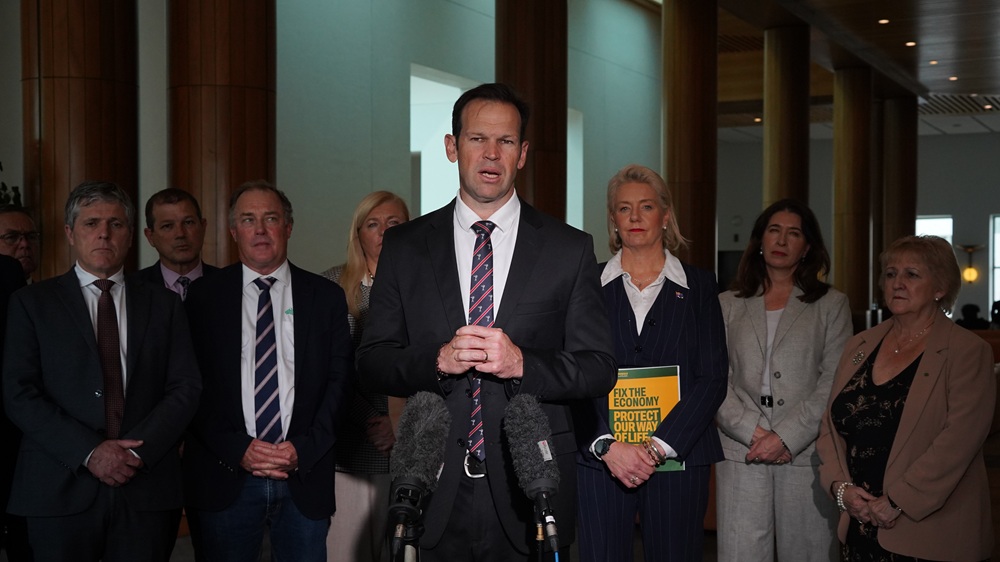
Matt Canavan calling for delays to the EPBC at a press conferene today.
NATIONALS leader Matt Canavan has called for a one year delay to sweeping changes to the Federal Government’s revised environmental laws, that will add a new layer of legislation to routine and ongoing land management activities.
Mr Canavan met with the National Farmers’ Federation (NFF) and AgForce, as concerns rise about Labor’s first guide of the EPBC Act into Environment Protection and Biodiversity Conservation Act 1999.
Senator Canavan said farmers are increasingly worried that the guide was cementing a new form of farm police
“Labor has done a deal with the Greens to change our environmental laws,” Senator Canavan said.
“Those changes used the international treaty powers to expand these laws to cover anything a farmer does within 50 metres of a watercourse in the Great Barrier Reef catchment area.”
Mr Canavan called for the Government to delay the implementation of the laws with with so much uncertainty about how they will roll out.
“Our farmers continue to be working in the dark just months befor these laws take effect. They due to take effect from the 1st of December, why not just push them back another 12 months?”
Better pathways needed
NFF President Hamish McIntyre said unless the government is open to amending the legislation, which industry continues to ask for, better pathways are needed.
“Our members are telling us farmers are confused, frustrated and increasingly concerned about what these changes could mean for everyday farming activities,” Mr McIntyre said.
“Farmers should not be left wondering whether routine land management activities could expose them to regulatory action.
“We’ve made it clear to the Government that the current approach is creating uncertainty. The Government needs to listen to those concerns and work with industry on practical solutions, including investment in mapping, decision-support tools and extension services.”
AgForce CEO Niki Ford said consultation only has value if there is a pathway to change.
“Where producers identify unintended or unworkable consequences, there needs to be a transparent EPA process for those issues to be assessed and for guidance, interpretation or regulation to be amended where necessary without fear of compliance actions,” Ms Ford said.
“Regulation that stops farmers actively managing their land can deliver the opposite of the environmental outcome it was designed to achieve. That is a risk we cannot ignore.
“These reforms have not been properly stress-tested against Queensland farming systems. An early independent review is essential to identify unintended impacts and correct them before they become entrenched.
Shadow Minister for Agriculture Darren Chester said the EPBC framework was originally designed to assess one-off development proposals, not the cyclical and ongoing land management activities that occur as part of normal agricultural production.
“Farmers are now extremely concerned they are unintentionally breaking the law, with limited to no information to assist in making decisions,” Mr Chester said.
“It has resulted in genuine fears farmers could get taken to court and be put out of business.”
Audit of treaties
Senator Canavan also announced the need for an audit of the international treaties that Australia is a party to at The Nationals conference this weekend.
“Any agreement that Australia is a party to must serve the interests of Australians, not foreigners. That’s why it is time that an audit is done. Too often, international agreements have become weaponised to take away the basic rights of farmers and everyday Australians, which is exactly what we are seeing now with the EPBC Act.
“In many farms this means the Federal Government has effectively taken over control of their entire farm, when it should be the states that have control of basic land planning issues.”
Mr McIntyre said the NFF also supports an audit of international treaties, quoting the 30 by 30 nature target as an example of a treaty that places unnecessary burden on the private estate.
“International ‘targets’ that seek to intrude into sustainable land management practices are not welcome and must be resisted,” Mr McIntyre said.
Source: Matt Canavan
The liberal and national parties never seemed to have any issues with the EPBC act in the past. They were the ones who created it. All Labor did was change a few lines in it. Everyone should know that once created laws and regulations only ever get more onerous and tighter over time. Why create something you know will be abused down the track.
It is a bit rich now for the Nationals to run around crying about this when they have been instrumental in creating the huge mess we have in Australia these days as they were too weak to stand up for what is right.
The whole act should be repealed and control over flora and fauna left for the states to sort out.