
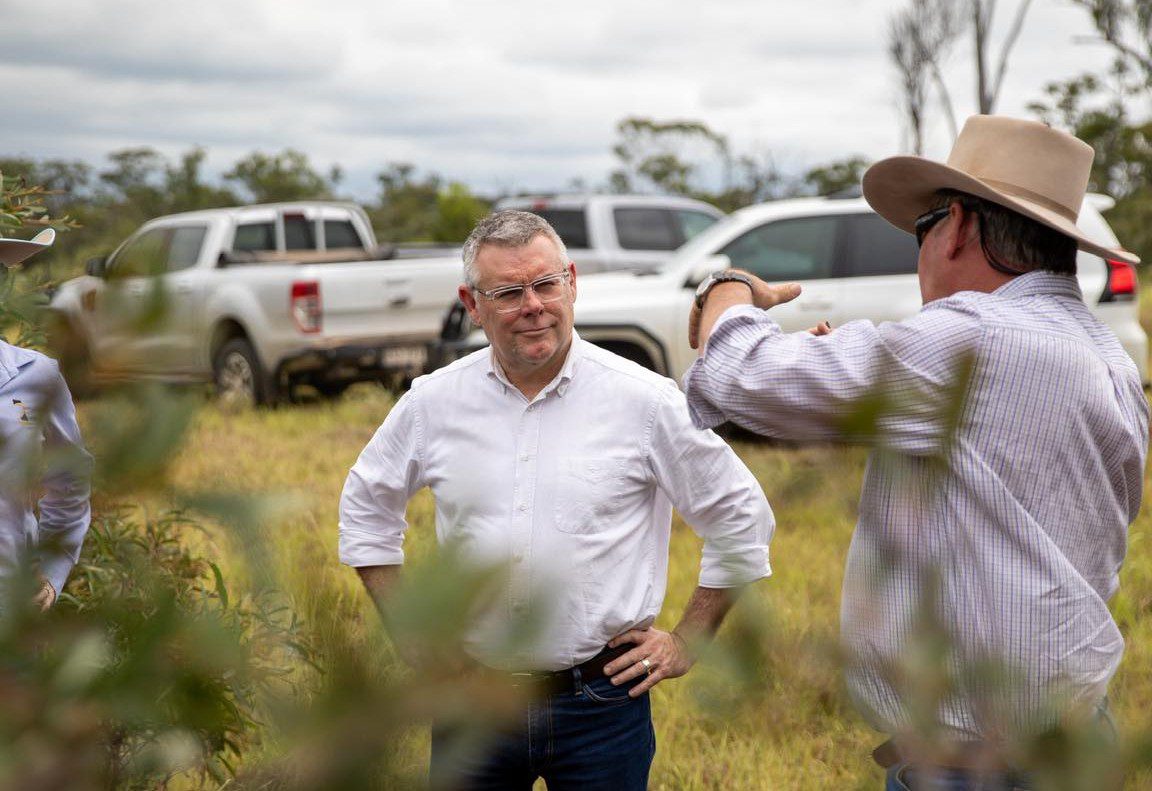
Murray Watt visiting producers in Central Queensland. Photo: Murray Watt Facebook
WHILE Murray Watt says his new environmental laws were not designed to interrupt routine agricultural practices, a spate of recent land clearing investigations and a closer look at the legislation suggests the complete opposite.
The Federal environment minister last year passed changes to the Environmental Protection and Biodiversity Conservation act, which will essentially bring a layer of Federal Government legislation over the top of routine agricultural practices.
While the industry has been negotiating with the Government to overcome the confusion the new laws have created, environmental groups have been bombarding the regulator with allegations of illegal land clearing.
AgForce cattle board member and Russell Pastoral Operations managing director Adam Armstrong has been working closely with legislation as part of the industry’s ‘EPBC taskforce’.

Adam Armstrong
He said environmental groups have engaged what they call “citizen scientists” from across the world to find evidence of land clearing through satellite imagery – and referring it to the Federal environment department.
“They don’t even know whether or not it is illegal, they don’t know what processes have been conducted and the department tells us they are obligated to investigate,” Mr Armstrong said.
“My view is that there needs to be some type of triaging system by the department with how they treat these allegations coming into them – just from an efficiency perspective.”
At the recent Property Rights Australia conference in Roma, agricultural consultants who have been helping producers navigate land clearing laws said they had been contacted by the environment department to help with EPBC enforcement. Beef Central has asked the department what their role would be, as it is unclear if the need to engage consultants is relation to the influx of allegations.
“During an investigation, the department routinely engages independent consultants to provide expert advice in relation to alleged significant impacts on protected matters,” the department says.
The allegations of illegal land clearing started before the Federal Government passed the changes to the EPBC act at the end of last year.
Groups like the Australian Conservation Foundation were releasing large documents with satellite images of land that had been cleared before the laws were passed, accusing the landholders of illegal land clearing and when they knew it was not illegal they accused them of “deforestation”. (And as this article points out, those releases received little questioning from media organisations)
These campaigns were a large part of the effort that pushed the Government down the path of changing the laws at the end of last year.
Investigations starting take hold
Federal environmental laws were in place before last year’s changes, however, ongoing land management like regrowth control was generally regulated through state governments.
Mr Armstrong said there are now multiple cases where producers had worked within state legislation and are now facing sanctions from the Federal Government.
He said there were more than 30 investigations currently ongoing in Queensland and New South Wales where producers had operated within state laws. In Qld it was on category x country and in NSW, Local Land Service officers had issued clearing permits where native vegetation was determined to be acting invasively and therefore did not meet the definitions required to need Federal Government approval.
Mr Armstrong said the NSW process was especially exhaustive.
“People have engaged in the process in good faith and now have compliance actions against them,” he said.
“That process in NSW is informed by both state legislation and the Federal EPBC. I have been through that process where you are tromping through the bush with an LLS officer ground truthing the local environment determining if ecological community definitions had been met.”
The department says undertaking activities that may have a significant impact on a protected has have a maximum penalty of $16.5m in fines or seven years in prison.
Mr Amrstrong said the department has told him that it will also issue what it calls “non-punitive” sanctions, where land can be locked up for 25 years.
Department rhetoric causes frustration
Frustrations have been boiling over in recent weeks, with officials from the environment department telling producers not to worry about the legislation and implying that its processes are simple. (using similar rhetoric to the below interview with environment minister Murray Watt)
The Federal Government says it wants to ‘triage agriculture out of the referral process’ and is trying to push landholders down its ‘self-assessment’ path. This means producers determine whether they are going to have a ‘significant impact’ on matters of national environmental significance and carry on with their land management activity if they believe they can.
But it is the lack of legal certainty that is driving the frustration about this approach, as it is now inevitable that a “citizen scientist” from the ACF will find it on a satellite image and force the department to investigate it.
Producers are also being asked to do this without any clarity on what constitutes a significant impact.
AgForce is saying the only way producers can have full legal certainty is by directly referring their activities to the Federal environment department – a process that can take months or years.
Self assessments are highly complex
Mr Armstrong said another misnomer that Minister Watt and his department are pushing, is that the process is simple.
“It is highly complex and producers are going to have to be extremely diligent with their self-assessment to ensure they are able to adequately protect themselves from potential prosecution by the department,” he said.
The self-assessment is a process of elimination that starts with a search for Matters of National Environmental Significance, which for most cattle properties will initially be relating to the Great Barrier Reef or threatened ecological communities.
Some threatened ecological communities include brigalow and poplar box. Although Minister Watt told producers earlier this year that this does not involve areas where these species were taking over and becoming a monoculture.
The process then goes through to an individual threatened species, which is where Mr Armstrong says it becomes particularly murky.
“You can filter it out, based on lack of habitat. But if potential habitat is present you then have to determine whether that species is potentially present,” he said.
“If it is potentially present you then have to determine if the action will have a significant impact.
“The lack of definition and subjectivity as to what constitutes a significant impact, could put a producer on a collision course with the compliance team at DCCEEW (environment department).”
If a protected species is mapped on the property, there are then ‘survey effort guidelines’ publishedon the department’s website.
“If I have red goshawk mapped as likely to be present on my property, (The red goshawk is mapped as being potentially present over the whole of the Australian mainland), the guidelines tell me that I have to spend 50 hours over 8 days/50ha on surveying to determine whether it is there,” Mr Armstrong said.
“The survey effort guidelines do not clarify if this level of survey effort is required where essential red goshawk habitat is not present or only required if habitat is actually present.
“I have to run transects, I need to look for that bird, I need to listen for that bird. Bird calls are a key identifier of species presence. Some listed protected birds are known to mimic other bird species.
“If I am surveying for the critically endangered regent honeyeater, I would likely hear it before I saw it. The regent honeyeater is known to mimic the noisy friarbird and the black-faced cuckooshrike (and possibly more). So, to legally protect myself, should I be ensuring that any black faced cuckooshrike or noisy friarbird calls I hear are not in in fact regent honeyeaters?”
Asked whether this is a job producers could do and cover themselves legally, Mr Armstrong said the department is giving advice that if producers do not have the expertise they need to engage an expert – which is very expensive and still does not provide complete legal protection to producers.
“The department does not appear to have sufficient resources for that and will need to in time or the whole system will break down,” he said.
Landholders urged to be vigilant
In the meantime, Mr Armstrong is warning producers to be vigilant when undertaking vegetation management activities or buying property.
“If you want legal certainty, you need to refer to the department for formal approval,” he said.
“If I was going to be buying a property where there had been any vegetation management in the last five years, I would not buy it unless there had been evidence of a formal referral, which has not been taking place, or an exhaustive self-assessment.
“You could be buying property that becomes subject to a compliance action, you won’t get a criminal sanction, but you could be subject to remediation of those areas where you could have a 25 year lock up where land could not be used agriculturally.”