
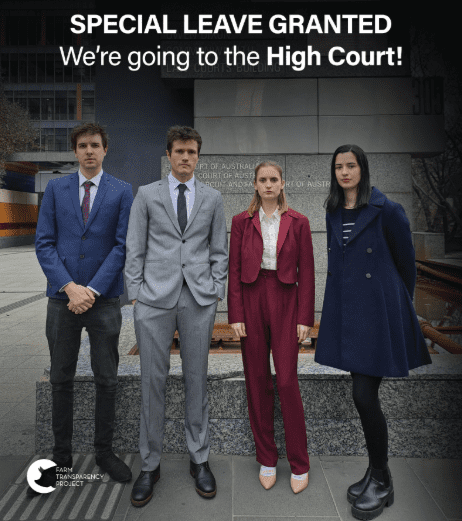
Animal activists are claiming a victory after the High Court yesterday agreed to consider their right to screen illegally-filmed abattoir footage.
The court yesterday granted activists Farm Transparency International (FTI) special leave to appeal a Federal Court injunction banning them from sharing a 14-minute kill-floor compilation.
The footage filmed by trespassers between January and April 2024, depicts goat processing at Victoria’s Game Meats Company (GMC) Eurobin facility.
This latest challenge – expected to be heard by the High Court in Canberra – will be the fifth time the issue has faced court.
The activists are hoping a High Court decision would set a precedent for broadcasting all illegal abattoir footage.
“We have total confidence in (FTI’s) ability to win this battle for the public’s right to know what happens in farms and slaughterhouses, once and for all,” they claimed on Facebook.
 In May 2024 activists sent the footage to the Department of Agriculture, Fisheries and Forestry and Channel Seven. The TV station did not broadcast the footage but published stories regarding the alleged animal cruelty at the abattoir.
The footage was published online by FTI’s agency Farm Transparency Project (FTP) in May 2024. However, a temporary injunction forced FTP to remove it within hours.
The matter was heard during a Federal Court trial in August 2024, After FTP admitted trespass, the court awarded GMC $130,000 in damages but denied a permanent injunction against the footage.
A further injunction, issued last August, awarded GMC copyright over the footage.
The activists opposed the injunction on grounds that it would breach their implied right to political communication under the Australian Constitution.
GMC appealed to the full court of the Federal Court, which granted an injunction on the footage and ordered its destruction. It was the first time that the Federal Court had made such a decision in response to an act of trespass.
However, this order was stayed, pending the outcome of the special leave application to the High Court.
On FTP’s Facebook page, the activists said: “The High Court will be the final arbiters on this case, with the outcome setting a binding precedent for future animal cruelty investigations in Australia.
“FTP will argue that the footage, which shows numerous instances of animal cruelty in breach of welfare requirements, as well as standard animal slaughter practices, should be allowed to be published and that the organisation should retain copyright over the footage that they captured.”
The group has launched a crowd fund-raising campaign to help pay of the ‘fantastic new legal team who put together the successful application’, they said. “Going to the High Court is an expensive undertaking, but this case is vitally important.”
Under Australian law it is generally held that copyright in a film or a photograph is owned by the photographer or film-maker.
In a review of the previous hearing, Sydney law firm Minter Ellison has reported: “This represents an interesting development in Australian law. Seeking an assignment of the underlying copyright will be an important consideration for individuals or companies that are subjected to illegal surveillance or captured on covert recordings.”
The legal experts noted that while people who are subjected to serious invasions of privacy can take action under the Privacy Act “this case provides a precedent for an alternative or additional cause of action and remedies.”