
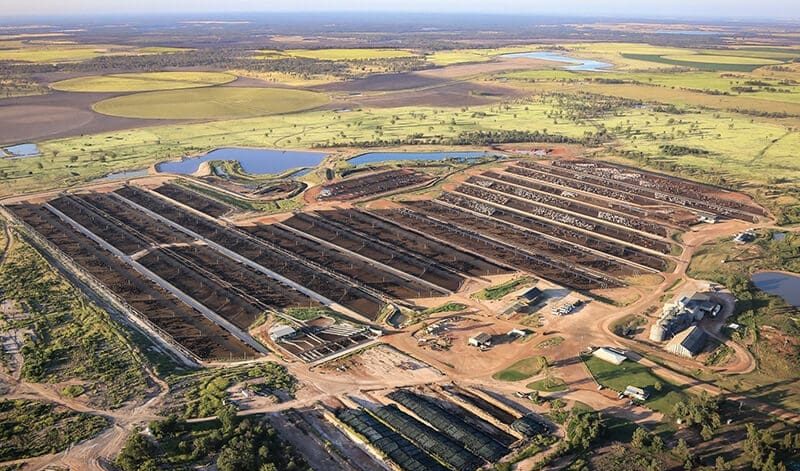
Stabroke’s 50,000-head yard near Chinchilla on Queensland’s western Downs
AUSTRALIAN feedlot capacity has continued to surge over the past year, with at least ten large yards adding production scale in various ways.
The industry’s quarterly feedlot survey has mapped the growth in industry capacity seen over the past three years. The June quarter survey (September data will not be released until the middle of November) showed a new record for national feeding capacity, at 1.706 million head.
That’s a rise of 68,500 head or 4.2 percent on the same time last year, and 150,000 head or 10pc higher than June 2023.
And that trend is showing little sign of slowing, as demand for grainfed brand program business continues to expand, and global outlook for our beef exports over the next year or two has rarely, if ever, looked better.
Mid-term report
Beef Central does a formal Top 25 Lotfeeders report every few years, last conducted in 2023 (click here to access). In the interim, we thought it might be useful to compile a brief ‘mid-term report’ to gauge progress and recent expansions, before we do our next Top 25.
Several broader trends are evident in this mid-term feedlot expansion report.
The first is that there’s more expansion happening in smaller yards, typically from 4000-5000 head in size.
Another is the underlying impact of Wagyu longfeeding as a key reason for expansion, with long-term pen occupancy under typical feeding programs 350-450 days having a distinct impact on feedlot annual turnover.
The trend is clearly seen in average days on feed across the Australian feedlot industry, which now sits at around 155 days. Over the past decade, the proportion of cattle being fed 60-99 days has shrunk, while cattle fed +300 days (exclusively Wagyu) has grown. Expansion in yard size is seen as one way of countering that reduced yard annual stock turnover.
Set out in a separate article appearing tomorrow are ten expansion projects we’ve identified – either completed in the recent past, currently underway, or likely to proceed in coming months. New projects could easily add another 150,000 head to current industry capacity, if fully executed.
There are others that we are aware of, which are not yet ready to be publicised. One of those will see a major expansion out to 36,000 head for a Darling Downs yard, submissions for which are currently before the local council. Beef Central will profile that project at an appropriate time.
One southern Queensland source involved in the construction of feedlot infrastructure told Beef Central that based on current proposals for expansion his company was involved with, 2027 was shaping up to be a particularly busy year.
In collating data for Beef Central’s fortnightly feeder steer market update, several sources have noted that the Darling Downs crossbred (flatback) feeder market has been holding up particularly well, despite the dry start to Spring and downward pressure on other parts of the market – particularly Angus. It was suggested to Beef Central that the rapid expansion of the Darling Downs feedlot industry has helped underpin that market, with feedlot buyers having to work harder than ever to keep pens full and fill commitments.
Close, but not yet
Beyond the scope of this report, there are several large lotfeeders who have flagged intentions to expand, subject to internal capital and corporate or local government approvals.
An example is NH Foods Whyalla feedlot near Texas, on the Queensland/NSW border, which is looking to edge-up from current capacity of 75,000 head to around 77,500 head, adding an additional 2500 head to full current license capacity.
Another yard with some possible future expansion is Smithfield Cattle Co’s Sapphire Feedlot near Goondiwindi. Sapphire is currently constructed to 28,750 SCU, within a licence for 48,560 SCU. When bought by Smithfield in 2016, the yard was built to 6000 head, with approval for 8700 head, undergoing several expansions since then.
Smithfield is reviewing the numbers on another potential expansion at Sapphire, but has not made any firm commitments at this stage. Smithfield’s second yard near Proston in Queensland’s South Burnett region is developed to its full capacity of 18,500 SCU.
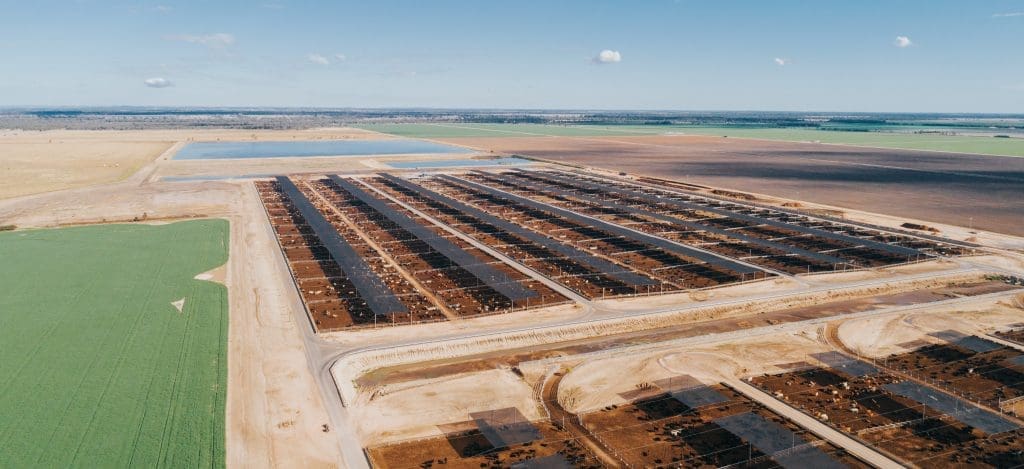
Sapphire Feedlot and Farm.
With feedlot expansion currently costing around $3500 per standard cattle unit (one lotfeeders’ current estimate), some operators are finding it hard to justify the expenditure at present.
Another business flagging expansion potential is Mort & Co, which recently listed its Pinegrove (Millmerran) and Yarranbrook (Inglewood) yards, suggesting there is an additional 28,000 head of ‘undeveloped’ capacity in those facilities’ licenses for potential buyers. There is no further expansion possible under current licensing at the company’s main yard at Grassdale, near Dalby.
The nature of expansions listed in tomorrow’s upcoming summary vary widely, ranging from another 1000-1200 head up to 50,000 head. Some are simply adding an extra row of pens and utilising existing milling, mixing and delivery infrastructure. Others are much more substantial.
Permanent shedding trend
Expansion is also taking place in other ways. One of these, being used principally in the Wagyu feeding sector, is through the installation of permanent shed structures, instead of simple shade cover. Under current regulations, this is allowing some lotfeeders to feed a lot more cattle within an existing licensed capacity. Typically, pen densities under shed structures can increase from around 16sq m per animal to 9sq m.
Considerable production advantages are being reported by those Wagyu lotfeeders who are using shedding.
In total, if the projects set out in tomorrow’s separate article are all executed as planned, national industry capacity will jump by around another 150,000 head.
Separate articles in this ‘mid-term report’ series will look at topics like the impact that water access is having on industry expansion; and financial considerations in expansion beyond the obvious infrastructure and building costs. Costs to populate any new pens with feeder cattle, and the ‘carry’ on the investment in feed and management before the first of the cattle from the new pens start to close-out, can be enormous.