
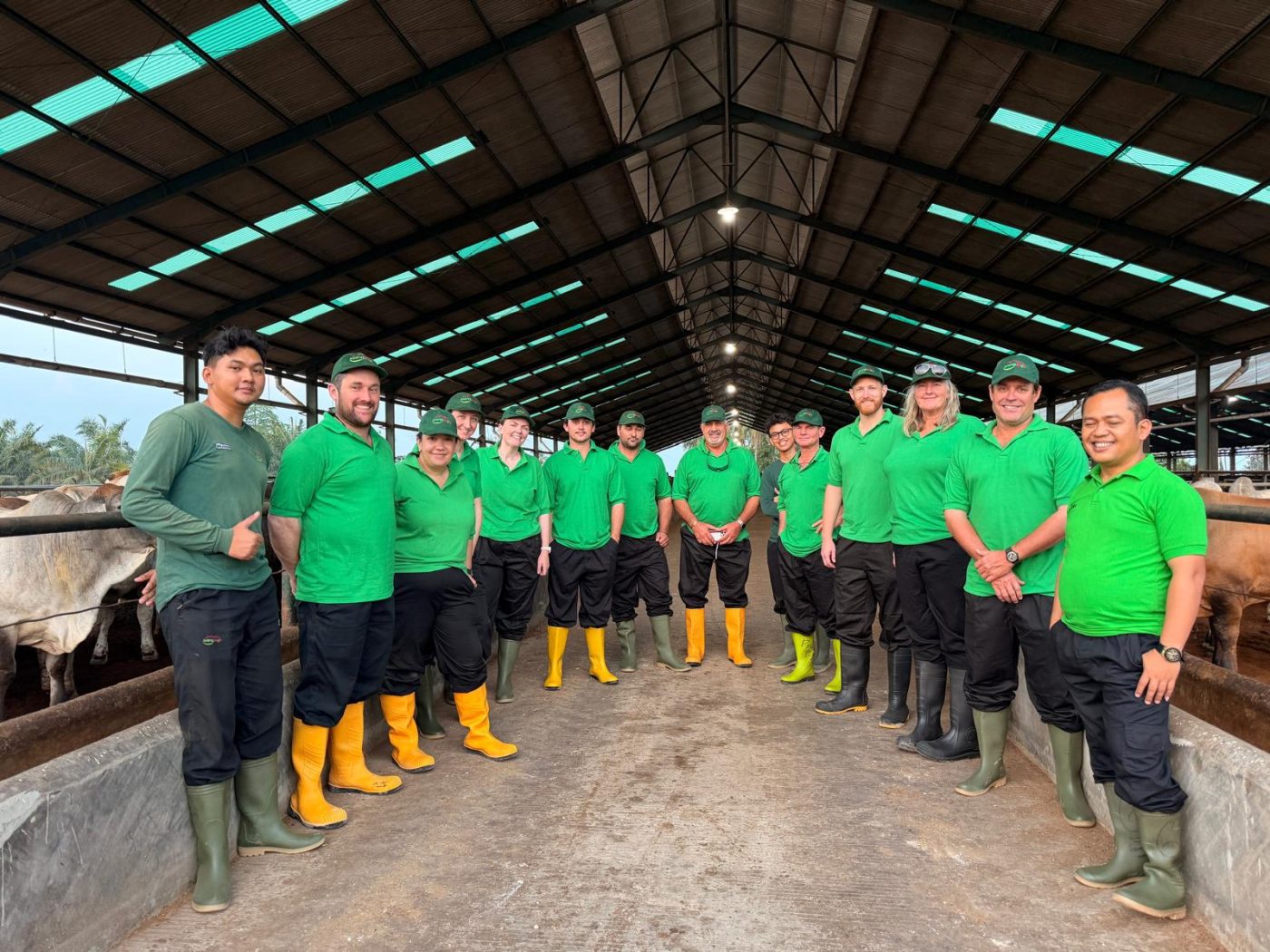
MLA staff, NTCA staff and JJAA staff, at the JJAA feedlot.
THE first thing I noticed when I stepped outside the airport in Lampung during my first trip to Indonesia was the humidity.
After around 30 hours of airports, planes and airport hotels, the humidity hit immediately. So did the hustle and bustle – so many people!
Indonesia was incredible for all the reasons you might expect: the people, the food, the cattle and the excellent company we travelled with.
But what stayed with me most was something I hadn’t expected.
It was the number of people whose livelihoods are connected to the live cattle trade, and the pride they take in being part of it.
At NTCA, and indeed in the industry in general, we often talk about the importance of live export to our own communities. We talk about the producers it sustains, the jobs it creates and the communities it supports across regional and remote Australia. We talk, rightly, about food security and the role our industry plays in supplying high-quality protein to the world.
I thought I understood the reach of our industry. But I had only ever really considered it from the Australian side.
That changed at the first feedlot we visited.
Juang Jaya Abdi Alam, in South Lampung, is a substantial operation. The feedlot sits on over 180 hectares, with capacity for approximately 24,000 head and annual production of up to 45,000 cattle.
But it wasn’t the size of feedlot or the number of cattle that stopped me. It was being told that the operation employed more than 500 people.
Five hundred people turning up to work, earning an income and taking that income home.
I immediately thought: why aren’t we talking about this?
It is easy to hear “500 employees” and absorb it as another industry statistic. But I met those employees, shook hands with them, listened as they proudly told us about the work they do every day to feed and care for the cattle we produce. Those employees are people with families and responsibilities. Their wages help put food on tables, send children to school and provide households with greater security.
And that was just one feedlot.
As we travelled through the supply chain, from feedlots in Lampung and Jakarta to abattoirs, a wet market and retail, we met people working at every stage. The passion was evident in every conversation.People are proud to work in the industry, as we are. They were proud to show us their facilities, explain their roles and talk about the cattle in their care. They wanted us to see the work they were doing and the standards they were achieving.
That pride matters.
These are not simply people receiving Australian cattle at the other end of a commercial transaction. They are skilled participants in a shared industry, with genuine ownership of their work and a commitment to doing it well.
We also saw how the benefits extend well beyond direct employment. Many feedlots have partnerships with local farmers and families. Through these partnerships, families may care for one or several cattle and share in the value created when the animal is sold or produces a calf.
Because caring for a small number of cattle can be done alongside other employment, it can provide an additional source of household income without requiring someone to leave their regular job. One animal may not sound significant when we are accustomed to talking about herds of thousands. For an individual family, however, one cow can be a productive asset. That cow can produce a calf, generate income and provide a starting point from which something larger can grow.
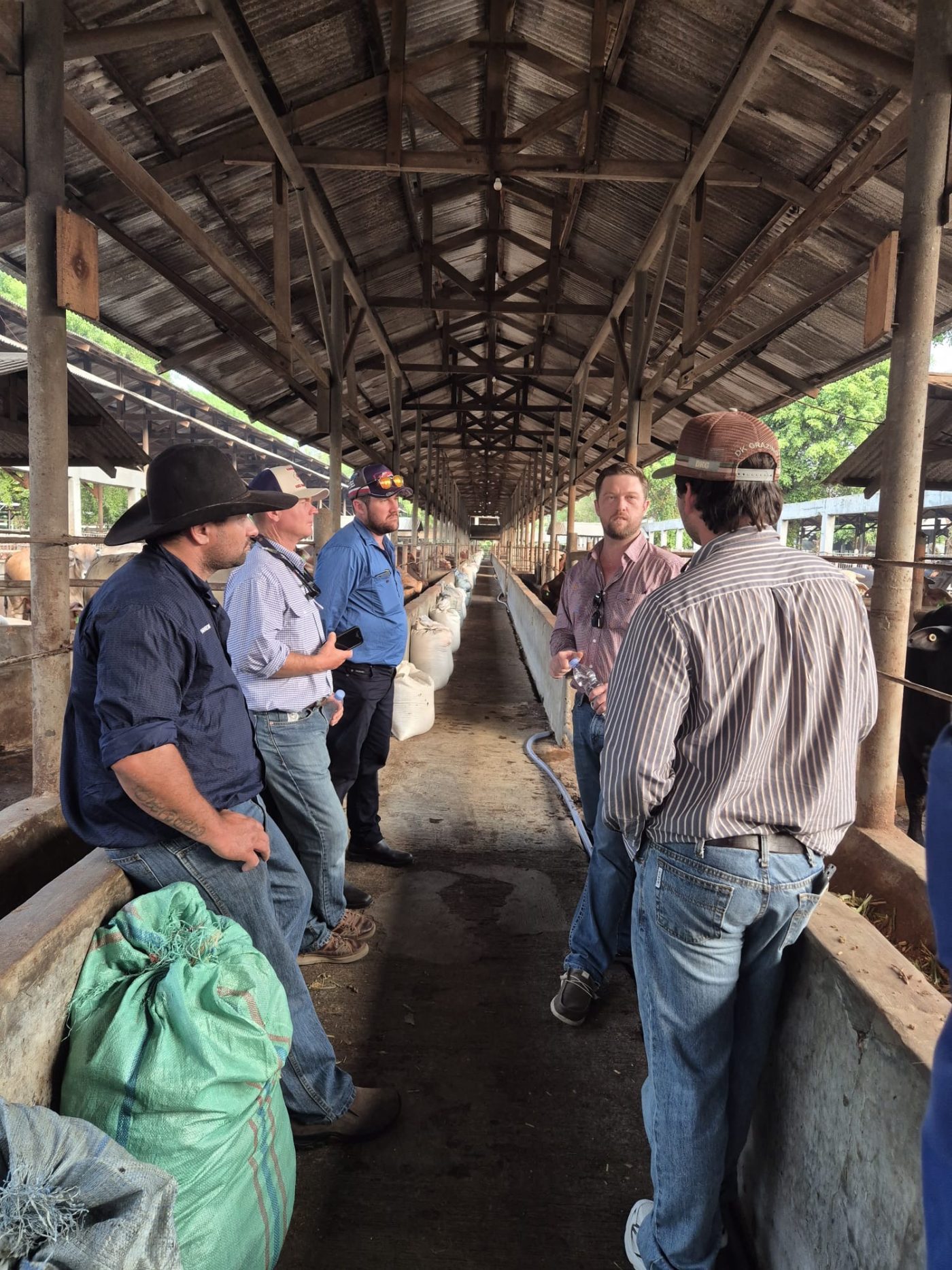
L-R is Buddah Avery (Larrizona Station), Reade Radel (Kandoona Red Brahmans), Cam Guggar (Cave Creek Station), Jack Webb (AAM ILO), and Jack White (DK Grazing).
At Great Giant Livestock in Central Lampung, we saw this operating at considerable scale. Its farmer partnership program involves more than 200 local farmers and approximately 1,800 cattle across the partnership program. Their goal is to double this number. That’s 400 families with an additional source of household income.
We also saw an impressive example of agricultural circularity. By products from the company’s enormous pineapple and cassava operations, including up to 250 tonnes of pineapple skins each day become feed for cattle. The cattle, in turn, produce manure and compost that go back onto the cropping land. Great Giant Foods employ over 20,000 people.
Nothing exists in isolation. The crops support the cattle, the cattle support the crops, and the operation supports thousands of workers and hundreds of farming families.
Recent industry research estimates that around 8,500 people are directly employed caring for Australian cattle in Indonesia. The trade generates approximately A$929 million in wholesale revenue each year and provides beef contributing to the protein needs of almost 28 million Indonesians.
Those figures do not capture the trade’s full reach.
They do not include every family member supported by a wage, every small business serving the supply chain or every opportunity created through additional household income. They can’t measure the pride we saw in the people who welcomed us into their workplaces.
Australia breeds cattle particularly well. Indonesia has the people, infrastructure, skills and market to feed and finish those cattle and supply fresh beef to its communities. Each country brings something valuable to the relationship, and the benefits travel in both directions.
That does not mean we should stop asking difficult questions or striving to improve. A strong industry should always be working to advance animal welfare, traceability, biosecurity and its broader practices.
But when we tell the story of live export, we should tell the whole story.
The trade does not end when a ship leaves Darwin, Broome or Townsville.
It continues in the hands of the stock people on the vessels, in the feedlot staff proudly showing visitors the cattle in their care. In the work of the truck driver, importer, processor and butcher. In the smallholder farmer caring for an animal alongside their regular job. And in the family considering what the income from a new calf might make possible.
We often say our industry supports Australian families and helps feed the world. After visiting Indonesia, I believe there is another part of that story we should tell more often.
This is not only an Australian industry with an Indonesian customer.
It is a shared industry, supporting families, livelihoods and communities on both sides of the Timor Sea.
That is something worth understanding, worth talking about and worth being proud of.
- Jessie Daniels is the Deputy CEO of the NT Cattlemen’s Association
Nice story! the NTCA trip to Indonesia would provide a valuable opportunity to gain a different perspective on the cattle industry, particularly from the producer’s point of view. It would also highlight the strong connection between the Australian and Indonesian cattle sectors, which brings together thousands of people across both countries.
Indonesia’s feedlot industry relies heavily on Australian producers to supply high-quality cattle and genetics. This relationship goes beyond the movement of live cattle. it represents an important partnership between producers, exporters, feedlot operators, and businesses throughout the supply chain.
Visiting Indonesia would give Australian producers a better understanding of how their cattle and genetics contribute to the Indonesian beef industry, while also providing insight into the challenges and opportunities faced by Indonesian feedloters with current global uncertainty.
Thanks for a great, well written yarn. The best way to look after a customer is to always let them know they are important. Highlighting these end users in Indonesia can inform our growers and exporters how best to tailor their industry to suit these buyers.
Jessie
We been talking about it for 30 years. Every now and then it dawns on another generation. Great that you’ve seen a bit of it and can keep that story alive.
However, all that counted for Nought when the activists did their best to stop the trade back in 2011 and it counted for Nought when the current government stopped the sheep trade.
Why do reckon the Indonesian Govn let in Indian Buffalo Meat and with it FMD.?
They saw that the Australians didn’t care about Indo needs.
How much of that has changed with the activists today?