
It’s about 4.30 pm in the afternoon in Seminyak, tourist central in Bali, and Mrs “Small Farmer” is collecting her two Bali cows which have been tethered out on a grassy vacant block for the day and she is now taking them home to spend the night in their pen behind her house where they will be hand fed some cut grass. This is the standard daily procedure for small cattle farmers all over Indonesia. She has a dozen or so vacant blocks in the area and she rotates her visits through them to gain the best grazing each day. Most of the buildings in this area are tourist accommodation or retail services.
She notices that one of the cows has been looking a little depressed during the day and has begun to salivate much more than usual. This cow also seems a little reluctant to walk but they must go home and it is only a few hundred metres away so she lets them make their own pace. Excessive salivation is one of the most obvious signs of Foot and Mouth Disease (FMD) as the blisters in the mouth are very irritating.
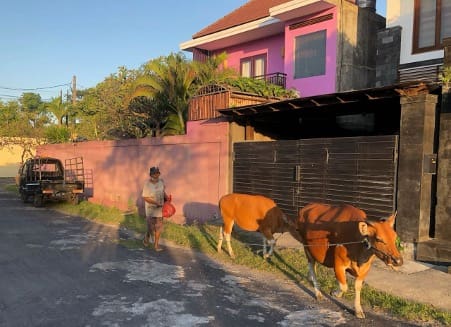
On way home the cows pass the villa rented by the Smith family from Humpty Doo in the Northern Territory. They have had a great week in Bali and are preparing to leave for the flight home. The sick cow drops a large amount of saliva onto the grass in front of the Smith’s villa as it walks slowly past.
When Mrs Small arrives home, she tells her husband who has been out cutting grass for these cows that one is looking sick. She knows that there has been a new disease in Bali for the last few years and asks Mr Small if their cow might have this disease and if they have been vaccinated. Mr Small tells her that his neighbours told him that if the government vets vaccinate their cows, they put a special ear tag in them and this means that the government then owns your cow. He was also concerned that he might have to pay for this vaccine and he was trying to save money. Given this (mis)information Mr Small Farmer decided to play safe. When the government vets came around to his house, he hid the cows on another property and told them that he had sold all his animals some time ago.
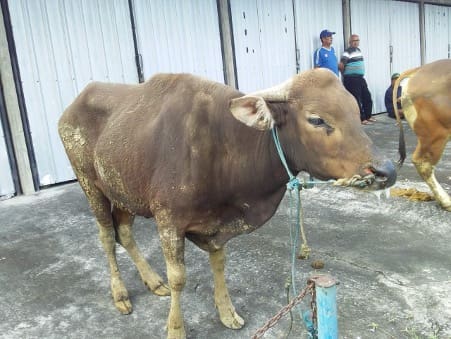
Photo from David Heath. This Bali bull is obviously in poor condition, has been laying down a lot and shows excessive salivation. Considering this photo was taken during the first FMD outbreak in Bali there is a good chance that this animal was infected with FMD. Saliva from infected animals contains high levels of live FMD virus.
Thirty minutes after the cow has dropped its saliva onto the grass in front of the villa the taxi arrives to take the Smith family to the airport. As they walk to the car, two of the children unknowingly walk through the infected saliva on the grass. They arrive 2 hours early with the flight leaving at 7.30 pm. Two hours and forty minutes later they land in Darwin. After another hour of immigration and baggage collection they arrive at the front of the quarantine line. The quarantine officer examines their declaration and asks if they have anything to declare. They explain that, as per their written declaration, they have not brought any prohibited items including food from Bali and that they have not visited any farms. The quarantine officer says that they are free to go directly to the exit. They have left their car in the long-term car park so they arrive home at their rural 5 acre block at Humpy Doo about 7 hours after walking out of their Bali villa. FMD virus is very sensitive to sunlight and high temperatures but they have been either in air-conditioned cars or aircraft or air-conditioned airport buildings since they left their villa so some of the virus in the saliva on the kid shoes is still alive. As they arrive home, tired from the long last day in Bali, they take off their shoes and leave them on the back verandah. Once inside everyone goes to bed with the unpacking left for the morning.
 The Smith family lives next door to Barry the local pig hunter. About a year ago Barry came home from a hunt with a number of very cute wild piglets. Barry’s kids offered one of the piglets to the Smith children and they pleaded with their parents to be allowed to keep the piglet assuring them that they would look after it. Their wish was granted. The pig proved to be an excellent pet and lives under the house. The pig came out from under the house glad to see the family home once again. It nuzzled the kids and then sniffed around their shoes when everyone went inside the house. The curious pet pig found a hint of a bovine scent on the bottom of some of the shoes and licked the tasty soles of a number of the shoes. Just enough live virus remained on the soles of the shoes to infect the pig with FMD.
A few days later the kids notice that their pet pig is looking a little sick when they bring out its dinner after returning home from school. It appears to be depressed and does not want to come out from under the house to get its food so they leave the food where it can find it later. During the night the local feral pigs come to visit the Smith’s block and can smell the pet pig’s food under the house. They quickly eat the pet’s food and approach the Smith’s pig where it is laying under the house. They give it a good inspection and sniff all around it and leave. FMD virus in pigs is very effectively spread through aerosol so the breath of the sick pig can infect any pigs that come close to it.
During the next few days these feral pigs roam over a wide area across the district where they interact with a number of other groups of feral pigs. Infected pigs produce 1000 times the volume of FMD virus that cattle do so they are an extremely effective virus multiplier and spreader of the disease.
A week later, about 5 km away, Fred the helicopter pilot is preparing for an early flight to a mustering job at a cattle station about 2 hours flying time to the south. As he walks to the hanger across the damp, dewy lawn he walks through some saliva left behind a few hours earlier by a wandering feral pig infected with FMD.
Fred flies directly to the homestead of the station to make a plan for the day’s mustering with the manager. After landing he walks across to the homestead where the manager is waiting with a coffee and the kids are feeding bottles of milk to the poddy calves on the lawn beside the house. Fred walks past the kids and says hello with a few words of encouragement about the great job they are doing with their calves. Some FMD virus from the pig saliva on the bottom of his shoe wipes off on the grass next to the calves. After they finish their bottles, they are free to nibble a little grass before they lay down for a sleep in the morning sunshine. Three days later the children notice two of the calves are looking sick. It’s Saturday today so after feeding the calves their morning bottles they are allowed to join their Dad and help in the cattle yards where the stock that Fred had mustered are being drafted and processed. Some of the heavier animals will be sent to slaughter on Monday while the medium steers will be sent to an export depot for live shipment at the end of the week. One of the neighbours is also coming to inspect the stock as he wants to buy a small number of pregnant heifers. The manager booked the local vet to come to do the pregnancy testing for the sale heifers and he has also been asked to call into the homestead to check on some sick poddy calves.
FMD virus is one of the world’s most contagious disease agents in ruminant livestock.
Official estimates of the cost to Australia of an outbreak are in the order of $80+ billion.
The standard approach to most outbreaks is to stamp the disease out by strict movement restrictions, quarantine and destruction of infected and at-risk stock. The complex logistical requirements to carry out this process on large remote cattle properties has never been attempted before anywhere in the world. It will not be as easy as it appears in the computer model simulations.
Enhanced biosecurity is a very cheap insurance policy against this potentially catastrophic disease incursion. Disinfectant foot mats have been removed from the airports across Australia. I would like to see biosecurity reasoning that removed this measure, especially in Darwin, to understand the policy logic involved. If a single virus gets through the net and infects local livestock we will lose the equivalent of about 12 nuclear submarines overnight.