
Author Don Nicol is a widely respected cattle geneticist who has worked on some of Australia’s largest and most significant composite breeding and crossbreeding programs over the past 45 years. His business, Breedlink, is a beef cattle breeding & genetics consultancy operating across Australia and internationally.

HOT summers and regular heatwaves across Australia are forcing many beef producers to re-assess the level of heat tolerance in their cow herds for sustainable production under extensive grazing.
Lowered fertility is a major consequence of these heat waves.
How much hair their bulls and breeders carry and how quickly their cattle clean up in the coat coming out of winter are important indicators of the heat tolerance of their herds.
Cows with short coats cope better with heat, as practical experience and research have shown since the 1960s from CSIRO research on the Tropic of Capricorn at Rockhampton.
Crossbreeding
Producers looking to improve the level of adaptation for their herd typically use crossbreeding to achieve their goals.
Bulls of tropical breeds, such as Brahmans, Droughtmasters and some other tropical composites offer a solution to improving coat type and adaptation, although they can also be affected by extreme heat.
Slick Gene – A possible game changer to lift adaptation in herds
Imagine a future time when cow herds are highly tolerant to heat and more productive because of it.
This can be achieved by introducing a specific dominant gene mutation named SLICK into the breeding program.
SLICK is a variant of the Prolactin Receptor gene (PRLR) that results in unusually short and sleek hair to carriers of this game-changing gene mutation.
There are six variants of the gene known to science at this stage. For a clearer understanding, we will refer to the SLICK variant as the ‘Slick Gene’ in this article.
The Slick gene was originally discovered in the early 1990s in the Senepol breed from the island of St Croix in the Caribbean, and later in some other tropical taurus breeds of cattle from the Caribbean and neighbouring South American countries.
Research in Florida, US, with a number of Senepol x British breed crosses indicated that a carrier of one copy of the slick gene had heat tolerance equivalent to a purebred Brahman.
Because of the dominant nature of the Slick gene, animals with one or two copies of the SLICK form of the gene will always have very short coats, high heat tolerance and increased functionality of the sweat glands.
SLICK cows have a superior ability to regulate body temperature during heat stress. The body temperature of slick cows can be one degree celsius cooler than non-slick cows.
The Slick gene is being used in a number of forward-thinking beef and dairy breeding programs in many parts of the world to positively improve heat tolerance.
Potential
At this stage, however, the usage in Australia is low, but there is great potential for a much higher utilisation, especially in northern Australia.
The only breed in Australia that is known to carry the Slick gene at this stage is the Senepol breed and its crosses.
Senepol is a Bos taurus tropically adapted beef breed popular in the southern States of the US. There is a strong breed association in Brazil with 500 members and 60,000 registered animals, and the breed is gaining popularity in Australia for crossing.
Most sleek-coated animals of the Senepol breed will have inherited one or two copies of the dominant Slick gene. The author first learned of the gene visiting with Dr Tim Olson of The University of Florida in Gainesville in the early 1990s.
The Slick gene was brought into northern Australia in the early 1990s by the Australian Agricultural Co when the company imported Senepol genetics as a contributing breed to its tropical composite, now called the “Mitchell” composite.
Senepol embryos were collected on the island of St Croix and southern US to ensure genetic diversity and initiate the composite program. Senegus, a popular cross between Senepol and Angus will also carry copies of the gene.
Like the Poll gene, the Slick gene comes in different forms – Homozygous slick animals carry two copies of the favourable form of the gene, and heterozygous with one favourable copy.
Breeding in the Slick gene – new DNA tools
The recent availability of a DNA diagnostic test for the SLICK1 variant is a major boost for breeding programs.
SLICK1 is the most common variant at present. Animals with two copies of SLICK will always pass on at least one copy to progeny, so with one cross, all the progeny will be sleek-coated.
This DNA test is now available in Australia from global genetics giant STgenetics, and possibly other genomics companies will soon offer it, depending on licensing. The exact location of the variant was discovered by LIC in New Zealand which patented the test.
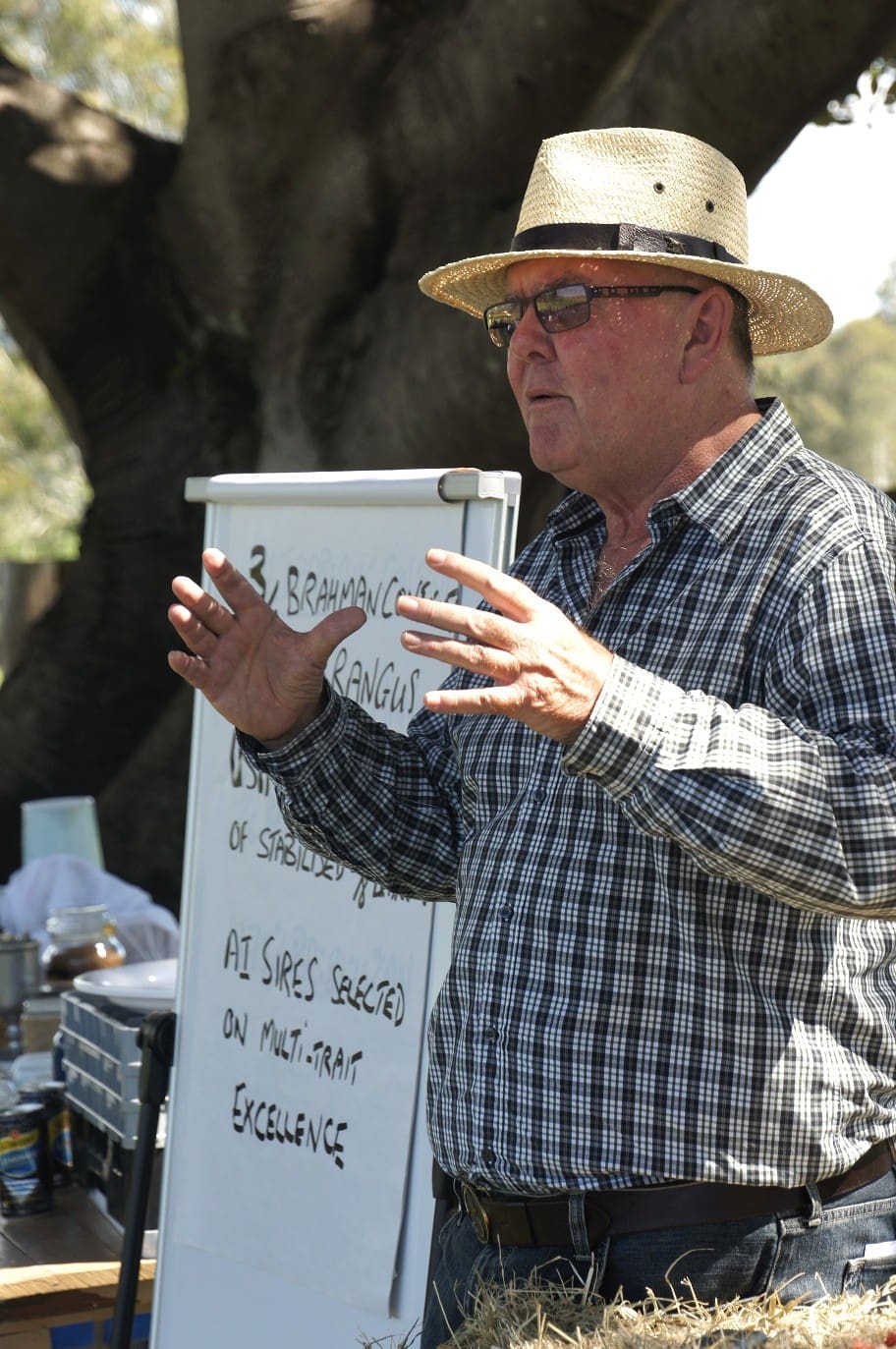
Don Nicol
A number of Australian beef composite breeders have also introduced the gene into their herds, starting a breeding program with an F1 cross with Senepol, following by back-crossing to bulls from other bloodlines that have been tested as carriers of SLICK.
As often happens with technology, our friends across the ditch have taken a lead with the gene. New Zealand geneticists developed and patented the first version of the DNA test.
New Zealand Genetics company Tropical Dairy Group (TDG) has been working for generations breeding in the SLICK gene to its dairy breeds program and offers semen internationally from dairy bulls that are homozygous for the trait.
Their target market is the tropical dairy world where Holsteins cannot sustainably produce milk with existing Bos taurus breeds.
Single-trait selection is to be avoided in beef cattle breeding, and that is also the case for introgression of the Slick gene. It is important that carrier animals used in SLICK breeding program, satisfy the standards for temperament, structure and fertility traits.
Advances in precision cattle breeding techniques like gene editing allow the introgression of a desirable DNA variant into an animal, without disrupting historical selection improvements.
This approach was successful in generating Slick Angus and Dairy cattle in the US, Brazil and New Zealand. Whether these approaches will be widely adopted by the industry is still to be seen.
The potential for this single gene to ramp-up heat tolerance in Northern Australia beef herds is now well proven in a number of countries.
The DNA test will be the catalyst to innovative producers incorporating it in their breeding program.
As I wrote this item during January, BOM was reporting heat waves in many parts of the country.