
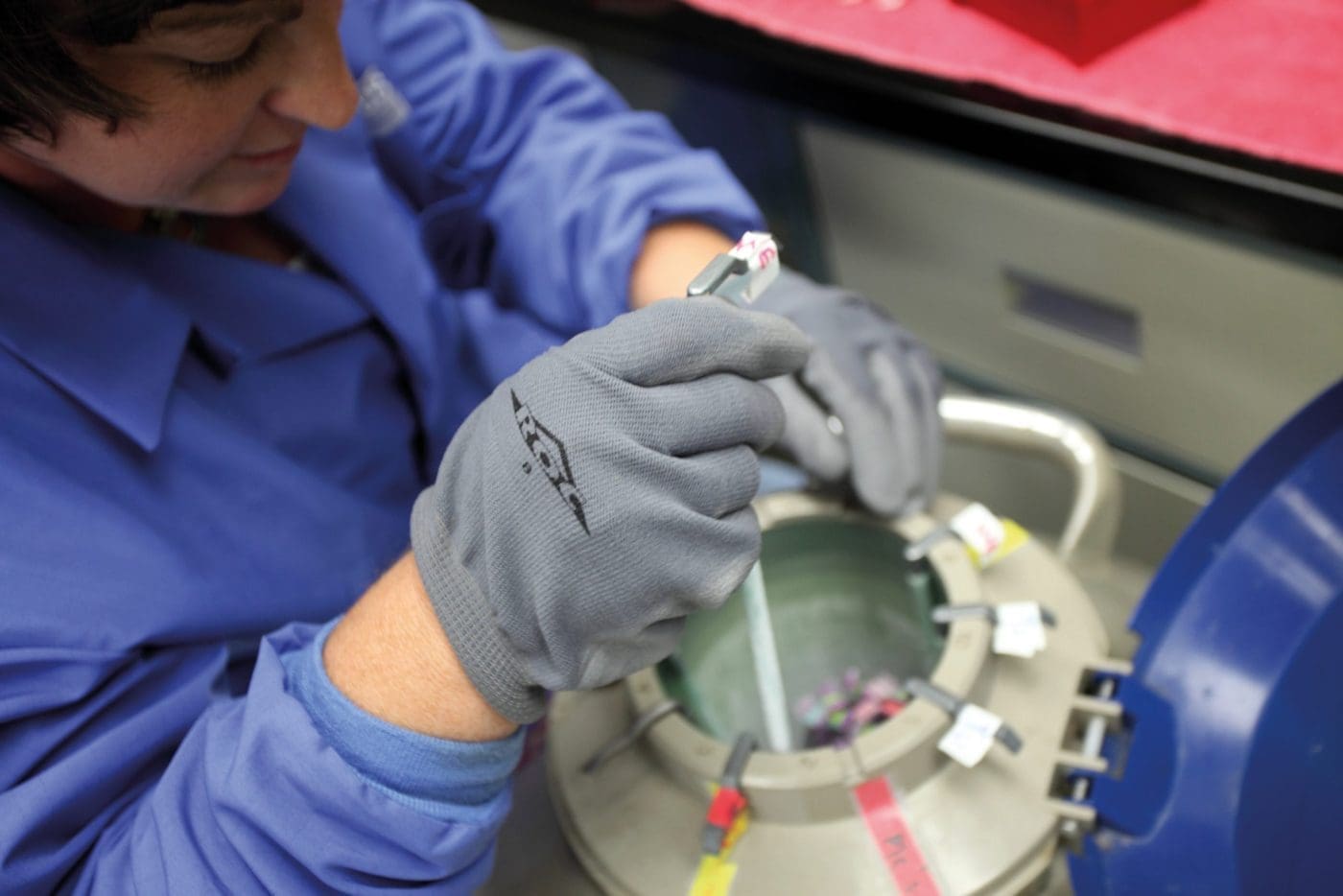
AS August begins, the spring bull-selling season is gathering momentum. Most breeding decisions will continue to involve new bulls and natural mating, but artificial insemination remains an established tool in many seedstock and some commercial programs.
Artificial insemination represents an investment not only in semen, but also in synchronisation treatments, labour and technical services. Choosing the genetics is therefore only one part of achieving a worthwhile result.
AI programs are often judged on pregnancy-testing day. However, many of the factors influencing that result are established well before the females enter the yards.
Preparation

Megan Brown
A recent seminar hosted by Northern Artificial Breeders in Scone focused on opportunities for producers to improve the results of their AI breeding programs. A key message from Megan Brown, National Manager of Minitube Australia, and Brendan Coonan of Northern Artificial Breeders was that preparation for AI needs to begin at least eight weeks before insemination.
Synchronisation protocols, semen quality and technician skill all matter. However these cannot fully compensate for females that are not reproductively ready, have experienced inconsistent nutrition or are part of a program that is assembled at short notice.
For producers considering an AI program, three areas require particular attention:
- Whether the females are ready
- What has happened nutritionally during the preceding weeks, and
- Whether the program can be implemented accurately.
Body condition is fundamental to the success of any breeding program. Most producers already consider body condition when preparing females for natural joining. It is equally important in an AI program and, together with cycling status, strongly influences how females respond.
These factors can be seen clearly when conception results are separated by female production category.
Pregnancy rates
To illustrate this point, Megan Brown drew on Syntex’s 2015 commercial field database of 431,008 fixed-time AI records. Across the complete database covering diverse field conditions and breeds, pregnancy rate averaged 50.39pc.
 In the category breakdown presented, 15-month-old heifers recorded the highest average pregnancy rate at 54pc, followed by dry cows at 52pc, lactating cows at 51.6pc and two-year-old heifers at 51.1pc. Early-weaned cows averaged 47.8pc, although this category contained only 308 females and shouldn’t be compared too heavily with groups containing tens of thousands of records.
These figures provide broad field benchmarks rather than predictions for an individual herd. They were drawn from a commercial database, not a controlled comparison, and provide limited information about the management, environment or selection of females within each category.
The relatively narrow range across most categories also reinforces that female production status alone does not determine a pregnancy result. Cow age, lactation status, days since calving, body condition, whether females are gaining or losing weight, cycling status, breed and seasonal conditions all influence the likely response.
Joining weight
These factors are particularly important when selecting heifers for an AI program. A commonly used benchmark is for heifers to reach 60–65pc of expected mature cow weight by joining. This remains a useful starting point, although the appropriate target will vary with breed, mature size, joining age and production environment.
Joining weight alone does not confirm reproductive maturity. A heifer can be heavy enough to join but still have an inadequately developed reproductive tract. Research presented at the seminar showed that heifers with larger, more developed uterine horns and clear evidence of ovarian activity generally achieved higher pregnancy rates than heifers with less-developed reproductive structures.
The practical point is that weight should not be considered in isolation. Age, growth history, cycling status and reproductive tract maturity all help determine whether a heifer is genuinely ready.
Artificial insemination should not be regarded as a way of rescuing a group of underdeveloped heifers. Synchronisation can manage the timing of ovulation, but it cannot replace the physical and reproductive development required to establish and maintain a pregnancy.
Nutrition in the lead-up to joining is one area that can disadvantage an AI program. Preparing animals with improved nutrition can’t be left until the final few weeks before insemination.
The follicle destined to ovulate passes through important final stages of development during the preceding weeks. Nutrition, health and environmental conditions during this period can influence follicular development, the quality of the oocyte, ovulation and the subsequent uterine environment. Increasing the ration at the last minute may therefore come too late to correct earlier limitations.
In heifers, the issue extends beyond the preceding eight weeks. Reproductive tract development reflects their longer growth and nutritional history, beginning well before they approach joining weight.
Field study
Megan Brown presented a three-year feeding study comparing rangeland-developed heifers with heifers receiving two levels of lot feeding before AI. At insemination, the rangeland heifers averaged 57pc of mature weight, compared with 66pc and 68pc for the two lotfed groups.
The feeding treatments clearly changed liveweight and growth rate. However, their effect on pregnancy rate was not consistent across the three years. Differences in temperature and rainfall between years had a greater influence on the variation in pregnancy results than the short-term feeding treatment.
This data highlights that reproductive development cannot always be corrected through a short period of increased feeding before joining. It also demonstrates why liveweight shouldn’t be considered separately from the environment in which that weight was achieved.
Seasonal conditions
Season affects both the quantity and quality of feed available during the lead-up to an AI program. Prolonged wet conditions can produce large amounts of lush pasture with high moisture and relatively low dry-matter content. Cattle may appear to have abundant feed but still struggle to consume enough dry matter to meet their energy requirements.
Rapid changes in pasture protein, fibre and mineral balance can create further challenges. Wet conditions may also increase animal stress and exposure to disease or other health pressures. These effects can flow through to hormone production, follicular development, ovulation and early embryo survival.
Local records presented by Brendan Coonan demonstrated the potential seasonal effect. Following an exceptionally wet autumn and winter in 2025, AI results fell to around 40pc. Results during the following spring returned to the mid-to-high 50pc range.
This comparison doesn’t prove that rainfall alone caused the decline. The records cover different herds and management circumstances, and several factors may have contributed. However, they show why pasture quality, dry-matter intake, female condition and recent seasonal conditions need to be considered when setting expectations for a program.
Eight weeks should therefore be treated as a minimum practical preparation window, not a biological starting point. Problems created by inadequate heifer development or longer-term nutritional limitations may require much earlier intervention.
The other factor in successful AI programs is in the synchronisation and insemination process. Synchronisation programs depend on treatments being administered at the correct time and insemination occurring within a defined window. Delays, missed treatments, inaccurate cattle identification or changes to the protocol can all reduce the result.
Planning
Planning a program needs to focus on more than ordering semen and engaging a technician. Brendan Coonan highlighted that successful programs depend on requires suitable cattle-handling facilities, reliable labour, accurate records and a clearly defined schedule for every treatment and yarding.
Facilities need to allow cattle to be handled efficiently and with as little stress as practical. A theoretically suitable protocol can quickly become difficult to implement if cattle can’t be moved through the yards safely and on time.
Pregnancy diagnosis also needs to be built into the program from the start. Where AI program is followed by natural mating, scanning at the appropriate time can separate pregnancies conceived to AI from those conceived in later cycles. This gives producers a clearer measure of the AI result and allows the cost to be calculated per pregnancy rather than per insemination. It can also show whether a lower-than-expected result was limited to the AI round or continued through the broader joining period.
While selecting the semen may be the most visible part of an AI program, much of the results depend on the preparation beforehand.
Time spent in selecting reproductively ready females, maintaining nutrition through the lead-up and following the program accurately are fundamental to a successful outcome.
In many cases by the time the technician arrives, the program has largely been set up either to succeed or to fall short of expectations.
 Alastair Rayner is the Strategic Account Manager for Southern Australia with Vytelle and Principal of RaynerAg. He has over 30 years’ experience advising beef producers and graziers across Australia. Alastair can be contacted here or through his website: www.raynerag.com.au
HAVE YOUR SAY