
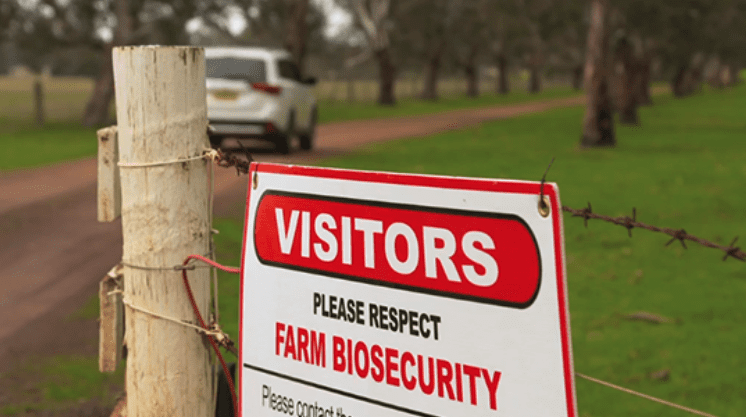
IN order for biosecurity plans to be successful, they must be followed by everyone who enters a property, but with more diverse land use happening it is becoming harder for property owners to manage.
Technology has been developed to help this – to ensure everyone who enters a property is complying with its biosecurity plan.
The technology was developed by an engineer from Norway, who never set out to build software.
 “My first job out of university was as an engineer in onshore gas operations in Queensland, which included land-access compliance on the Western Downs,” Carina Steinbakk, Director of Aevi Tech said.
“It was my job to make sure every vehicle that drove onto a property was clean: washed down, weed and seed free, with a certificate to prove it.
“I wrote those certificates by hand. Forty-odd a day on a clipboard that wouldn’t stay dry. One copy for the driver, one for the landholder, one for the file — and if anyone had ever asked to see one of them later, good luck.
“That’s the gap CertMate closes. The washdown itself hasn’t changed — it’s still a person, a hose and a wash bay. What was broken was the proof that the vehicle was washed properly, by whom, and when — a record that holds up when a landholder, a regulator or a lawyer asks to see it.”
Landholders want assurance their biosecurity is being followed
Last month AgForce wrote in its submission to the sunset review of Qld’s Biosecurity Regulation 2016, that all companies, contractors, service and infrastructure providers who drive onto a property be required to prove they followed that property’s biosecurity plan — and share their spray, activity and decontamination records with the landowner.
AgForce General President Shane McCarthy said one of the major concerns is currently mining companies, contractors, service and infrastructure providers are not required by law to engage with property biosecurity plans.
“Workers move between properties and regions and risk spreading invasive weeds and disease via their activities if farm biosecurity plans are not followed,” he said.
“It’s landholders who bear the economic, regulatory and reputational consequences if something happens.”
AgForce CEO Niki Ford also pointed to the lack of enforceable obligations on third parties to provide spray records and activity notifications for the use of chemicals.
“Spraying under powerlines, around gas infrastructure and access corridors is often carried out without notice and records are not shared with producers, which can impact withholding periods and production assurance requirements,” Ms Ford said.
Ms Steinbakk said while everyone has a General Biosecurity Obligation, proof that someone has done the right thing and taken precautions to stop the spread of weeds or disease has largely relied on goodwill.
“CertMate gives producers a way to demand and receive proof at their own gate and is a place to keep all on-farm biosecurity records in the same place. This is the type of assurance landholders and AgForce are calling for,” she said.
What is CertMate and how does it work?
CertMate is a land-access compliance platform that links the people who own the land and the people who need to come onto it — and it proves, on the record, that everyone did what they were supposed to.
“Properties are assigned and linked to the operators and contractors who access them, so everyone is working off the same map and the same plan,” Ms Steinbakk said.
“A crew member logs a compliant washdown or check-in from a phone at the gate, even with no reception, because it works offline. It records the vehicle, location and time and requires a signature.
“If a property has automatic check-in enabled, geofencing or number-plate recognition, arrivals can be logged without anyone lifting a finger, and if there’s a breach (a vehicle entering without a valid certificate, or going where it shouldn’t) the landholder is notified immediately.
“Every certificate is time-stamped, tamper-evident and verifiable by QR code, sitting in an audit trail. Each property also keeps a digital check-in list — a live register of everyone who has come onto it, when, and whether they were compliant — so a producer can see at a glance who’s currently on the place and who’s been through.”
Ms Steinbakk said the platform offers more than just compliance; it is also a safety net if there ever is a biosecurity dispute.
“CertMate gives the producer hard evidence to bring to that table: not ‘I think the contractors are careless’, but a record of exactly who came, when, and whether they were compliant,” she said.
“Not only does that protect the property, but it also improves the relationship between producers and industry rather than straining it.
“When both sides can see the same transparent record, they can fully trust one another.”
HAVE YOUR SAY