
A Speckle Park steak takes pride of place on the cover of the inaugural World’s 101 Best Steak Restaurants book. Behind it sits a breed building its case the way producers and processors want to see it: measured eating quality, verified genetics and results on the rail.
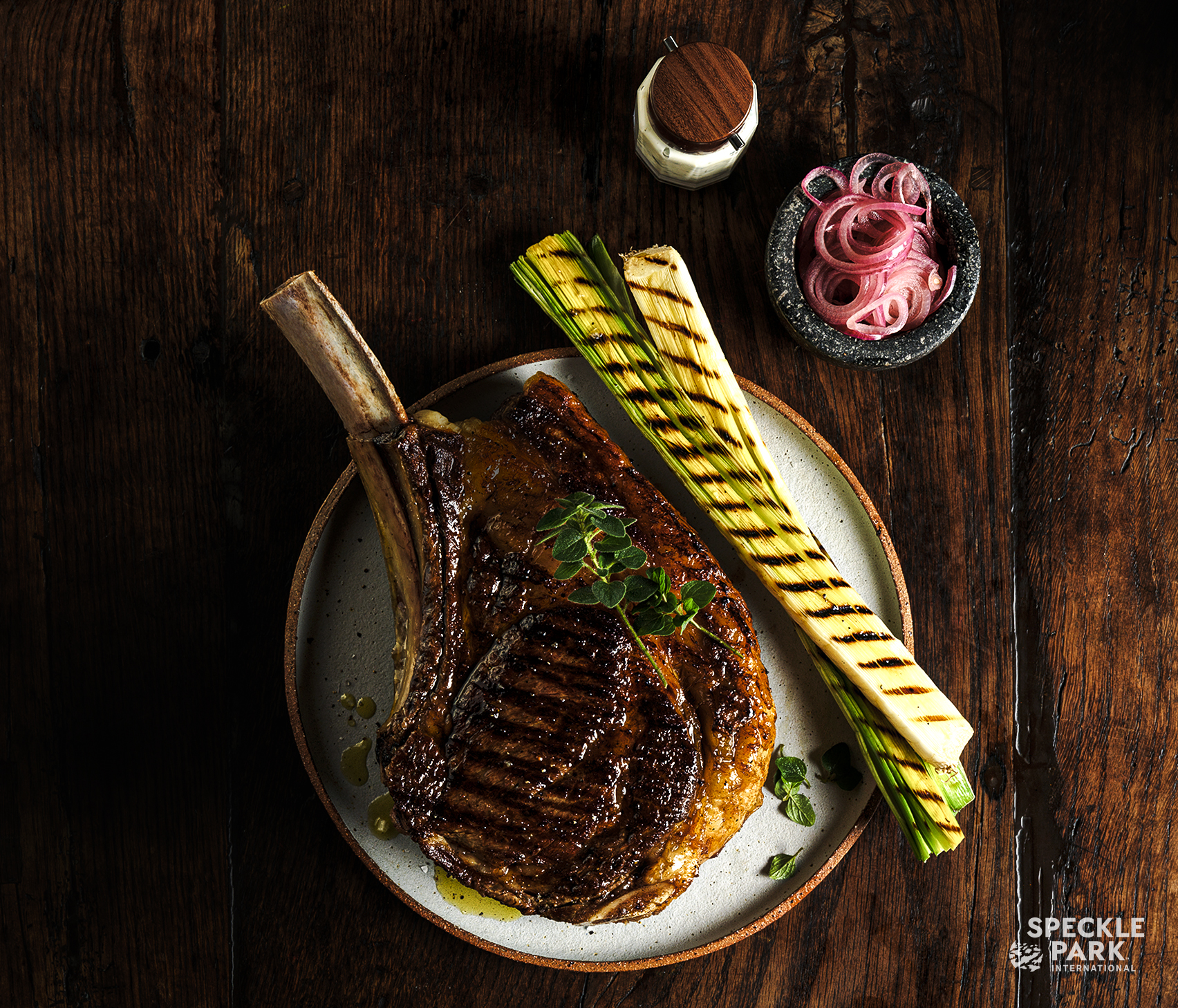
Speckle Park rib eye on the bone. Photo: Jason Loucas. Styling: Jane Collins.
THE steak featured on the book’s cover came from Margaret, Neil Perry’s Sydney steakhouse, ranked No. 2 on the World’s 101 Best Steak Restaurants global list. It was Speckle Park, bred by Minnamurra Pastoral Company.
A great steak wins attention. What keeps commercial and seedstock producers interested is whether that quality can be measured, repeated and paid for. Speckle Park’s offer is straightforward: quiet, easy-doing cattle that mature early, finish on grass or grain and fit the system producers already run.
PAID ON MARBLING
Speaking at Speckle Park International’s (SPI) Where Data Meets Direction workshop at UNE’s SMART Farm in Armidale in early November, Neat Meat managing director Simon Eriksen explained how his New Zealand brand, SpeckleBeef, gets paid for quality.
“We don’t grain finish, but we must deliver with consistency,” he said.
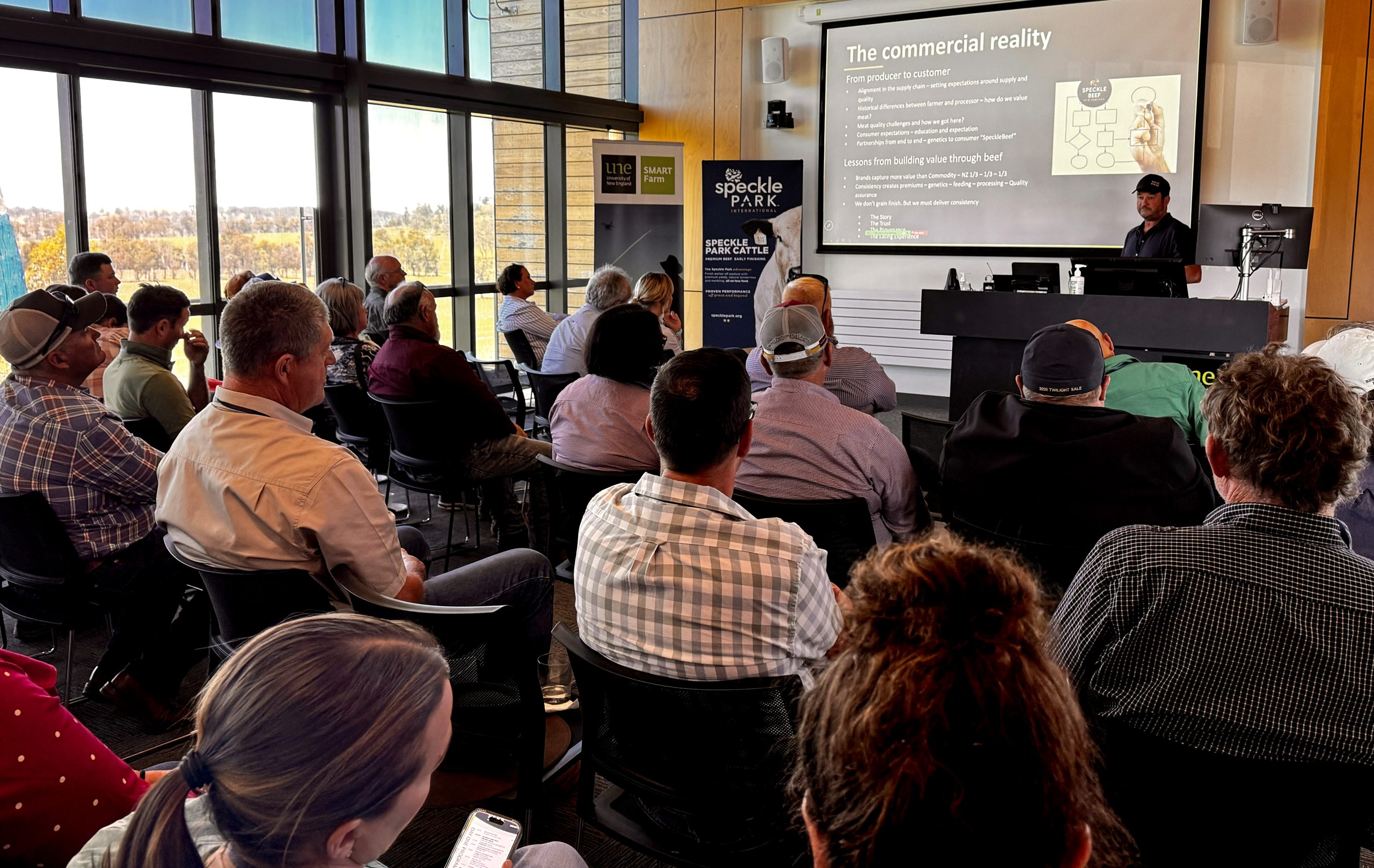
Simon Eriksen of Neat Meat on the commercial reality of building value through beef at SPI’s Where Data Meets Direction workshop, UNE SMART Farm, Armidale.
About 70 farmers supply the grassfed program and are paid the processor’s prime schedule plus a premium for marbling. Every animal is tagged from straw to plate and camera-graded at processing. Mr Eriksen said grading results had shown how readily Speckle Park cattle lay down marbling. The aim is 100,000 head a year within five years, largely from Speckle Park sires over dairy cows.
The proof is on the plate. SpeckleBeef sirloin and scotch fillet have won gold at the New Zealand Food Producer Awards two years running, from entries Mr Eriksen picked blind: “I put my hand in the box and didn’t look at the piece of meat.”
“The value in the brand is the partnership,” he said. “If we don’t have farmers collectively working together to solve problems across the supply chain, we don’t have a strong brand.”
UNE meat scientist Professor Peter McGilchrist told the workshop that eating quality comes down to a few big levers, including age at slaughter and marbling. He then asked breeders: can sires be found that lay down marbling earlier, so cattle hit market specifications younger, off grass or with fewer days on feed?
For producers, that means turning cattle off sooner on less feed. For processors, more young cattle that grade. For seedstock breeders, genetics with a clear, measurable value. That is exactly where Speckle Park is built to perform and with grassfed exports up 13pc to a record 1.1 million tonnes in 2025, the timing suits the breed.
THE AUSTRALIAN EVIDENCE
Australian producers are already putting the breed to the test, many by joining Speckle Park bulls to the cows they already run. In Western Australia, Arley Speckle Park averaged an MSA Index of 62.46 across 119 Speckle Park-infused cattle processed so far in 2026, with 86pc grading above the national top-quarter threshold. Arley also buys infused steers from its bull clients, giving them a direct path into its butcher and restaurant supply.
At the 2026 RNA Paddock to Palate, a record 1358-head competition, Minnamurra Pastoral Company’s Speckle Park cross steers placed third for MSA eating quality in the 120-day export class (37C), after placing second for the same award in 2025.
Tamworth livestock consultant and agent Andrew Hosken, who has reviewed MSA kill sheets from established Speckle Park commercial programs across a number of processors, has consistently seen yearlings grade MSA at close to 100pc. “If you’re looking for functionality, economy and profitability, Speckles tick nearly all the boxes,” he said.
The breed is also finding a place on dairy farms. In South Australia, Dairy Adventures is taking a growing number of its Speckle Park-cross dairy calves through to finished weights above 600kg, targeting an MSA grid with Thomas Foods International. “Speckle Park have been the best calves to rear,” said Narelle Zanker.
PUTTING IT TO THE TEST
For stud breeders weighing up the breed, every registered purebred Speckle Park is parent verified by DNA.
SPI’s Commercial Register links commercial steer and heifer results back to their sires and into BREEDPLAN and SPI has joined MLA’s multibreed genetic evaluation, which aims to give cattle a common language for their genetic credentials.
The next test comes in March, when the 2027 Speckle Park Signature Beef Challenge is judged in Melbourne. Entries cover purebred and infused cattle from grass-fed and grain-fed systems. Every entry is backed by DNA-verified Speckle Park parentage.
“Commercial producers, processors and chefs don’t buy on reputation alone. They want to know what they’re getting, time after time. Every entry helps us answer that question with evidence rather than anecdote.”
Vaughn Johnston
Chairman, Speckle Park International
A Speckle Park steak on the cover of the inaugural World’s 101 Best Steak Restaurants book shows what the breed can deliver on the plate. The Speckle Park Signature Beef Challenge is about building the evidence behind that quality and demonstrating its repeatability across commercial production systems.
Find out more about Speckle Park genetics and the Commercial Register at specklepark.org.
HAVE YOUR SAY