
Rainfall outlook
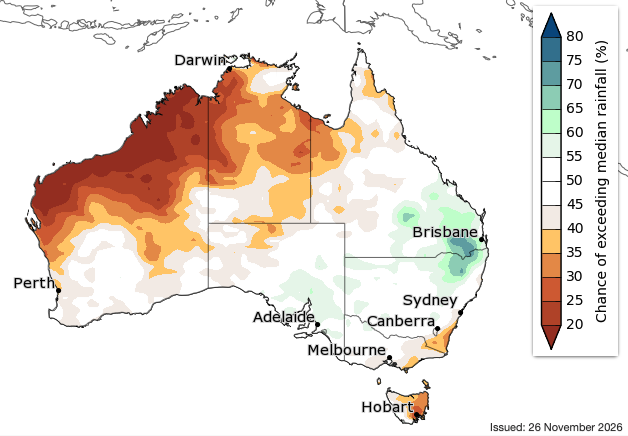
December to February rainfall is likely (60 percent to greater than 80 percent chance) to be below average across most of northern Western Australia and Northern Territory as well as parts of the far south-east including much of Tasmania.
The likelihood is highest for the northern coast of Western Australia.
 There is an increased chance of unusually low rainfall1 (40 to 60pc chance) for parts of north-western Australia, with the likelihood being the highest (60 to 80pc chance) along coastal parts of the Kimberley, Pilbara and Gascoyne regions. Despite the drier than average forecast for northern Australia, it is the wet season so substantial and at times heavy rainfall is still likely – just below the long-term average overall.
Above average rainfall is likely (60 to 70pc chance) for parts of southern Queensland and north-eastern New South Wales, along and west of the Divide. Compared to the forecast issued last week, the wetter than average signal has reduced in extent.
The wetter than average signal is more pronounced during December, extending to cover much of Queensland, and parts of north-east New South Wales and central Australia.
For most other areas, including southern parts of the mainland and much of the east coast of the mainland, there is no clear signal for either wetter or drier conditions for the season, meaning there are roughly equal chances of above or below average rainfall.
The ACCESS-S rainfall forecast is consistent with other international models.
1Unusually low/high rainfall is that in the driest/wettest 20% of December to February records between 1981 and 2018. Select your location on the map for more localised information.
Outlook video
Temperature outlook
Above average temperatures likely across Australia
December to February maximum temperatures are very likely to be above average (greater than 80pc chance) across almost all of Australia.
There is an increased likelihood (over 50pc chance) of unusually high maximum temperatures2 across much of Australia, with the highest chances (over 70pc) across eastern parts of New South Wales, eastern Tasmania, and much of the north extending into central Australia and much of Western Australia. For much of Australia, this season represents the hottest time of year.
Minimum temperatures are very likely (greater than 80% chance) to be above average across almost all of Australia, excluding the Gascoyne Coast of Western Australia.
The chance of unusually high minimum temperatures2 is very high (60% to over 80% chance) for much of the country excluding around the Gascoyne Coast of Western Australia, southern South Australia, western Victoria, south-west New South Wales and western Tasmania. This represents 3 to 4 times the normal likelihood.
The ACCESS-S forecast for temperatures is consistent with most international models, however ACCESS-S predicts higher chances of above average temperatures compared to some other models.
2Unusually high maximum and minimum temperatures are those in the warmest 20% of December to February days and nights, respectively, between 1981 and 2018.
COMPARISON
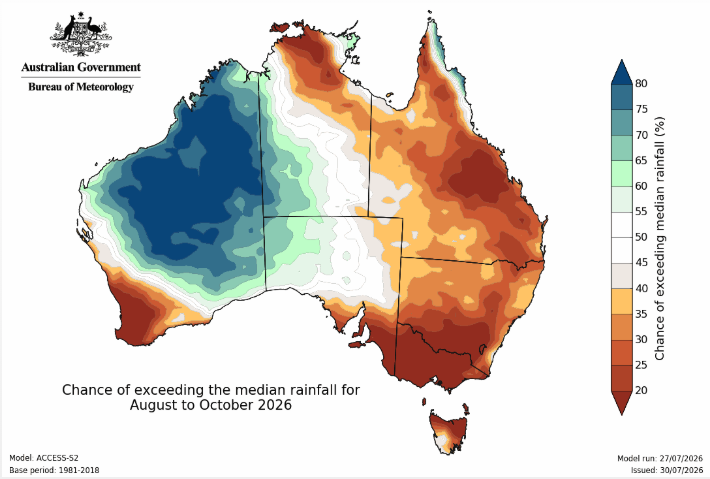
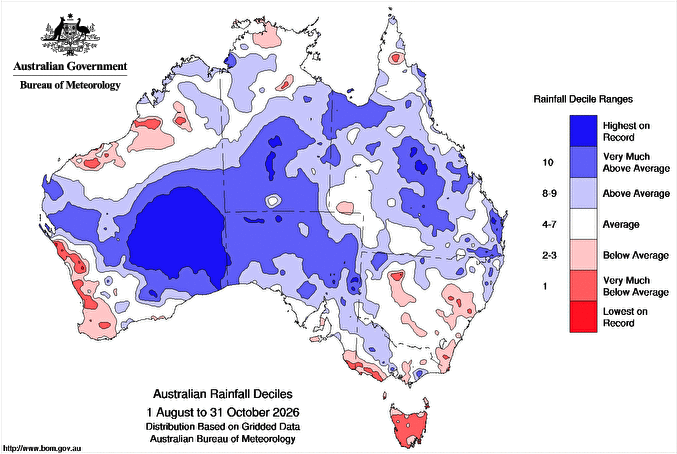
Previous three-month outlook versus actual rainfall received
Aug to Oct 2026 rainfall outlook (issued 30 September 2026):
Aug to Oct 2026 rainfall deciles:
Source: BOM
HAVE YOUR SAY