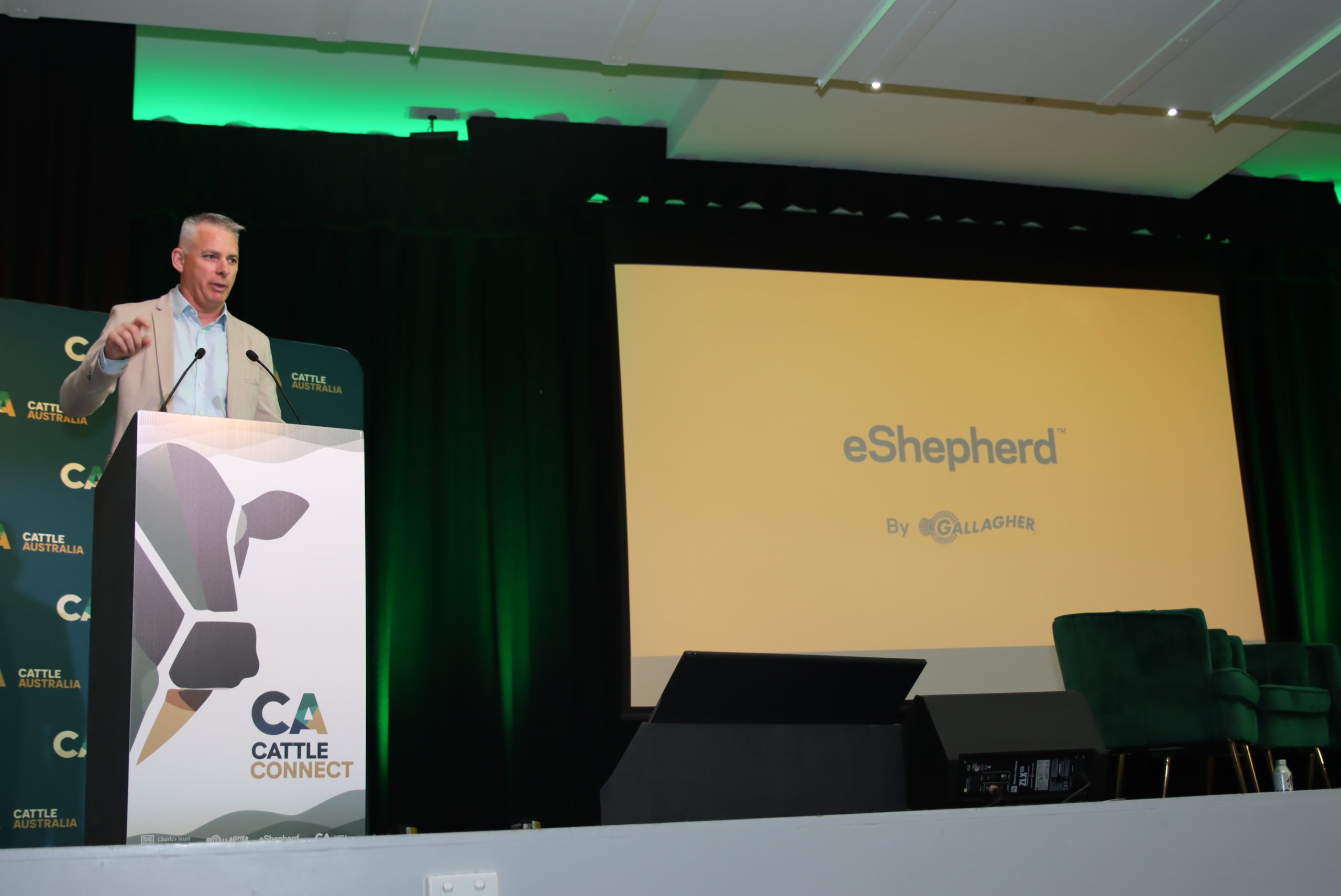
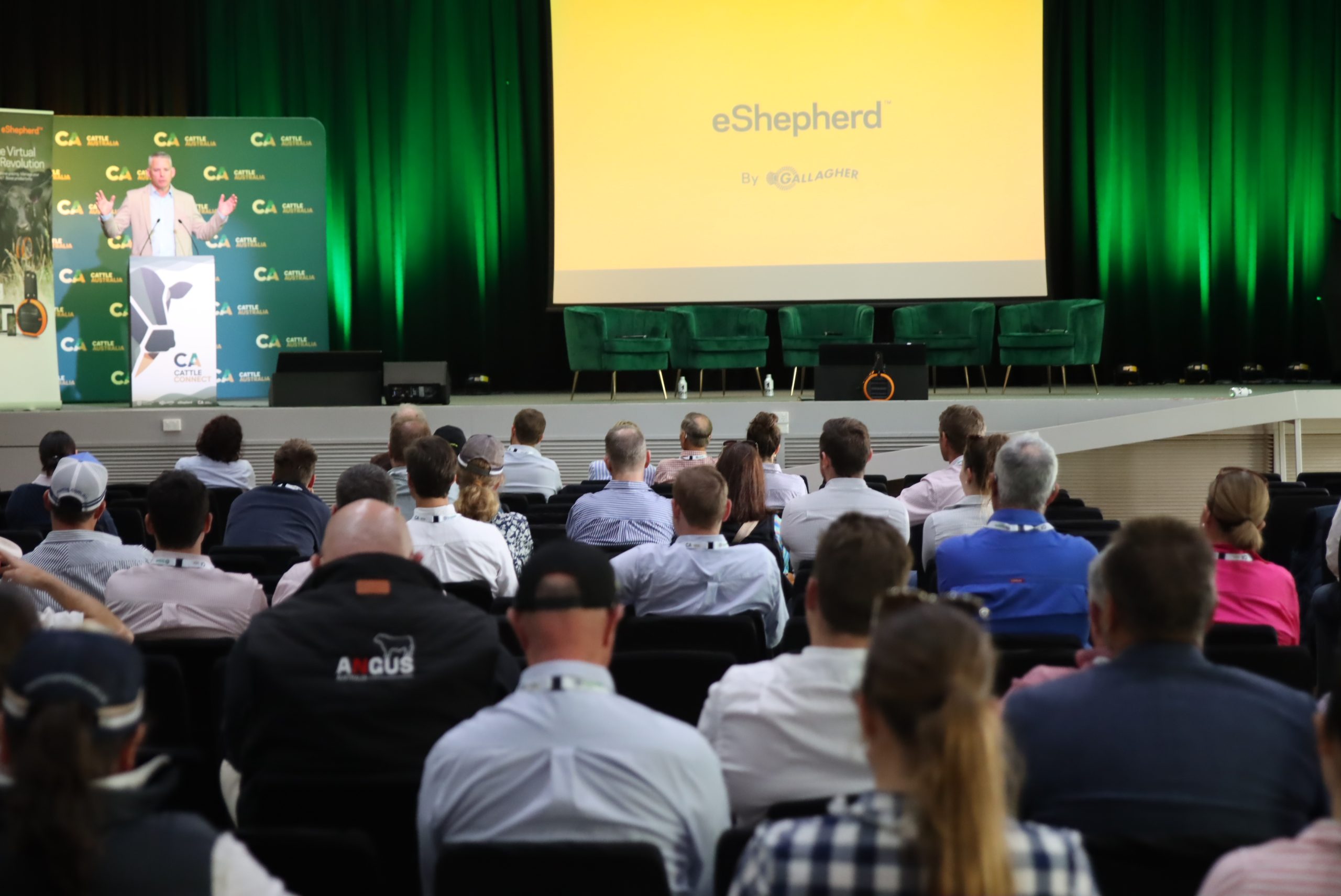
Rob Clayton from Gallagher eShepherd addressing the 2026 Cattle Connect conference in Wagga Wagga.
MOVING cattle during a major rainfall event on a property in another state from a distant hotel room, grazing land that hasn’t been utilised in 50 years and cows wearing cameras that can be used to monitor the health of other cattle around the clock.
The introduction of wearable technology for cattle could ultimately prove to be as transformative for the livestock sector as the introduction of GPS-guided tractors was for the cropping sector 25 years ago, Rob Clayton, Gallagher eShepherd Chief Executive told the recent Cattle Connect conference in Wagga Wagga.
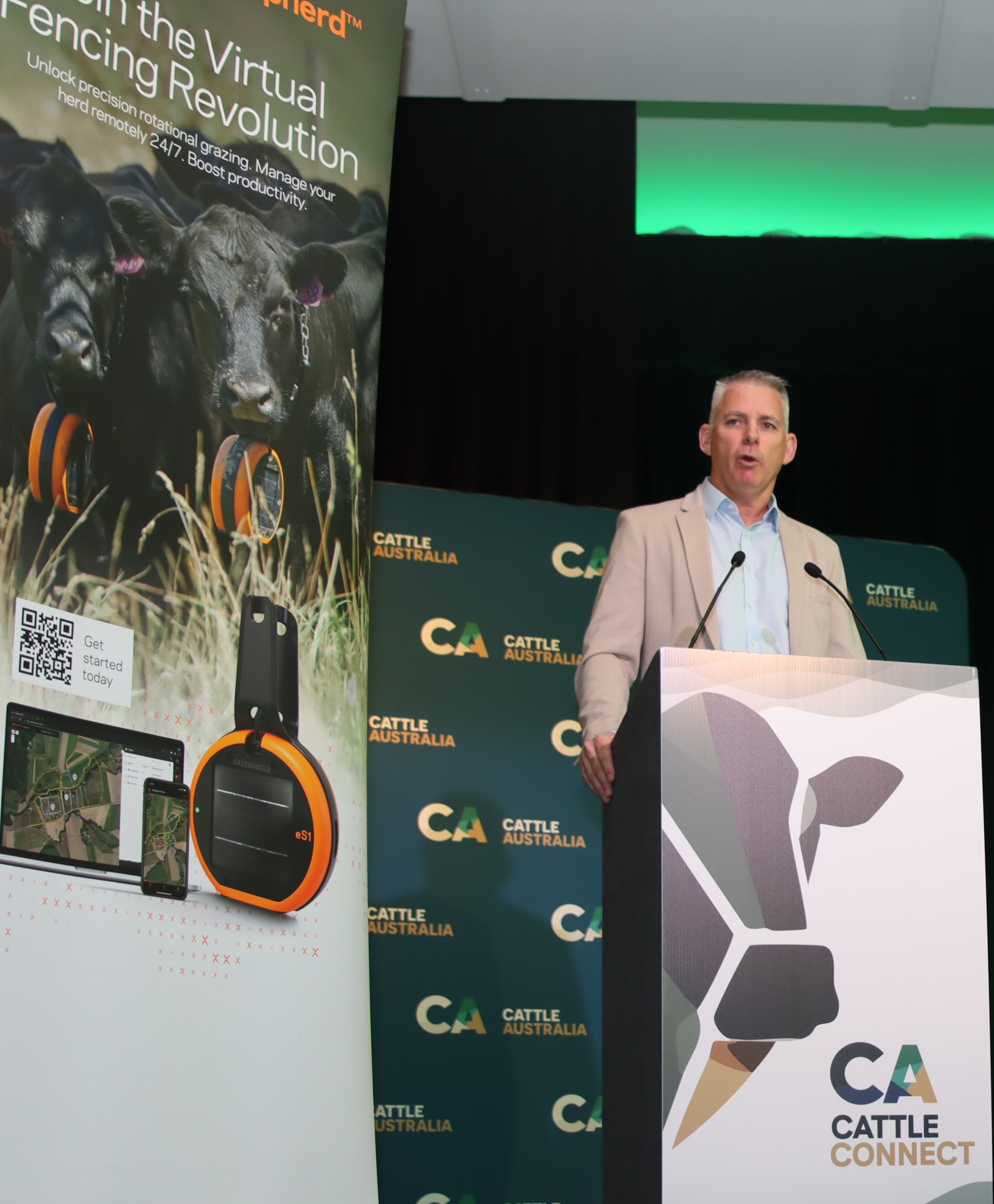 Mr Clayton grew up on a family property at Coonamble in north west NSW and held national and international leadership roles with Nutrien before returning to Australia and joining Gallagher to run its virtual fencing and precision management division earlier this year.
He told Cattle Australia’s Cattle Connect conference recently that virtual fencing is set to be just the first step in a much bigger technological shift in cattle production.
He believes the greatest value of wearable livestock technology lies beyond its ability to replace physical fences, but in the potential it offers to fundamentally change the way cattle are managed.
During his presentation he revealed a number of developments Gallagher is currently working on including a smaller and lighter second-generation virtual fencing device along with the potential for camera-based technology that is capable of estimating cattle weights to market competitive accuracy.
Additionally, the company is also considering the use of wearable cameras on cattle that can be used to monitor the weight, health and wellbeing of other cattle in the same mob, and even alert producers to problems such as empty water troughs in real time.
Moving cattle another State away – a practical example of technology at work
To illustrate how virtual fencing is giving producers new options and flexibility, Mr Clayton shared the example of south west Queensland cattle producer whom he referred to as Susie.
Before she left home to travel to Wagga Wagga to attend the Cattle Connect conference, she checked the weather forecast and saw that about 40mm of rain had been forecast for her property.
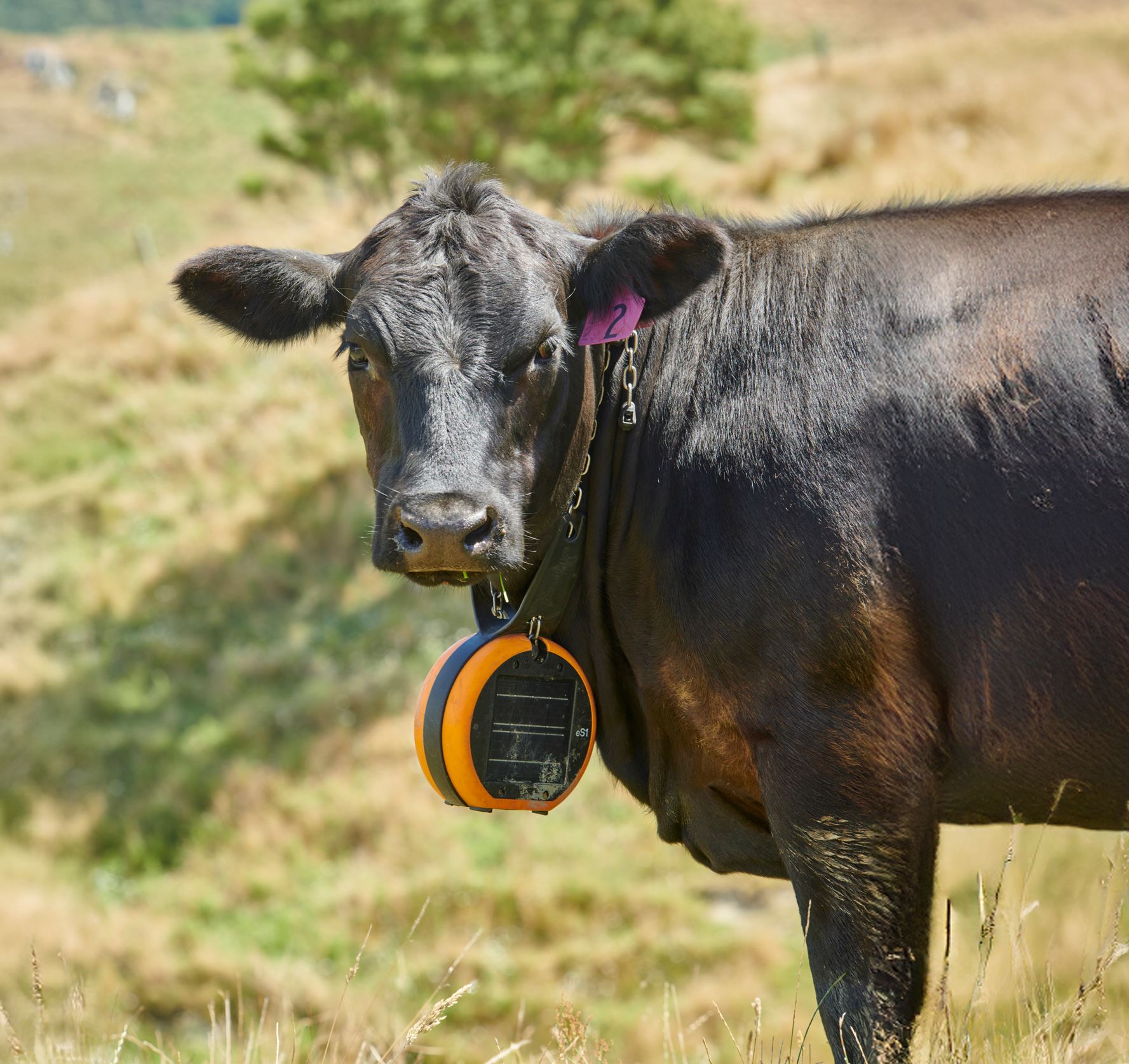
A stock image of an Shepherd neckband. Source: Gallgager.
She left a gate open so cattle grazing in a back paddock could move out of low-lying country if conditions became too wet.
But on the first morning of the conference she woke to find out that her property had in fact received 300mm of rain, and her farm worker was unable to get to the property because roads had been cut by flooding.
Under that scenario, Susie would have little option but to simply hope her cattle had made their way out of the paddock before rising creek levels cut off their escape route.
 But, under another scenario with the use of virtual fencing technology, the situation was very different.
Had her cattle been wearing virtual fencing collars, Susie would have been able to look at her phone and immediately establish where they were.
She would have had the ability to move the cattle to wherever she wanted to move them to from her hotel room in Wagga.
“Now I think that’s pretty good. I think that’s not just the use of technology; that’s giving more options to farmers,” he said.
“That’s giving control where we had no control.”
Mr Clayton said the company was receiving numerous examples of producers using the technology to overcome previous constraints in their operations.
At Cattle Connect he said had spoken to one producer who was now able to graze an area representing 20 percent of their farm for the first time since 1973.
The area adjoined a creek where the risk of fences being washed away had made maintaining physical fencing impractical.
Some producers were now selling or reducing the use of contracted mustering helicopters because they were able to progressively move cattle using virtual fence boundaries.
‘Have we seen this movie before?’
Mr Clayton believes these advances represent only the first wave of benefits that will flow from wearable livestock technology.
 He recalled the scepticism that greeted the arrival of GPS-guided tractors in the cropping sector about 25 years ago, including on his own family’s farm.
At the time his father questioned why the family would spend thousands of dollars on an auto-steer system when he had “sons who could drive his tractor for free”.
But the real significance of GPS technology was not that it enabled tractors to drive in a straight line without human intervention, he said.
“It was about the start of precision agriculture, and that’s why I say I think I’ve seen this movie before.”
Prior to the introduction of precision agriculture technology, the smallest practical unit of measurement and management in a cropping enterprise was a paddock.
Mr Clayton recalled that when he was a young agronomist helping out on the family farm, the smallest unit of measurement was a paddock. But a paddock contained all sorts of variations from soil types to wet and dry patches that meant blanket treatments would not work uniformly.
“But we didn’t have the tools to manage anything other than a paddock, we didn’t have variable rate technology, we didn’t have GPS, we didn’t have grid sampling.
“We didn’t have all of these things that we have today, where the unit of measure has gone from the paddock to the square metre.”
Mr Clayton said he believes wearable technology will follow a similar path by changing the unit of measurement and management from the mob to the individual animal.
“This isn’t about the fences. It’s about managing individual livestock as individuals.
“Today this technology allows us to do that. This technology allows us to understand exactly where our livestock are, exactly what they’ve eaten, exactly where they’ve been.”
This opened up a range of possibilities that had not previously been possible.
“This isn’t about the fences. It’s about managing individual livestock as individuals.
“Why don’t I let the shy feeders through the fence 10 hours before the bullish feeders?
What happens when they’re drinking out of this dam and the water quality is X, and they’re drinking out of this trough and the water quality is Y? Does that affect how much beef my cattle produce? We could never economically manage that before. Today, this technology allows us to do that.”
Cows with cameras
Asked how far away some of new developments he discussed were, Mr Clayton confirmed Gallagher was already working with camera-based cattle weighing technology.
“We are actively trialling camera technology that is weighing cattle right now.”
He said the technology was achieving weight estimates that were competitive with conventional technology accuracy.
“But our plan includes vision technology built into our devices as we go forward.”
He said the company has about 250 data scientists, developers and research and development specialists working on the technology.
He expected continued investment and competition in the sector to drive down costs and increase functionality over time.
He encouraged cattle producers to experiment with wearable technology on a relatively small scale, perhaps by equipping 50 or 100 cattle, to establish where it could deliver benefits specific to their own operations.
Mr Clayton said attitudes towards technology such as GPS guidance on his own family’s farm had changed considerably since it first emerged 25 years ago.
Having initially questioned why they would invest in the technology, he said now the family operation could not afford to operate without it.
“And now our tractor stops when GPS isn’t working.”
HAVE YOUR SAY