
University of New England criminologists are urging more farmers to report farm crimes, as a national survey reveals 91 percent of farmers have experienced a crime, but most of these crimes have never been disclosed to police.
Data from the first national Farm Crime Survey in 20 years has been released by the University of New England’s Centre for Rural Criminology, providing a fuller picture of rural crime victimisation in Australia.
The results demonstrate that farm crime continues to come at a significant financial and psychological cost to farmers, but only 3 out of 10 crimes are brought to the attention of the police. Subsequent crimes particularly tend not to be reported.
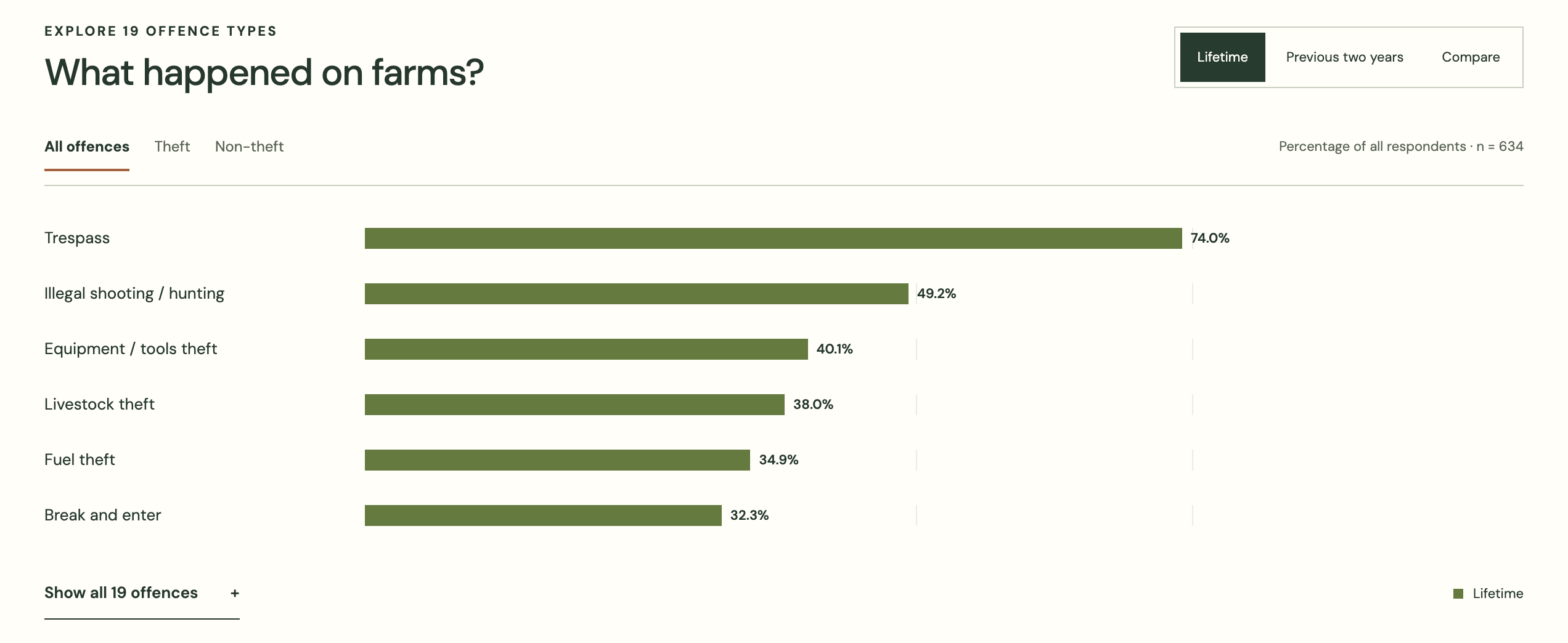
Co-director of the UNE Centre for Rural Criminology, Associate Professor Kyle Mulrooney, says the most common crimes experienced according to the survey were trespass, illegal hunting stock theft, machinery and tool theft and fuel theft, with fuel theft seeing a significant increase since the last survey.
“Farm crimes are unique in that we’re talking about immense tracts of land and large distances between neighbouring farms, and between farms and communities, along with a lack of surveillance on private property. This makes it very difficult to detect criminal activity, and if farm managers are off-site, it can be months before a crime is discovered, making it very difficult to investigate,” A/Prof Mulrooney says.
But the consequences of a farm crime can be broad and far-reaching.
 “Some crimes have different implications and consequences on farms compared with urban environments – for example the commonly experienced crime of trespass introduces a very real biohazard risk on a farm, which has the potential to shut down farming operations. The motivation for trespass is often hunting, so the possibility of illegal firearms on the property also creates fear and anxiety,” he said.
Technology to improve surveillance has come a long way, but the uptake of various protections on farms has remained low to date, the survey revealed, at 49 per cent for CCTV, 12 per cent for property marking, 9 per cent for GIS-enabled tracking devices and 3 per cent for surveillance drones.
“We asked about the perceptions of effectiveness and barriers for adopting a range of measures, with cost and perceived difficulty in implementation being high deterrents, as well as the perception that no one single measure would be enough.”
Yet adding to the problem, the survey demonstrates the fear of victimisation is a common source of psychological stress for people on the land.
“Overall, the survey findings demonstrate that there is significant fear among farmers of being victimised, alongside uncertainty as to the best way to best protect property and belongings on a farm, and low confidence that justice will be done if a crime is committed,” A/Prof Mulrooney says.
“It’s a complex problem, and one that remains a big issue for our rural communities. However, to be able to understand the depth and breadth of the issues and have a hope of improving the picture we’re seeing, it’s really important that farmers are reporting every crime they experience or suspect.
“When incidents are not reported, they are not recorded and this leaves farm crime under counted in official statistics and less visible in decisions about police resourcing, specialist officers and prevention funding,” he said.
Explore the farm crime survey report here.
Source: University of New England
HAVE YOUR SAY