
153rd Edition: November 2026
Key Points:
- Australian boxed beef sales to Indonesia have nearly halved this year as state importers buy cheaper alternatives.
- Indonesian feedlots will still chase Australian feeders for Lebaran in March 2027, their biggest earner of the year, but are taking on more risk to do it, with expensive feed costs, a record-low rupiah and finished cattle prices capped by the government.
- Vietnam is the market with the most room to grow for Australian cattle, with Thai cattle prices increasing sharply and no government price caps.
Regional Trends and Overview

Dr Michael Patching
Australian cattle face less competition in Southeast Asia than they did a year ago, but they are getting harder for buyers to pay for. Thai feeder steers that undercut ours in Vietnam and Malaysia for most of the year are now $4.50 AUD a kilogram, and China’s shrinking herd is again pulling Mekong region cattle north.
Costs are the problem. Corn is short across the region, the rupiah is at a record low against the US dollar our cattle are sold in, and governments are taking a bigger hand in who imports what, most of all in Jakarta. I don’t expect 2027 to be a better year overall. Indonesia takes so much of our volume that a weaker Indonesian trade outweighs gains anywhere else, Vietnam and the Philippines could soften the blow, Vietnam most of all, but don’t think of it as an overflow or alternative market.
I don’t normally cover Japan, but it fits the same pattern. A5 Wagyu from steers sold for a record JPY3,051 a kilogram ($28.60 AUD) at the Tokyo wholesale market in the first half of November, 14 per cent up on a year earlier, as fewer cattle come forward. Japan has lost about 20 per cent of its beef cattle farms in three years, under pressure from imported feed costs and a weak yen. Shrinking herds throughout the region will keep cattle prices firm well into 2027.
Australian dairy cattle are on the order books
Malaysia’s Farm Fresh landed 3,000 cows from Melbourne in November, the Philippines’ National Dairy Authority took 1,419 heifers in October, and Jakarta continues to talk about importing 100,000 dairy cattle in 2027.
Regional Price Graph
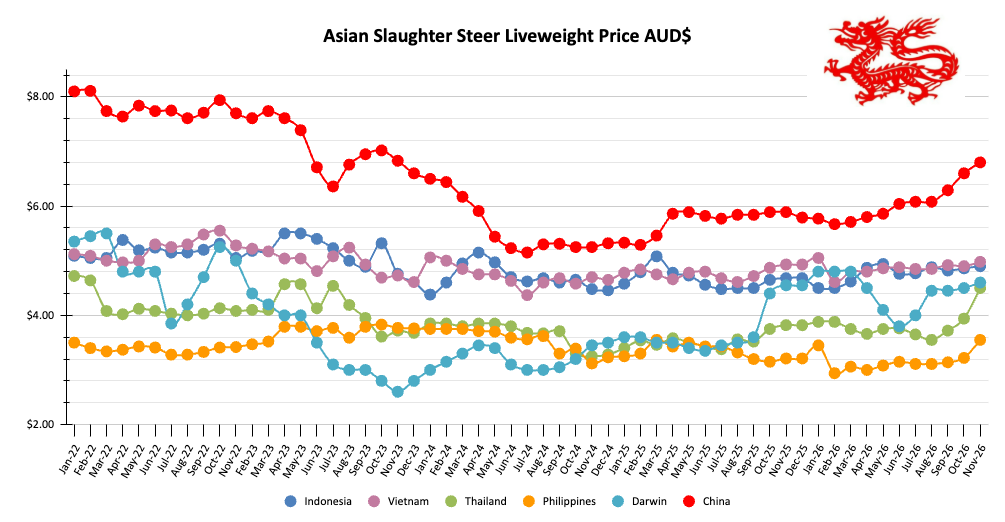
Indonesia: Slaughter Steers $4.91 AUD per kg live weight (IDR 12,210 = $1 AUD)
Indonesia will keep taking Australian feeders through the Ramadan buying period, with the fasting month expected to start around 8 February 2027. Lebaran, the Eid al-Fitr holiday at the end of Ramadan, falls on about 10 March and is the biggest earner of the feedlot year, so I expect feedlots to keep buying even where the numbers are marginal (or at a loss).
Shipments to the end of October were 11 per cent below last year, though July, August and October were all stronger than a year earlier as importers have looked to buy heavily before prices rise even further as the wet season begins.
Lampung feedlots are selling bulls and steers at Rp59,000 to Rp61,000 a kilogram live weight ($4.83 to $4.99 AUD). Australian feeder steers are landing at about US$3.80 a kilogram CIF ($5.69 AUD), and heifers and composites at US$3.60 ($5.39 AUD). Jakarta topside rose to Rp150,667 a kilogram ($12.34 AUD) on 9 November as year-end buying began.
Jakarta’s firm hold on beef and feed imports
 Indonesia’s beef importers’ association, APPHI, said on 5 November that 84 per cent of this year’s beef import allocation went to state-owned enterprises, which passed it on to one private company and twelve of its affiliates. Between this arrangement and our high prices, Australian boxed beef has lost ground. DAFF figures show 29,200 tonnes shipped to Indonesia in the ten months to October, against 53,727 tonnes a year earlier. Feed is going the same way. The state livestock company, PT Berdikari, now brings in about 60 per cent of Indonesia’s soybean meal, and has just signed a supply deal with the feedlot company Estika Tata Tiara and Brazil’s JBS Seara.
Corn and soybean meal prices impact to the feedlot
Corn is selling at Rp7,500 to Rp8,200 a kilogram on the open market, or $614 to $671 AUD a tonne, well above the Rp6,400 ($524 AUD) floor the National Food Agency set on 10 November. El Niño has cut the crop, imports are closed while Jakarta pursues self-sufficiency, and late rain has delayed planting, so the February to March harvest that normally brings relief may come late. Indonesian mills are paying over 60 per cent more for corn than Vietnam’s mills paid for imports this year.
Soybean meal is dear partly because the weak rupiah feeds straight into an almost entirely imported product, and partly because of who now imports it. Running imports through Berdikari, on the model of Bulog, the state logistics agency, adds handling, storage and margin costs, and puts allocation in government hands.
Corn or soyabean are not a big part of a cattle feedlot ration, which typically relies on by-products such as cassava pulp, palm kernel cake, copra meal and rice bran. The trouble is that poultry and fish mills switch to those same by-products when corn and soybean meal get dear. Rice bran has doubled to Rp6,000 to Rp6,500 a kilogram ($491 to $532 AUD a tonne). Cattle bought now for Ramadan will be fed through the dearest part of the feed year. Feedlots cannot charge more for finished cattle, so dearer feed comes straight out of their margin. Most will accept that rather than go short of cattle for Lebaran, but the feedlots that misjudge it will feel it in the new year.
Vietnam: Slaughter Steers $4.98 AUD per kg live weight (VND 17,200 = $1 AUD)
Vietnam is buying Australian cattle again. After 2,014 head in January, shipments stopped entirely from February to June while Thai cattle came in through Laos. They resumed in July and rose to 5,213 head in September, though no shipments were recorded in October. I expect buying to pick up somewhat into the Tet trade ahead of the Lunar New Year on 6 February 2027, because the Thai cattle that replaced ours are no longer significantly cheaper. Margins will be thin either way. Feed mills including New Hope and Haid lifted cattle feed prices by 200 to 300 dong a kilogram ($12 to $17 AUD a tonne) in early November, and cheap pork is holding down what beef can fetch at market.
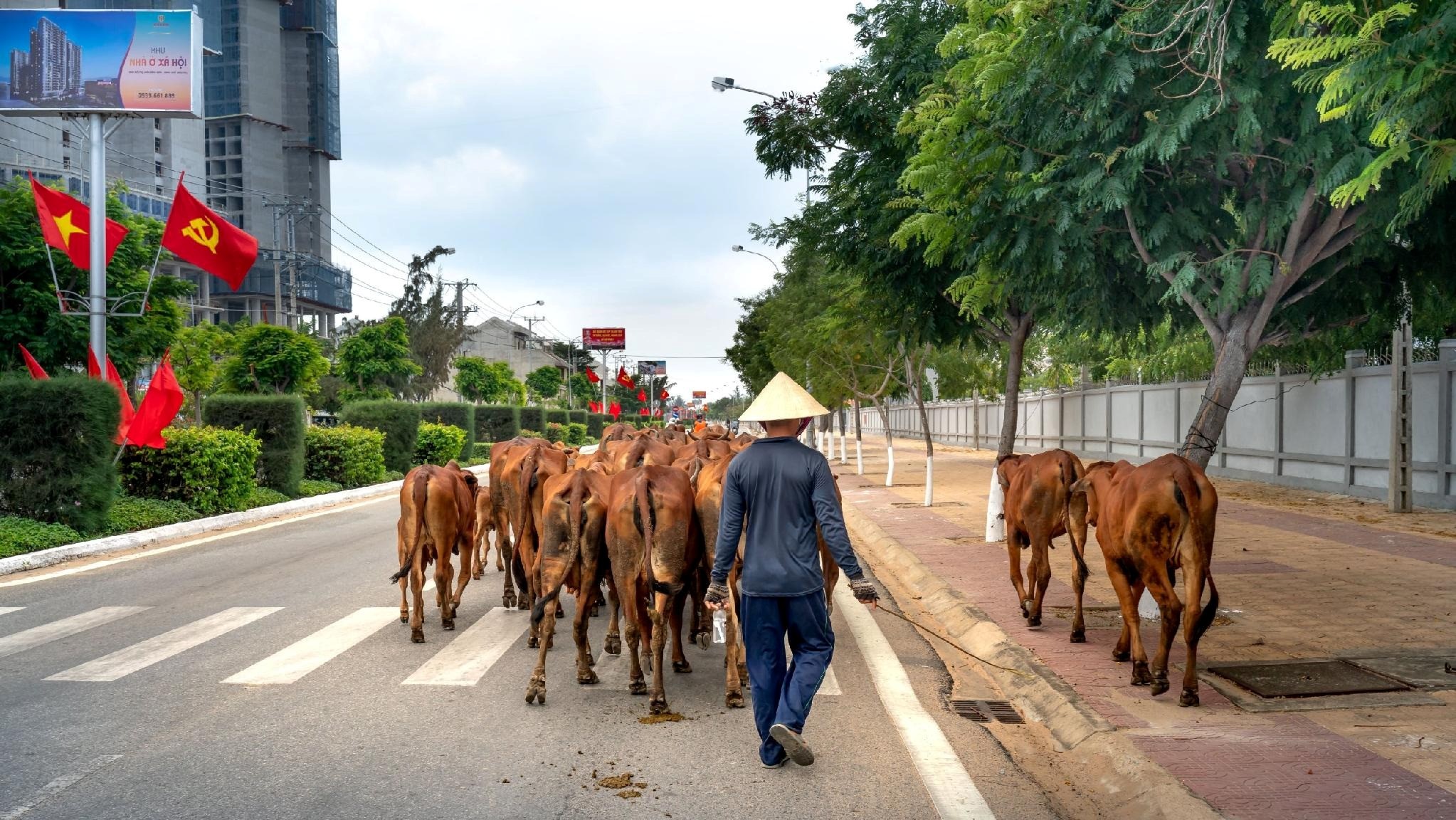
Image: Cattle being walked along a city street in Vietnam (Credit: Quang Nguyen Vinh)
Poor record of large cattle projects in Vietnam continues
In 2015 Ha Tinh province approved Binh Ha Livestock’s plan for a cattle and feed complex, with registered capital of $266 million AUD and meant to turn off 254,200 cattle a year. Cattle farming there stopped in 2017 after heavy losses, and on 29 October the site’s assets, including about 40 empty yards, sold at auction for about $17 million AUD. For those with a strong memory, 2015-2017 was a significant period of strong trade to Vietnam with several large companies entering the industry backed by provincial government plans for cattle industry expansion. Following significant a significant government restructure and crackdown on corruption, most of these companies have either pivoted operations or closed their farms, leaving only a handful of supply chains and importers remaining.
Philippines: Feeder Steers $3.55 AUD per kg live weight (PHP 42.66 = $1 AUD)
The Philippines is one of the few markets taking more Australian cattle this year, with 25,498 head to the end of October, up 9 per cent and mostly feeders. Cattle prices are up on the back of the same high feed costs facing other countries in the region. I expect demand to hold steady into the new year. Manila has more than doubled its corn import allowance to cover a 1.42 million tonne shortfall due to poor crops, but a 60-day pause on some pork imports should support meat prices over Christmas.
Thailand: Feeder Steers $4.50 AUD per kg live weight (THB 22.67 = $1 AUD)
Thailand matters to our trade as a competitor, and it is a weakening one. Thai feeder steers suitable for feedlotting are making about 102 baht a kilogram live weight, or $4.50 AUD, up from $3.72 AUD in September. My contacts warned me in September that Thai cattle were getting scarce, and that is now being reflected in pricing.
Thai cattle into Vietnam
The Thai-Cambodian border has been shut since the fighting of July 2025, and Prime Minister Anutin says it will stay shut until the disputes are settled. Thai cattle for Vietnam are limited to going through Laos, most over the Third Thai-Lao Friendship Bridge at Nakhon Phanom and the volumes are large. Thailand’s livestock department told an April regional meeting that it exported 196,319 cattle to Vietnam in 2025, up from 61,368 in 2024, and 64,298 in January and February this year alone. This rise in volume also reflects a regional shift to official trade which puts pressure on traders and reduces the use of products like salbutamol in the feed which contributes to cattle profitability.
Myanmar, a long-standing source of cattle for Thai and Chinese buyers, is tightening too. A survey by the International Food Policy Research Institute (IFPRI) found the diesel price paid by Myanmar farmers more than doubled this monsoon season, and many went back to ploughing with cattle instead of tractors. Cattle kept for work are cattle not sold across the border.
Malaysian buyers have a reason to compare
Malaysia has taken only 1,319 Australian slaughter cattle this year, against 18,867 in 2021, as cheaper Thai cattle then took the trade. It will stay a small market for us, but Thai cattle are losing their edge there too. Local beef retailed at a median RM36 a kilogram ($13.11 AUD) in the first half of November, unchanged on a year earlier, while Indian buffalo block rose 9 per cent to RM24.90 ($9.07 AUD). On my rough numbers, a Thai feeder at about RM12.30 a kilogram live weight ($4.48 AUD) costs a butcher about RM33 ($12.01 AUD) for every kilogram of saleable meat, which leaves very little under RM36. Butchers cannot work on that margin for long, and with high quality Australian cattle closing the cost gap on Thai feeders, I expect Malaysian importers to at least start pricing our cattle again.
Cattle as collateral
Thailand’s agriculture ministry is preparing a pilot, discussed with the state agricultural bank on 12 November, that would let farmers pledge registered beef cattle as security for bank loans. Farmers who can borrow against their cattle do not have to sell them when cash runs short. That would help Thailand hold on to breeders in tough years, and leave fewer Thai cattle for the markets we sell into.
China
A widening hole in China’s supply
China’s agriculture ministry had live cattle at 31.09 yuan a kilogram in the first week of November, about $6.80 AUD and 15.8 per cent up on a year earlier. The US Department of Agriculture’s Beijing office expects the herd to shrink from 95.57 million head in June to 92.26 million by January 2027 as farmers keep culling breeding cows. Two years of losses, with cheap imported beef holding down calf and cattle prices, pushed many to sell their cows or leave the industry, and they remain wary of rebuilding even now that prices have recovered. Imports will not fill the beef supply gap quickly, with Australia and Brazil both paying penalty tariffs until their 2027 quotas open.
A $2 AUD a kilogram premium over Thai or Darwin cattle changes the arithmetic on access. The longer China’s shortage lasts, the more likely it becomes that the protocol for Australian cattle is reworked, or that other routes into China, such as through Laos, are seriously considered. Nothing will move quickly, but the China question is more open than it has been in years. In the meantime China keeps drawing in neighbouring cattle, which helps our cattle compete in Vietnam and Malaysia.
Australia: Feeder Steers Darwin $4.60/kg liveweight
Rabobank expects Australian beef production and exports to rise about 3 per cent in 2027, where MLA’s September forecast had production falling 3.6 per cent. I expect Australian cattle prices to stay strong either way and probably go higher in 2027, and that will make it heavy going for live export, which will be competing with our own processors. Darwin feeder steers are at $4.60 AUD a kilogram, up from $4.50 AUD in October. Sustained pricing at this level, on top of the issues with Indonesian currency and feed costs, could make for very subdued volumes in 2027.
Year 2026 cattle exports up to end of October – comparison across SE Asean markets
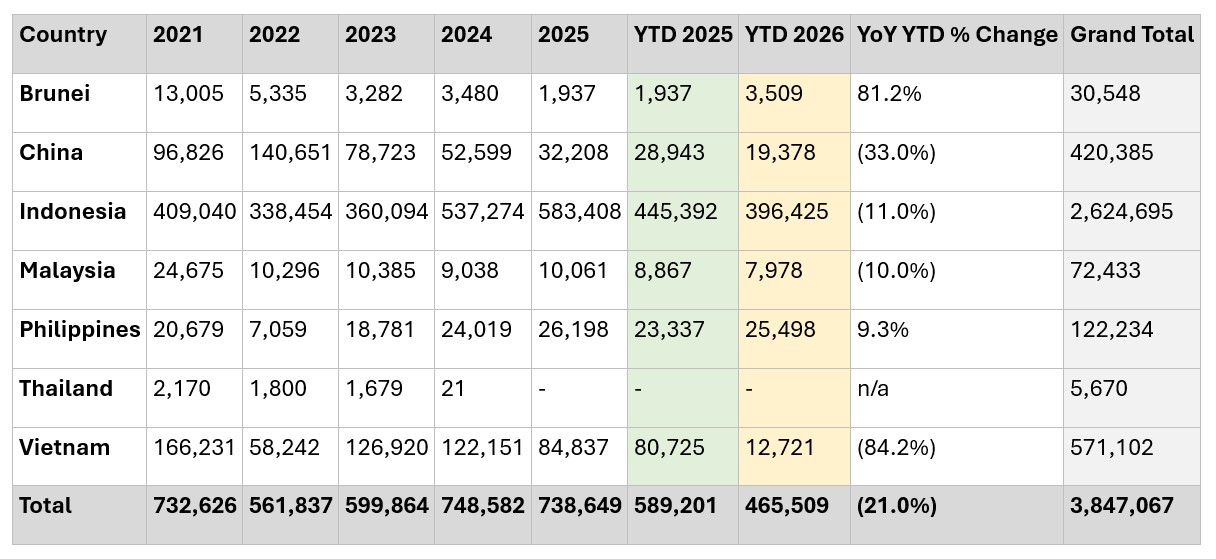
Table source: DAFF website
HAVE YOUR SAY