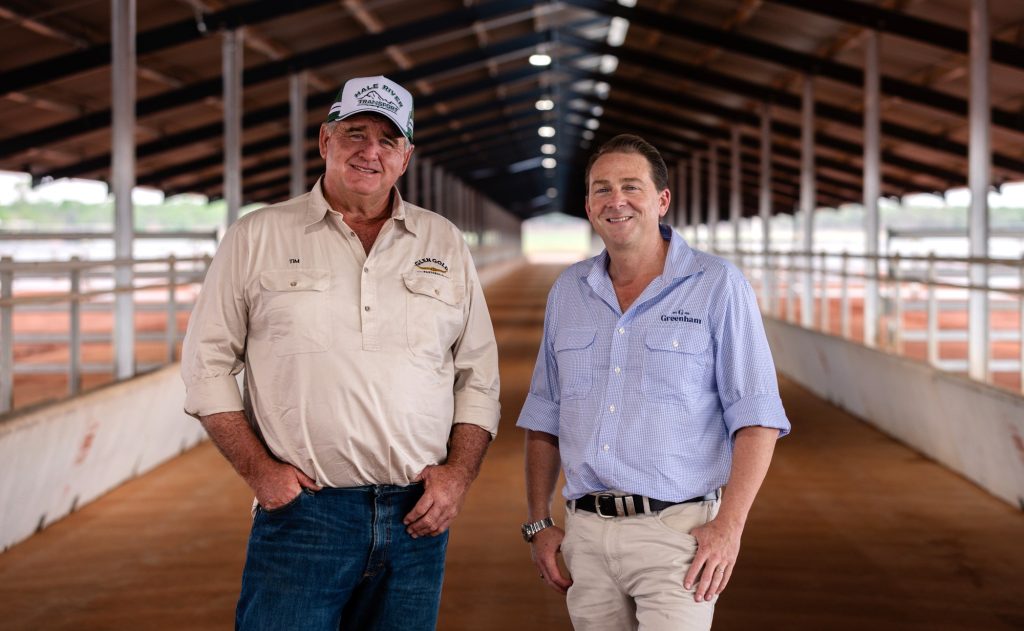
Joint venture partners Tim Edmunds from Glen Gold Pastoral, left, and Greenham managing director Peter Greenham in the new staging facility on Napier Valley, south of Katherine
SLAUGHTER cattle procurement by southern processors out of the Northern Territory has traditionally been about as ‘ad hoc’ as it can get, but an ambitious new supply chain management project launched near Katherine yesterday promises to change all that.
A joint venture involving Victorian beef processor Greenham and Central Australian cattle and transport identity Tim Edmunds has launched an innovative new supply chain model, designed to iron out many of the kinks that have existed in the trade up to this point.
Greenham, like other southern processors, has for decades sourced slaughter cows and bulls out of the Northern Territory, for processing mostly at the company’s Tongala plant in northern Victoria.
‘Cow Hotels’
At the heart of the new project is a network of facilities, colloquially dubbed ‘Cow Hotels’ located at staging points along the 3400km supply route, each about 14 hours driving time apart (see map below).
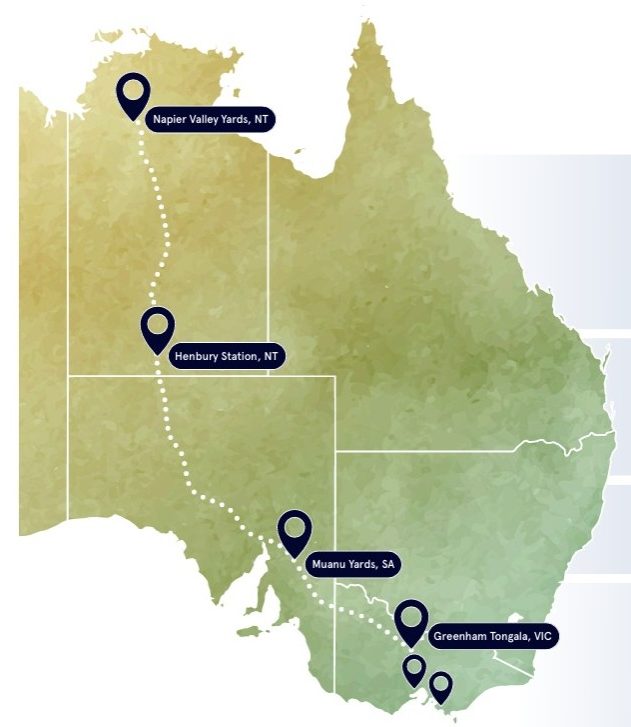
Click on image for a larger view
As part of the scheme, Greenham has bought Napier Valley, a cattle/hay production holding 30km just off the Stuart Highway south of Katherine, while Tim Edmunds’ Glen Gold Pastoral Co has bought the adjacent property, Jarrahdale.
Combined, they cover 6500ha, including 3000ha of developed country producing hay and quality grazing, in a 1000mm rainfall bet, to act as an aggregation point for the project. The holdings will be run jointly.
Surrounding paddocks on both properties can comfortably background another 3000-4000 head.
The holdings were first put to market three years ago, having been developed by former owner Peter Schubert as a large scale hay production facility, generating up to 16,000 round bales of hay each year.
Click the link below to see the 2023 listing video for Napier Downs and Jarrah.
Investment in infrastructure
An extensive depot/aggregation/feeding facility has recently been built at the Napier Valley site, designed to manage the key challenge of continuity of supply out of the region to meet Tongala’s daily and weekly requirements.
The facility is designed to aggregate cows and bulls from NT properties across the Barkly, VRD, Sturt Plateau and Top end region, and as far west as the Kimberley in Western Australia, in readiness for transit to Tongala.
Greenham managing director Peter Greenham told Beef Central there were a lot of older holding facilities in the NT that did not have the infrastructure to handle large volumes of stock adequately for transit like this.
“That’s why we’ve made this investment – Greenham is committed to the north, and we are committed to buying these cattle in volume and getting the best possible outcome in the chillers. We have good markets in the United States and elsewhere for our Never Ever Grassfed beef program, which this product is directed into,” he said.
Mr Greenham said the normal turnoff window for northern cows and bulls from March-April to October-November aligned well with local (Victorian) supply, which was in its low-point in the cycle during that period.
“We have been sourcing significant numbers of cows out of the north for the past 28 years, but we now see the time being right to develop a much better and more efficient supply chain model with these investments,” Mr Greenham said.
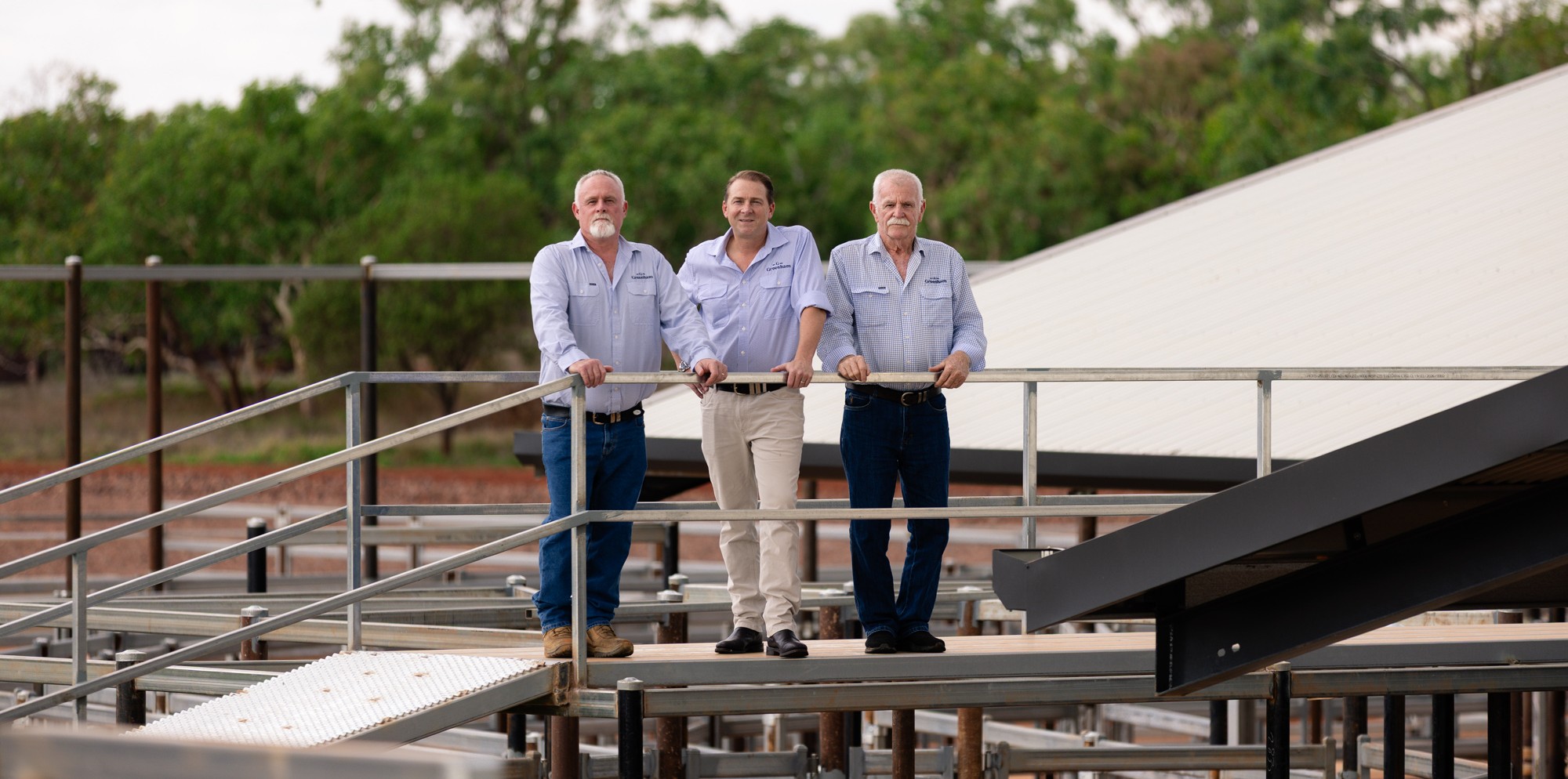
Greenham Group Livestock Manager Adam Pretty, left, with Managing Director Peter Greenham and Senior Livestock Group Manager Graeme Pretty at the new Napier Valley facility. Click on images for a larger view
One of the challenges with consignment of NT cows to southern processors in the past has been the need to build ‘road-train sized loads’, joint venture partner Tim Edmunds said.
The new Napier Valley facility would allow vendors to sell consignments of any size – a few head, a single deck or 30 decks – with cattle sorted into appropriate consignment sizes at the site. Previously, a vendor typically needed to assemble about 132 head (or multiples of) to make up a full road-train consignment. Batching-up those road train sized consignments will now happen at the new Napier Valley facility.
It’s an aggregation point, a transaction point, and a pre-shipment preparation point, and reduces a lot of the hassle for the producer
Up to 2000 cows are likely to pass through through the facility in a typical week, which is designed to be as efficient as possible, given labour challenges.
“It’s an aggregation point, a transaction point, and a pre-shipment preparation point, and reduces a lot of the hassle for the producer,” Mr Edmunds said.
A new set of covered yards and sortation facility has been built at the Napier Valley site, with capacity for 5000 head. The facility includes dipping (NT cattle typically dipped twice before transit) and roadtrain weighbridge, allowing cattle transactions to be made on a liveweight, over the scales basis. Surrounding country is used to grow high quality fodder including sorghum, cavalcade (a centro legume) and jarrah hay, totalling about 10,000t/year.
While the joint venture has managed to save some money on construction cost, Mr Edmunds estimated that the facility could have cost $12-$14 million to construct, without those savings.
The facility has been built to ‘over capacity’ for current requirements, with a view towards future expansion in trade.
Better animal welfare outcomes
Dipping and sortation will happen at the site before transport, and cattle assembled at Napier will be re-hydrated and put onto good feed for typically five to seven days before shipment, setting them up for optimum transport and animal welfare outcomes, and better performance in the chillers.
 The staging facilities at Napier and further south are not designed as ‘feedlots’ targeting weightgain, but simply to freshen cattle up before transit, refilling glycogen buckets, in order to travel better, optimise meatworks yield, and reduce dark cutting.
“It’s all about re-hydrating the cattle and getting them onto good feed, so that when they get to the Tongala plant, they hang up in the best possible condition,” Mr Edmunds said.
A later stage of the project (not core to the primary plan) may see some cows held longer at the Napier facility over the wet season under a weightgain strategy, to allow trucking to start as early as February/March the following year.
“Our business has had a great relationship with Tim Edmonds and Glen Gold for the past 28 years,” Mr Greenham said. “He came to us about 18 months ago with a plan to solidify the relationship further, through building this supply chain, and we see tremendous value in it for all involved – producer, transporter and processor,” he said.
More ‘Cow Hotels’ further south
As can be seen in the map accompanying this article, two other ‘Cow Hotels’ are located further south – each about 14 hours’ drive apart. The first is at Glen Gold Pastoral’s Henbury Station south of Alice Springs (4000 head yards capacity under shade cover, built a year ago at a cost of $8 million) and the second at the Edmunds’ Hale River Transfer Facility in the Clare Valley in South Australia (1500 head capacity, with access to high quality lucerne hay.
From there, the Greenham Tongala processing is a further seven hours transport distance, completing the supply chain.
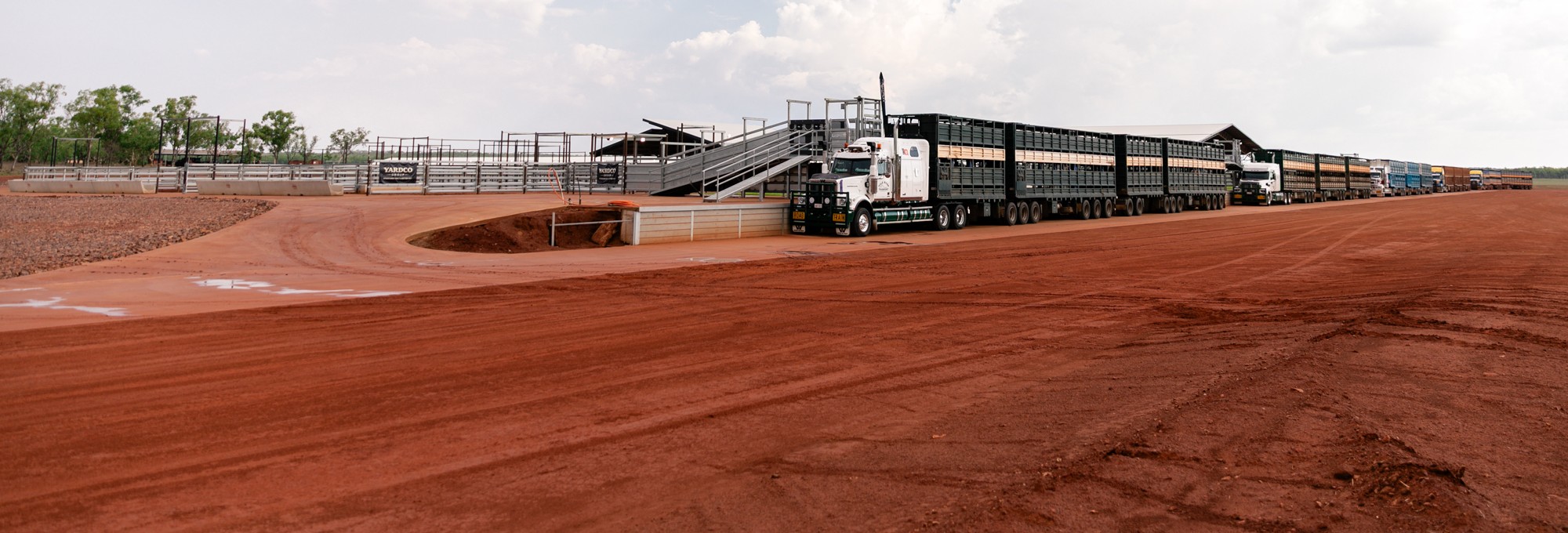
Five roadtrains lined up at the new Napier Valley facility. Click on image for a larger view
Continuity of supply is key
Tim Edmunds said the key slaughter cattle procurement challenge out of northern Australia had always been continuity of supply – either too many, or not enough – at different times of year.
“In the winter when the season is in full swing, we could see 150 to 200 decks being shipped south a week, but the industry could not kill that number quick enough,” he said.
“This investment is very much about gaining better control of numbers, and evening-out the flow of cattle through a typical year. If Tongala has a kill roster requiring 70 decks of northern cows for a certain week, we can put 70 decks on trucks for that week’s requirements.”
Tim Edmunds’ Hale River Livestock Transport business (click here to read profile in Beef Central’s Top 25 Livestock Transporters feature) will play a key role in the delivery of cattle among the supply chain.
Greenham’s recently expanded Tongala plant now has capacity for 1600 head per day. That’s divided between a day shift comprising chilled boning including yearlings and cattle for supermarket contracts, and the second hot boning shift for cows and bulls that the Territory cattle are directed into.
Some primal cuts from the better end of those cows are harvested for chilled markets, while the balance is mostly manufacturing beef, produced under Greenhams’ Certified Grassfed programs.
- About 250 people attended the opening of the new Napier Valley facility south of Katherine yesterday afternoon, officially opened by local Member, Jo Hersey.
HAVE YOUR SAY