
MORE than a decade of work into the prevalence of growth stunting in children across the world has concluded that the true nutritional value of meat is being undersold – and that it should be known as a “brain superfood” rather than a good source of protein.
Dr Adegbola Adesogan from the University of Florida was a standout at last week’s Societal Role of Meat conference in Geelong, giving the crowd a confronting explanation of the importance of animal-sourced foods in some of the world’s most disadvantaged communities.
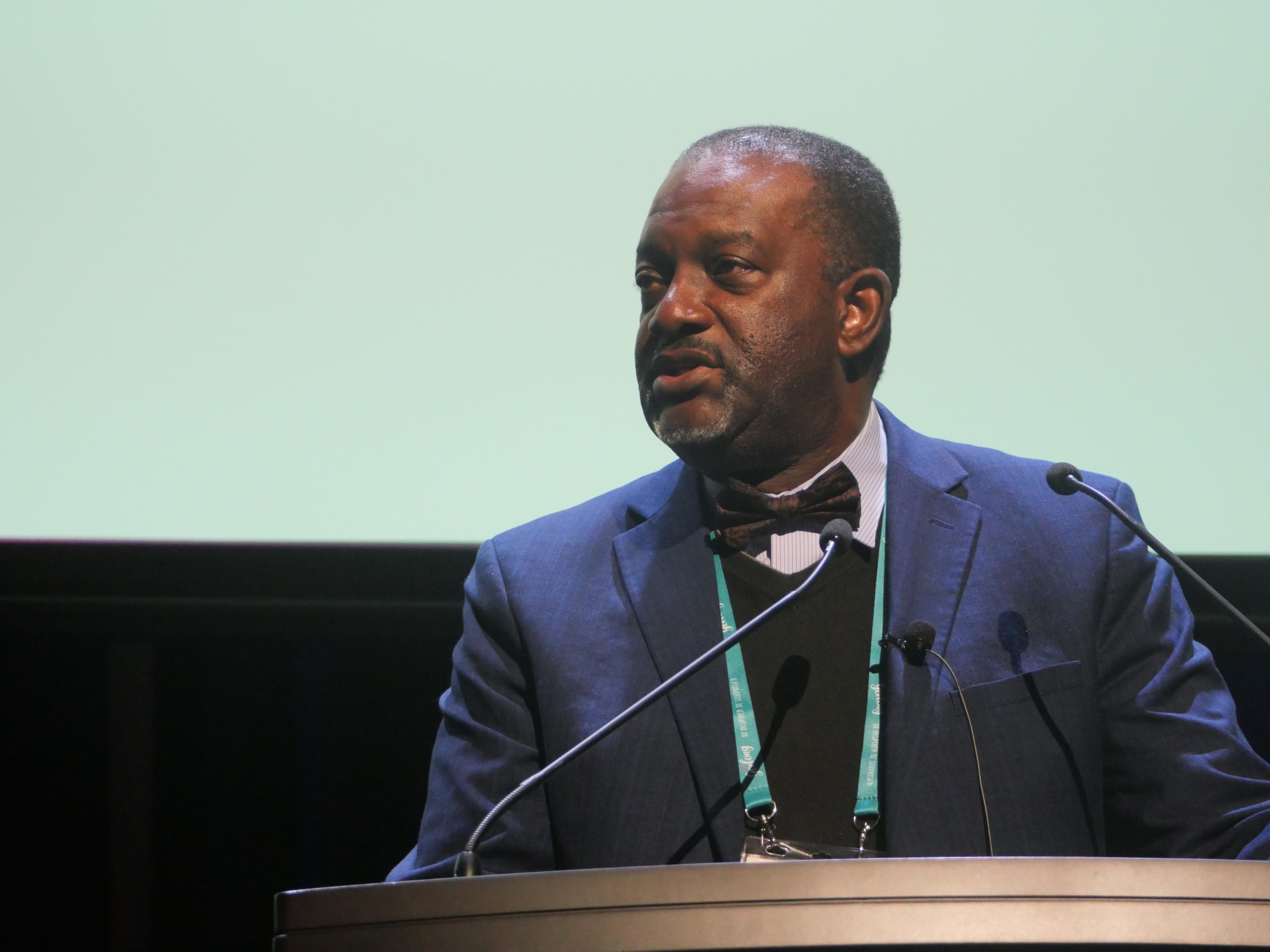
Dr Adegbola Adesogan presenting to the Societal Role of Meat conference.
“In many parts of rural Africa and Asia, our people are vegans or almost vegans, and this is not a choice,” he said.
“If you think about many of these poor world dwellers, they do not choose diets that are almost devoid of animal source foods.”
Dr Adesogan grew up in Nigeria before moving to the United Kingdom and onto the United States. He said he learnt of the condition of stunting 12-years-ago before it became his life’s passion.
“Stunting is one of the measures of malnutrition. Usually, calories are sufficient but there is a deficiency in micronutrients,” he said.
“It cripples the development of children’s physical stature and their brains. It is intergenerational, it increases the risk of non-communicable diseases and World Bank researchers have shown that if a country’s workforce is predominantly made up of people who are stunted in childhood, the GDP of that country is penalised by 7pc on average.”
The highest rates of stunting in the world are in Sub-Saharan Africa and South-East Asia, however, it is also prevalent in first world countries – with 3.4pc of children having it in the United States and 2pc in Australia.
“When we think about the crippling effects of this condition on the cognitive development of a child, even the 2pc level in Australia is too high,” Dr Adesogan said.
Meat is more than just protein
While there several factors that contribute to the prevalence of stunting like poor hygiene, Dr Adesogan said there was one item that was best at controlling it.
“Animal source foods are the best food item for reducing the risk of stunting,” he said.
 “There are other factors, but from a food standpoint, animal source foods are such a breath of fresh air. One of the key aspects when we’re thinking about cognitive development of infants is how readily those micronutrients can be supplied to the developing brain and this is where the concept of bioavailability of micronutrients comes in.
“And if you look at the animal source foods, not only do they have higher concentration of those micronutrients that are essential for cognition, but they have greater bioavailability and they are the most natural forms.”
Dr Adesogan said it was time the meat industry started marketing its many nutritional benefits – rather than just protein.
“Many of us like spinach, but I don’t know if you’re going to eat 2.5kg of spinach to get your iron needs met. Whereas with liver, just a small amount can satisfy your iron needs,” he said.
“I have started talking to my friends in the meat industry in the US and telling them that we need to be careful about using the term animal protein because, if we do, we create the impression that what we are supplying from the animal foods is mainly protein.
“But protein is just one of the key nutrients that are supplied. We have started calling them ‘brain superfoods’ and I think this helps with the discourse about the societal role of livestock.”
(See more about the Societal Role of Meat Conference on last week’s episode of The Week in Beef)
Meat improved academic performance
Dr Adesogan referred to a study of school children in Kenya, which found an improvement in academic performance when a little bit of meat was added to their diets.
“They were fed diets based on beans and corn, so they had plenty of calories and they had protein,” he said.
“But what the researchers were trying to do was to see what would happen to the exam scores of the children if they added a little bit of meat or milk to the diet.
“And what they found was that meat addition, just a matchbox size, improved cognitive performance, test scores, physical activity, leadership behaviours, milk supplementation, growth and B12 status. Averaged across two years, test scores increased by 45pc when meat was supplemented and by 28pc when milk was supplemented.”
Busting taboos against meat
Taboos against animal sourced foods were a big topic in speeches about the role of meat and livestock in third world countries.
Dr Adesogan said there were many examples of cultural factors that were limiting exposure to animal sourced foods across the world – from African kids being told that if they eat animal sourced foods they will become thieves when they get older to Meatless Mondays, which has grown across the developed world.
He said some interesting work was done with a $70m grant from USAID and The Gates Foundation trying to break some taboos about animal sourced foods.
“My colleague wanted to break that taboo that if children eat eggs, they will become thieves as adults.
“She succeeded by working with women, providing jingles, working with influencers – I don’t have the time to describe how she did it. She broke this taboo so much so that at the end of her study, the children within the intervention group were eating six eggs/ week.
“Women’s empowerment was increased because when the men who are receiving eggs from the gifted hens were saying ‘let’s sell these eggs’ the women for the first time refused and said ‘no, look at the difference the eggs are making to our children’.
“This made the national news in Burkina Faso.”
Dr Adesogan is clearly a man of great intellect, passion, and integrity. The world is very fortunate to have humans like this on our side.