
AGRIBANKER Rabo has this morning issued an Australian beef forecast for 2027 suggesting both production and exports will increase by another three percent in 2027, on top of record levels seen in 2026.
Rabo’s forecast for next year is the first released since the recent significant rain event that has delivered good falls across large areas of cattle country in both northern and southern Australia.
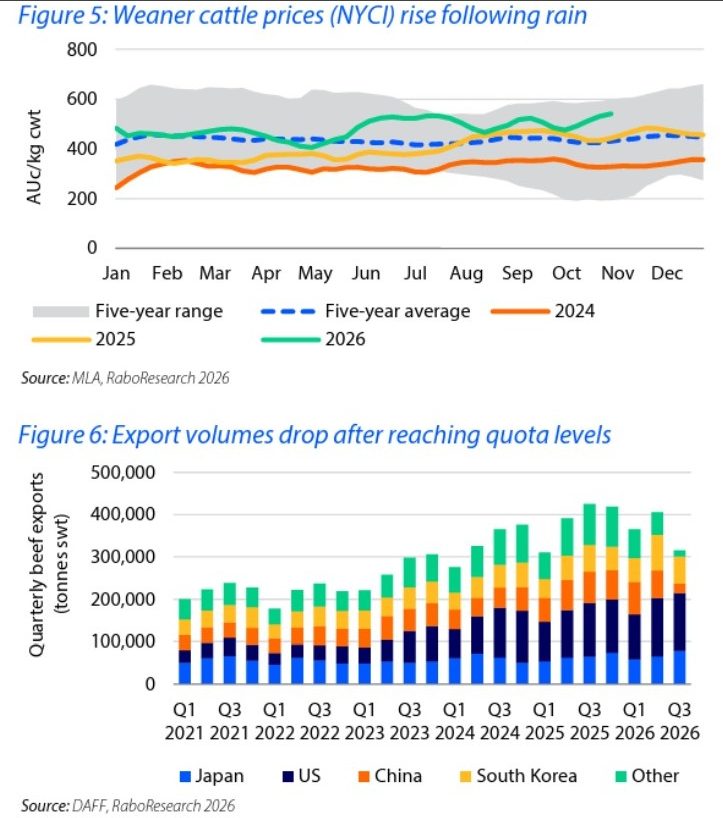
The forecast contrasts with Meat & Livestock Australia’s projections for next year suggesting both production and exports will be down.
MLA’s most recent (September) Industry Projections Update had 2027 beef and veal production at 2.914 million tonnes, down 109,000t or 3.6pc from record 2026 levels. MLA suggested beef exports next year would reach 1.58mt shipped weight, down from record 1.646mt estimated for this year (although that 2026 figure now looks highly unlikely, given the sharp decline in processing activity since recent rain).
To be fair, however, MLA’s projections were made prior to the more recent rain events, and underpinned by pessimistic BOM forecasts for summer rain.
However, the possibility of drier seasonal conditions and changing trade arrangements could still temper the Australian market, the Rabo report conceded.
Global beef supply declines
Rabo’s forecast for increased Australian beef production and exports next year comes as global supply declines for a second consecutive year.
RaboResearch has global beef production declining by 0.1pc in 2027, after an estimated 1.5pc contraction in 2026.
This would be the first time since 2015 that global beef production has declined in consecutive years, the report’s lead author, senior animal protein analyst Angus Gidley-Baird said.
Australia’s beef industry was expected to enter 2027 from a position of considerable strength, he said, after managing high cattle numbers, variable seasonal conditions and changing trade flows during 2026.
 “Australia has been able to turn a large cattle inventory into record beef production and exports, while cattle prices have remained strong, and that provides a solid platform heading into 2027,” Mr Gidley-Baird said.
“Assuming drier seasonal conditions and given the large cattle inventory, we expect slaughter numbers to rise by around 3pc next year. With carcase weights likely to plateau as more grassfed cattle enter the system, we are forecasting beef production to rise at a similar rate.” he said.
Strong overseas demand had helped the Australian cattle market absorb the increased production through 2026.
“Processor cow prices have traded at historically-high levels for much of the year, reflecting strong US grinding beef demand, while young cattle prices have responded more directly to seasonal conditions,” Mr Gidley-Baird said.
“The central issue for 2027 will be the impact of the El Niño weather pattern. If conditions become dry early in the year, we could see larger numbers of cattle coming onto the market, which would put downward pressure on cattle prices and potentially test processing capacity.”
Trade access uncertain
Global beef trade is expected to remain unsettled after what RaboResearch describes as one of the “most protectionist years” for the sector in 2026.
China introduced a 2.688mt tariff-rate quota with allocations for individual supplying countries, while the United States changed market access through additional beef quotas.
Europe suspended Brazilian beef imports over antimicrobial compliance requirements, and Indonesia changed the way it allocates beef imports.
“Trade flows have had to adjust quickly as policy settings have changed, and we expect disruption to remain part of the market landscape in 2027,” Mr Gidley-Baird said.
“Some of those changes should become more predictable as exporters, importers and supply chains gain experience operating under the new arrangements, but access to key markets will remain an important driver of where beef moves and at what price.”
He expects Australian beef shipments to China to remain high in early 2027, potentially exhausting Australia’s quota by around May. Strong shipments to South Korea could also trigger its safeguard measure again, potentially by July.
Brazil, the world’s largest beef exporter, is seeking to diversify its markets as China’s quota arrangements constrain shipments, the report said. As reported on Beef Central earlier, both Japanese and South Korean officials visited Brazil in 2026 and there is a possibility that Brazil may be granted access to these markets in 2027.
US cattle supplies remain tight
Mr Gidley-Baird said US cattle supplies are projected to remain historically tight in 2027, supporting elevated US cattle and beef prices.
“China’s domestic beef production is forecast to decline as its herd rebuild continues, while its beef imports are expected to recover by around 3pc following an estimated 10pc fall in 2026,” he said.
Consumer demand remains key to US market support
Domestic US beef consumption is forecast to ease 1pc in 2027, with consumers more likely to trade among beef cuts, formats and retail channels than shift decisively away from beef to cheaper protein options, Rabo says.
“Affordability pressures are rising, yet resilient demand should continue to absorb limited supplies at elevated prices,” Mr Gidley Baird said.
However a recession or larger than expected supply increase are the primary downside risks in the US market, while stronger heifer retention could prolong the high price cycle.
In China, beef prices have risen steadily since May, up about 9pc year-on-year in September, off the back of contracting supply. Domestic beef production was down 0.7pc year-on-year, while slaughter numbers fell 3pc, with domestic Chinese production likely to fall a further 1-2pc in 2027.
Rabo anticipates that next year, quota utilisation among exporting nations supplying China, and China’s degree of willingness to absorb higher import costs will become important factors.
Tight supply puts affordability in focus
Australia and New Zealand are expected to record the strongest production growth among the major beef-producing regions, the report suggests, with growth of 3.5pc for Australia and 8.8pc for New Zealand, compared with declines of 3pc for Brazil, 1pc for the EU27 and UK, and 1pc for China.
US production is expected to be relatively flat.
“Global beef availability remains tight and, in a number of markets, cattle and beef prices are already historically high,” Mr Gidley-Baird said.
“Another year of constrained global production means the industry will need to carefully manage supply-chain costs and margins, while recognising there is a limit to how much additional cost consumers will be prepared to absorb.”
The report says beef prices have reached record highs across many regions. It also notes the FAO beef price index was 17pc higher year-on-year in May 2026.
The widening price gap between beef and competing proteins is encouraging some substitution towards pork and poultry in some regions, Rabo says.
Mr Gidley-Baird said the combination of limited global supply and Australia’s comparatively strong production outlook should continue to create opportunities for Australian beef exporters in 2027.
“That is a positive position to be in, although the El Niño weather pattern, consumer affordability and trade settings will ultimately determine how the year plays out,” he said.
HAVE YOUR SAY