A YOUNG cattle industry leader has challenged the beef industry to get more involved in online comment sections to correct misinformation, while senior industry leaders have pledged to lift their own games in the social media space.
It has been said before that every problem is ultimately a communication problem.
That thinking encapsulated one of the key themes to emerge from an engaging discussion between senior and emerging beef industry leaders at the recent Cattle Connect conference in Wagga Wagga.
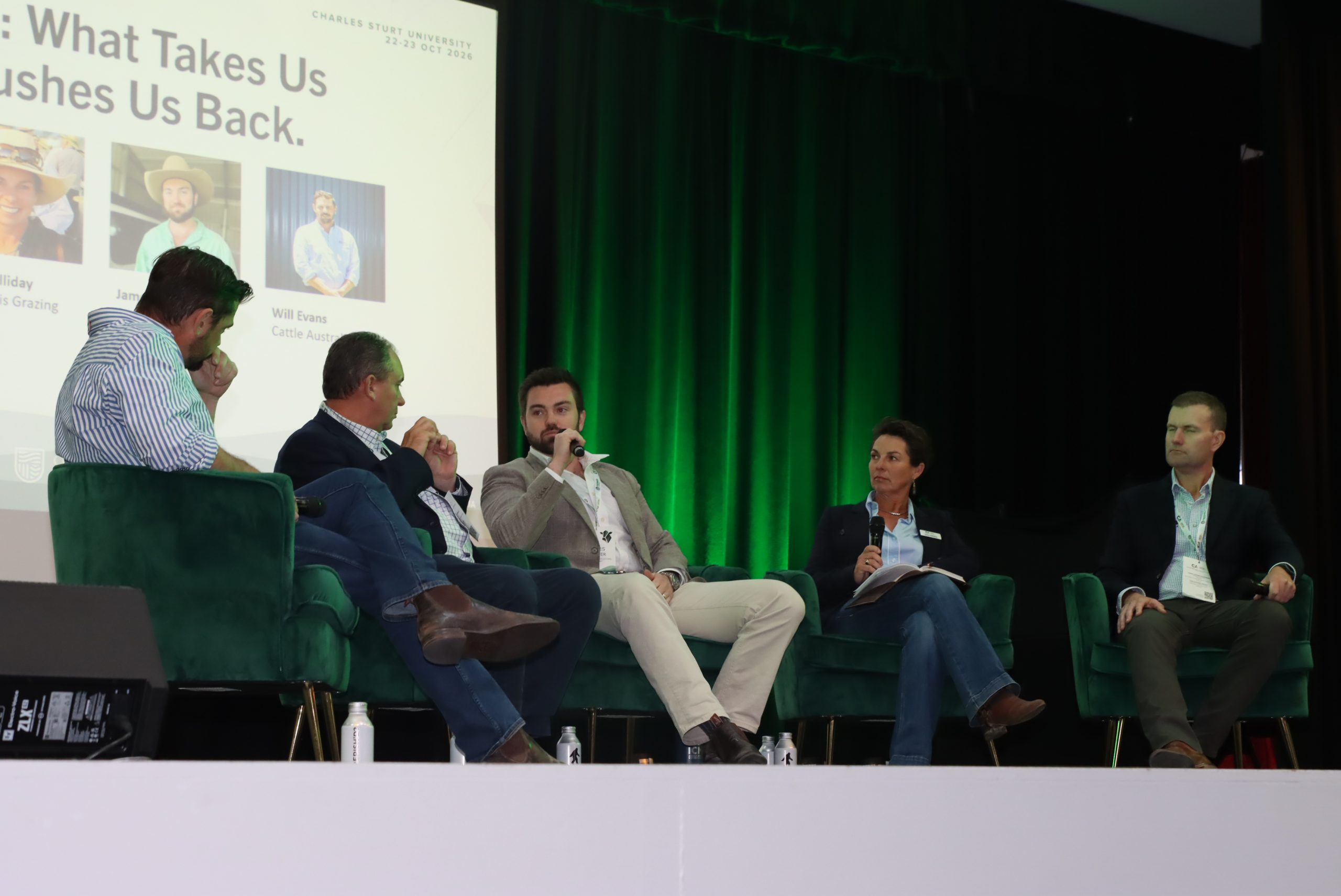
The Cattle Australia conference concluded with a panel session moderated by CEO Will Evans which brought together Cattle Australia chair Garry Edwards, prominent stud Angus breeder and newly elected CA board member Erica Halliday, Meat & Livestock managing director Michael Crowley and Australian Agricultural Co processing manager and Nuffield Scholar James Carter.
The panel reflected on the day’s discussions, identify the challenges they would most like to remove, and consider where the industry should focus its efforts next.
While the conversation covered issues ranging from market access and succession planning to technology adoption, profitability and carcase yield measurement, it repeatedly returned to a common theme: the question of how can the beef industry communicate more effectively, both with the wider community and with its own stakeholders?
And, perhaps more importantly, who is prepared to do something about it?
“Get into the comments section”
Rising industry leader James Carter challenged producers and industry representatives to become more active in online conversations, particularly when misinformation about agriculture was being circulated.
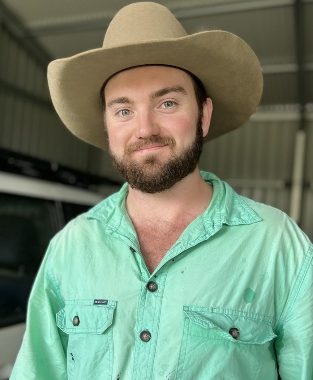
James Carter
He said the industry could not afford to leave negative or misleading commentary unchallenged.
“I look at an article that comes out online in the news that has got a negative tint on agriculture, and I see all these comments from people who have absolutely no idea what they’re talking about, but none of us are commenting trying to push back with the facts,” he said.
“I think it is on us to be in those comments sections when those things pop up and defending it.”
Mr Carter said social media provided an enormous opportunity to reconnect consumers with agriculture, particularly as the divide between urban and rural communities continued to grow.
He recalled bringing friends from the city to his family’s farm and being struck by how little they knew about food production but also their interest in learning about it.
“Had all my mates come down to the farm last year for the first time and it was pretty incredible how amazed they were at how everything worked,” he said.
“Bringing those influencer people in we have got to be so open, it is amazing just what word of mouth does.”
Earlier in the day Michael Crowley outlined how MLA was been actively working with social media influencers to help the industry to connect to reach large audiences outside agriculture.
Mr Carter said there were also opportunities for people in the industry to show the public what happens throughout the beef supply chain, including the meat science and animal welfare practices.
“I think we’re all ambassadors of the industry. We just need to start showing our good news stories.”
Industry leaders accept the challenge
Mr Crowley said industry leaders also needed to be willing to embrace non-traditional communication channels and acknowledged that he personally was challenging himself to do more.
“I am doing some training at the moment and getting some coaching because I need to do a better job,” he told the audience.
“In my role I need to be more visible than I am so I am challenging myself around that.”
He also stressed the importance of consistent messaging across the industry.
 “I guess what we need though is to make sure we’re relatively on the same page with the message we’re telling.
“And then you have that message with many voices. That becomes really powerful.”
Cattle Australia chair Garry Edwards also described his recent experience entering a Facebook discussion about the cattle transaction levy review.
He said he had spent several hours responding to comments, only to find himself subjected to criticism from fellow producers for attempting to explain the facts.
The exchange continued until other producers joined the discussion and began supporting the facts he was putting forward.
“And I guess this is the challenge, because I have never done that before,” Mr Edwards said.
“And the reality is if we aren’t prepared to tell our stories and cop some of the crazy assertions, because there are all these preconceived folklore ideas, it is a big challenge.
“And in the absence of us providing facts, the space is just filled by whatever information is put in there.”
From defending to explaining
Newly elected CA Board member Erica Halliday is already “walking the walk” with more than 16,000 followers on social media.
She suggested the cattle industry stakeholders also consider how they approach dealing with industry criticism on social media.
“I think we need to change our attitude a little bit from saying they are attacking us to they don’t understand us,” she said.
“And it is our job to explain it.”
Ms Halliday said some of her most successful online content involved simply explaining everyday farming practices, including animal welfare and the realities of livestock production.
She argued the industry needed to reach beyond its traditional audience rather than continually communicating with people already familiar with agriculture.
“We don’t need to preach to the converted,” she said.
“We need to get to the masses and the best way to do that is to inform and educate the story that we have.
“It should be easy, it is a great story.”
Earlier, when asked by panel moderator Will Evans which single challenge she would remove from the industry if given the opportunity, Ms Halliday identified negative public perceptions of beef’s contribution to climate change.
“I actually see the elephant in the room, which is still the public around the world that are pointing their finger at beef as being the bad guy in terms of climate change.
“So that’s the one that I would take off the table with facts, and also championing farmers again, going back to the noble thing that they do, which is creating one of the most nutrient-dense forms of protein on the planet.”
Opening the farm gates
Mr Edwards has often stated that people in the cattle industry need to get “comfortable having uncomfortable conversations” and reiterated that viewpoint at Cattle Connect, urging people to overcome their traditional reluctance to promote themselves and their industry.
He argued that agriculture has become too accustomed to allowing negative stories about drought and hardship to dominate public perceptions, while failing to highlight the successful businesses, innovation and the opportunities available in regional Australia.
“We are too humble as a sector and unashamedly we don’t tell these stories,” he said.
“If we have to get control of this image then we have to change the messaging.”
That would also mean becoming more willing to invite outsiders onto farms and into agricultural businesses.
“For decades we have been told to shut the gates and keep people out,” he said.
“If we want to change this, we’ve actually got to open the gates and let people in.”
Mr Carter highlighted education as another important opportunity, pointing to initiatives he had seen overseas that brought agricultural experiences directly into schools.
“One thing that stood out for me was in Denver they have an amazing system of education into schools,” he said. “Think of Healthy Harold that that comes to our schools, they have an agriculture van that comes to schools, and a mini dairy and things like that.
“It’s an amazing initiative which we could potentially bringing to Australia now, and I think about the work ACC (Australian Country Choice) and Anthony Lee is doing (promoting more agricultural education in schools).
“I look back at when I was at school – teachers are such a big impact on you and I think it is really important that we get onto these guys early and teach them about the great opportunities the ag industry has.”
In an illuminating follow up response, Mr Crowley said MLA has done a lot of work looking at where the actual weaknesses are that stand in the way of greater agricultural education in class rooms, and they had identified one specific problem in particular.
“One of the big things that stood out is there is a lack of confidence among teachers to teach agriculture,” he said.
“So the curriculum was actually in pretty good shape. It can be improved, we can have different delivery mechanisms, we can do the virtual truck classroom stuff, that is really important but it is hard to scale.
“Students actually want to know, so how do we give teachers more confidence?
“I was blown away by that. And there’s just not enough teachers that also come from an agricultural background, so that is also something for us to look at.”
Reaching the producers who aren’t in the room
The communication challenge was not confined to the industry’s relationship with consumers.
Mr Edwards said the cattle transaction levy review had exposed significant gaps in the industry’s ability to reach and engage with its own levy payers.
The consultation process, which included face to face visits at many out-of-the-way locations in addition to the larger regional centres, and also included a national online survey, had brought the review committee into contact with many producers who rarely participated in established industry meetings or forums.
“What we need to solve is how do we communicate to those people and how do we engage to get the messages out there that need to be out there, because in the absence of us having the means of accurately communicating people frankly make stuff up,” he said.
“The lack of understanding about how parts of our industry work are astounding.”
Mr Edwards also noted that it was often harder to attract producer attention at times when the industry was generally travelling well, with complacency a major barrier to active engagement.
“It is very hard in Australia in agriculture to get people to engage when people are going okay to good,” he said.
“It’s pretty easy to get them to engage if something is going really bad.”
“We’re on the cusp of something really big here”
Asked where he thinks the industry needs to focus, Mr Crowley pointed to the uptake and adoption of industry research.
The industry had been able to significantly increase the amount of investment made available for adoption and driving practice change through leveraging matching funds for industry research from the Federal Government.
“I just wonder whether we’re on the cusp of something really big here,” he said.
“We can now match private investment to significantly scale up.
“I think this just might become – if we can get this right in terms of where the technology is now at – what I see, we’re seeing generational change on farm, we’re at a point where there’s enough momentum and we can engage that next level of producer who really wants some support to drive some change in how do we de-risk that, because that will help us go a lot faster.”
Stronger on-farm predictor of over-the-hooks outcomes
In terms of where he sees the biggest missing gap, he pointed to the industry’s work to create on-farm tools in extensive production that give producers a stronger predictor of over-the-hooks outcomes of their live cattle.
“Objective measurement on farm is probably a big gap for us.
“We’ve got a lot of ag tech, we’ve got genomics, so a lot of predictability, and we’re remotely monitoring, but we haven’t seen scanning technology evolve beyond ultrasounds since the 80s
“How do we move beyond what we can currently measure, and what are those things that are going to be more material but are going to be cheap and really effective? I think that is the big gap for us.”
HAVE YOUR SAY