
LOWER beef production during October caused by rain disruptions and producers electing to hold cattle back until next year is already starting to impact beef exports.
Monthly trade data released by DAFF this morning shows October beef exports to all markets at 128,836 tonnes. That’s down 3pc from September shipments, and 8pc lower than October last year.
Earlier, it was anticipated that the final quarter of 2026 might deliver a surge in export and production volumes, as conditions started to dry-off in large parts of Australia. However that has not yet eventuated, with the traditional winter lull (especially in southern states) not yet showing signs of lifting. In fact the week before last was the smallest full national production week (no holiday impact) since the January season re-start period, to just over 140,000 head.
That figure is somewhat diluted, however, because Queensland processor Stanbroke no longer contributes its weekly kill stats (typically around 6000 head) to the voluntary data collection.
For the calendar year to the end of October, Australia has now shifted 1.338 million tonnes of chilled and frozen beef into export markets – still up 71,000t on the same period last year, due to the strong start to the 2026 processing season.
 With less than two months of the production year left, and the recent unexpected impact of rain, It’s now looking like Australia’s calendar year beef exports will fall a little short of MLA’s most recent September projections update. MLA’s September forecast suggested a likely export shipped weight for the year of a record 1.646 million tonnes, up 15pc on last year’s prior record 1.546mt.
Since that analysis, however, there has of course been some dramatic shifts in seasonal outlook, on the back of BOM’s pessimistic spring/summer forecast built around the threat of a ‘Super El Nino.’
With most export beef plants due to stop their chains on 17-18 December – just seven weeks away – a full-year export figure a little over 1.5mt now looks more realistic. Further follow-up rain could impact that even further.
Most large export customers showed some decline in trade volume last month.
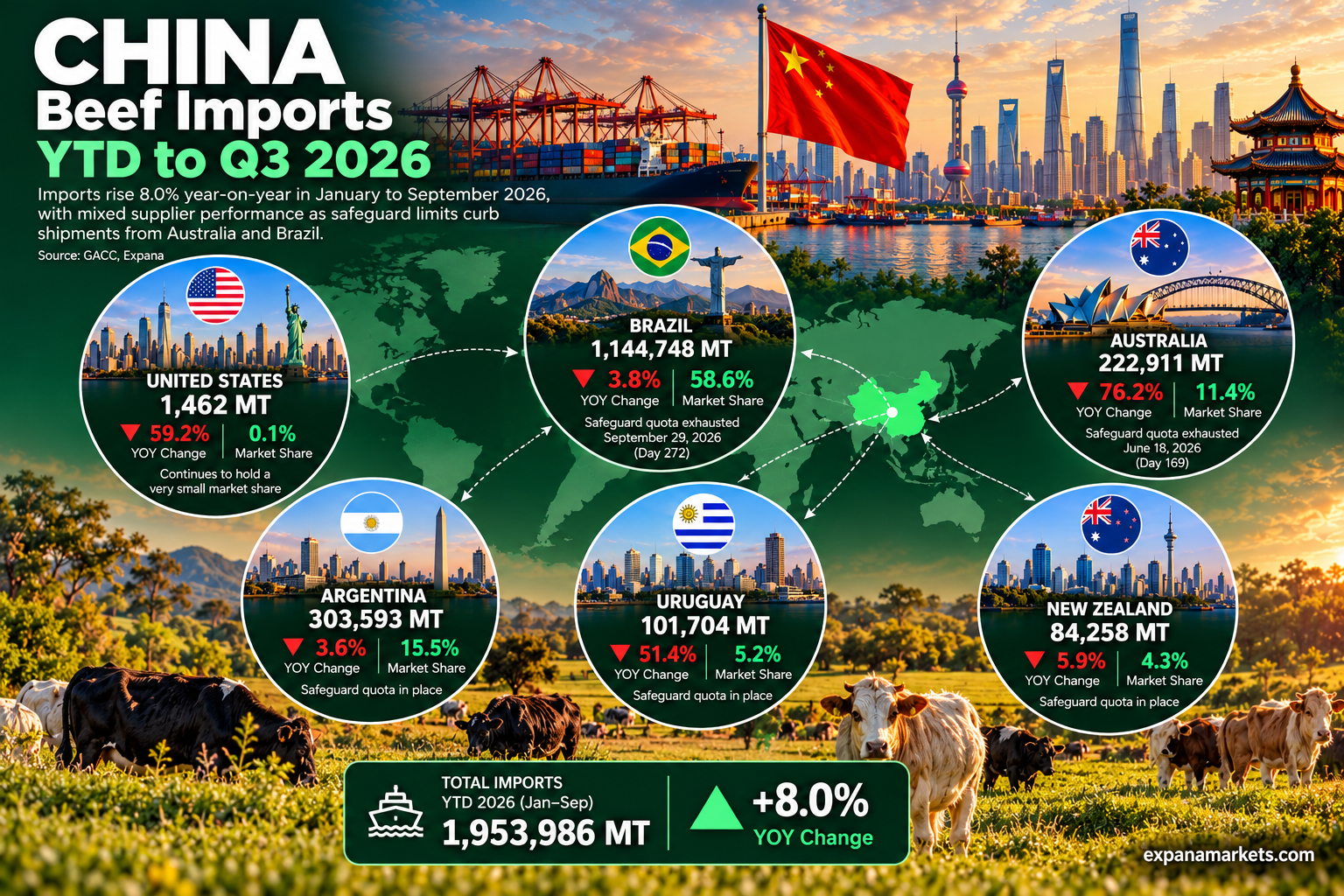
Most seriously impacted was China, which continues to operate at only 20-40pc of earlier volumes, due to the impact of the 55pc tariff enforced in mid June, through to 31 December.
Trade into China last month reached only 10,852t, up about 4000t on the previous month, but still greatly reduced compared with pre-tariff levels. This time last year (the new quotas and tariffs were not announced until early January), China took 20,200t, and the month before that, 24,000t.
Calendar year to date, China has now taken 173,800t of Australian beef (82pc of which was frozen), sharply down on the 223,000t for the same ten months last year.
Low export volumes to China between now and December may mask what is widely anticipated to be record trade volumes in January, as the new quota year kick in and the race starts to fill Australia’s 206,000t tariff-free 2027 allowance. Adding to that, some trade sources are anticipating unusually large chilled airfreight shipments to China during the first couple of weeks of January, to restock storages run down since the 2026 tariff was imposed.
For reader interest, Expana’s Asia Pacific market analyst Junie Lin recently provided us with the following infographic tables plotting Australia’s recent export performance into China, against competitors. We will get into the routine of including some of these in our future monthly export trade reports. Click on the infographics for a larger view.
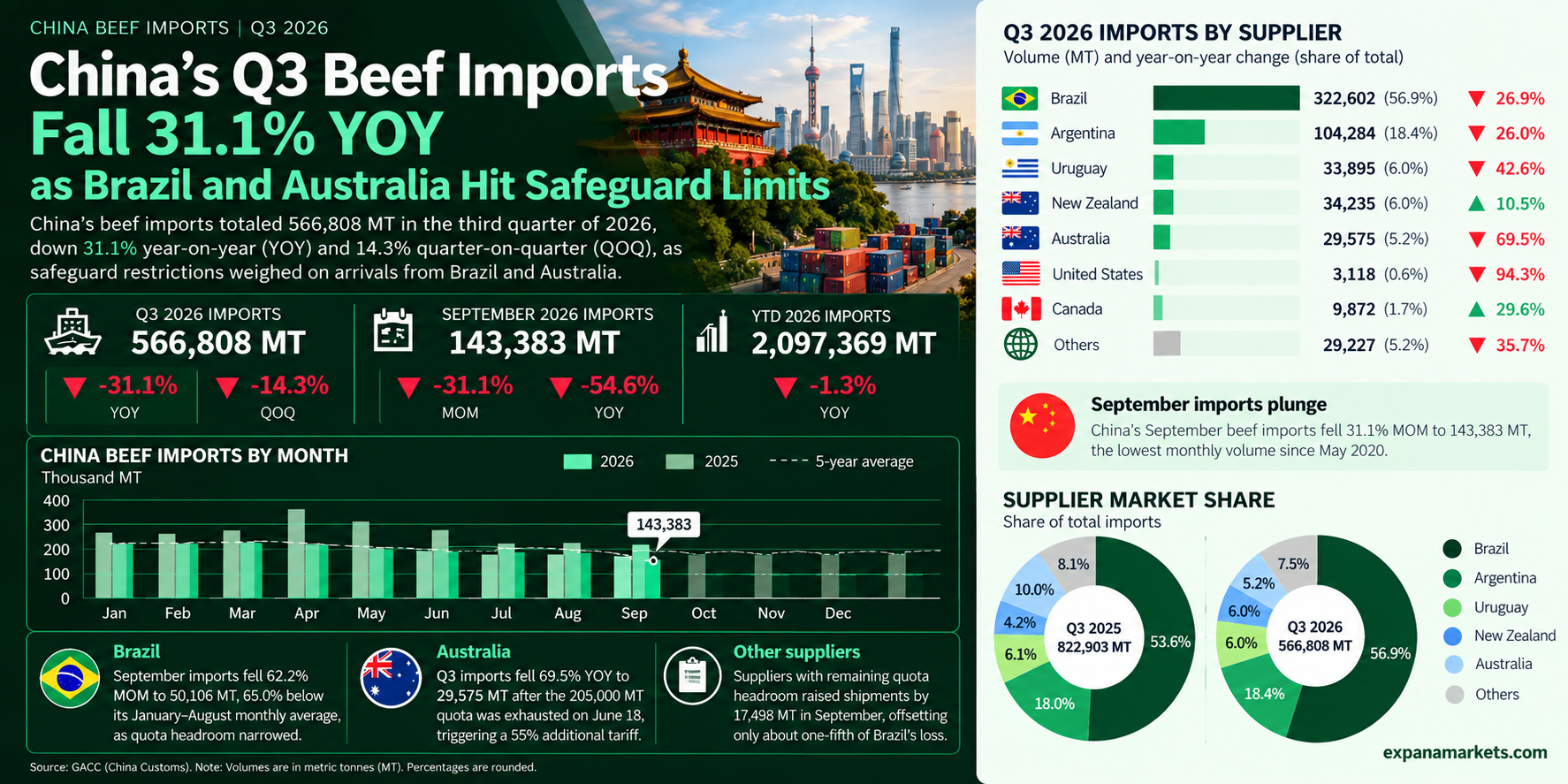
Click on infographics for a larger view
The United States continues to be the largest destination for Australian export beef, including some displacement out of China. The US took 42,981t of Australian last month – that’s down marginally on September volume, but 3pc higher than October last year, when trade was vigorous.
Year to date, the US has now taken a massive 421,565t – the largest ten-month tally ever recorded – up 51,200t or 14pc on the same period last year. It reflects the deep deficit in US beef production due to a cattle herd at 70-year lows, and showing little real sign of recovery.
Among other large export customers, Japan took 22,796t of Aussie beef last month, down 4300t or 16pc on September, and 15pc lower than October last year. For the ten months ended 31 October, trade into Japan has topped 226,000t, up 7pc on the same period last year.
South Korea’s intake of Australian beef last month reached 17,239t, slightly down on September, but virtually the same as October last year. Year to date trade has reached 223,916t – almost identical to Japan – but more than 40,000t higher than the same period last year, in the absence of US exports.
In smaller and emerging markets, beef trade trends last month were mixed.
The United Kingdom performed strongly, taking 1490t, almost all in chilled form. While similar in volume to the previous month, it was down about 25pc from the unusually high 2067t seen this time last year. Year to date shipments to the UK have now reached 17,583t, up 3445t or 24pc on last year.
In the absence of any Free Trade Agreement, the surrounding European Union region took only 753t last month, similar to September, but slightly lower than October last year.
Indonesia took 2754t of mostly frozen Australian beef last month, down about 10pc on September, but a long way from the 5191t exported in October last year. Year to date figures have reached 29,200t, down dramatically from 53,727t for the same period last year.
The Middle East region (nine countries in total) took 5420t in October, up 20pc on September trade, and up by a similar amount on last October. Year-to-date exports have reached 40,887t, up by a solid 7100t or 21pc on last year.
Canada continues to shine as a more recent Australian beef export customer, reaching 6323t last month, a solid 1750t or 38pc on September, and 250t higher than September last year. Year to date trade has reached 49,423t, up another 7100t or 17pc on last year.
HAVE YOUR SAY