
CATTLE transactions at Australian saleyards increased by 7.4 percent in 2025–26, while sheep transactions declined by 11.6 percent, according to the latest annual Saleyard Survey released by Meat & Livestock Australia (MLA).
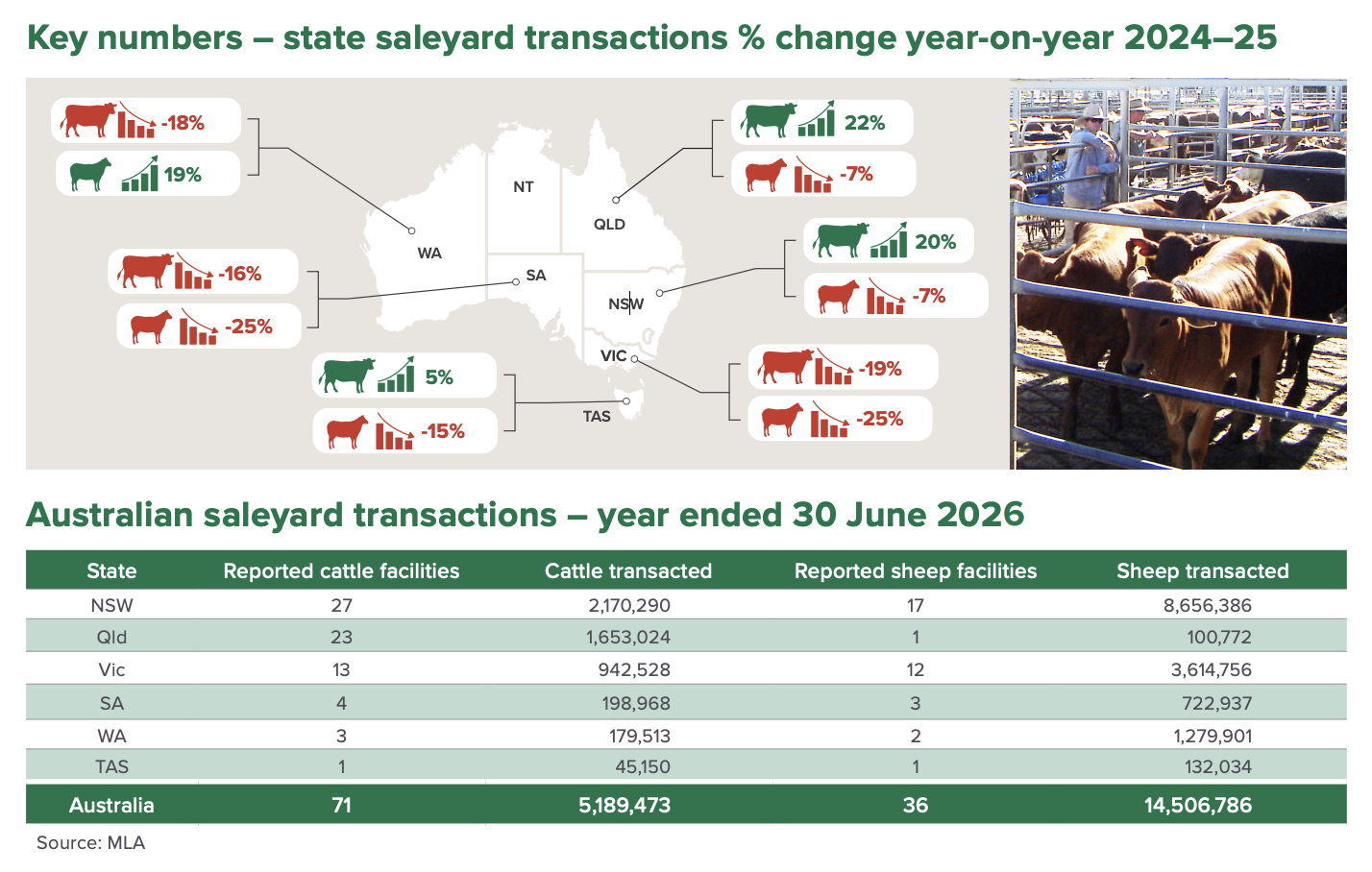
The survey, conducted by MLA’s National Livestock Reporting Service (NLRS), recorded more than 5.18 million cattle and 14.5 million sheep transactions across Australian saleyards in the financial year ending 30 June 2026.
Cattle transactions increased by more than 356,000 head compared with 2024–25, while sheep transactions declined by approximately 1.9 million head.
MLA’s NLRS Manager, Stephanie Pitt said the annual survey provided an important snapshot of livestock movements through Australia’s saleyards, highlighting significant differences in activity between states and livestock categories.
“The latest results show contrasting trends across Australia’s cattle and sheep saleyards, with increased cattle transactions in several key producing states alongside reduced sheep throughput across much of the country,” Ms Pitt said.
“Saleyards remain an important part of Australia’s livestock marketing system, and the annual survey provides valuable insights into how transaction volumes are changing across different regions and selling centres.”
Cattle transactions strengthen in NSW and Queensland
New South Wales and Queensland led the increase in cattle saleyard transactions, recording year-on-year growth of 19.8pc and 21.6pc respectively.
 NSW remained Australia’s largest state for cattle saleyard transactions, with 2.17 million head passing through 27 reported facilities, followed by Queensland with 1.65 million head across 23 facilities.
Roma Saleyards in Queensland recorded the highest individual cattle throughput nationally, with 362,051 head, an increase of 21.5pc year-on-year.
In NSW, Dubbo Regional Livestock Market recorded 313,565 cattle transactions, up 31.8pc, while Tamworth Regional Livestock Exchange increased 38.1pc to 241,244 head.
Elsewhere, cattle transactions declined by 19pc in Victoria, 17.7pc in Western Australia and 16.1% in South Australia, while Tasmania recorded a 5.5pc increase.
Sheep saleyard volumes decline across eastern states
National sheep saleyard transactions fell to 14.5 million head, with declines recorded across most states.
NSW remained the largest state for sheep saleyard transactions, recording 8.66 million head, down 6.5pc year-on-year.
Victoria recorded the largest proportional decline among the major sheep saleyard states, with transactions falling 25.3pc to 3.61 million head, while South Australia experienced a 25pc reduction to 722,937 head.
Western Australia was the exception, recording a 19pc increase in sheep transactions to 1.28 million head, supported by increased throughput at Katanning and Muchea.
Wagga Wagga Livestock Marketing Centre remained Australia’s largest sheep selling centre, recording 2.27 million transactions, followed by Central West Livestock Exchange at Forbes with 1.86 million head.
“The results demonstrate that saleyard activity can vary considerably between regions, reinforcing the importance of having reliable and consistent reporting across the industry,” Ms Pitt said.
“Through the NLRS, MLA continues to provide transparent livestock market information that helps producers and other industry participants understand market activity and make informed decisions.”
To view the full 2025–26 Saleyard Survey visit: 2025–26 Saleyard Survey
HAVE YOUR SAY