AUSTRALIA’S $22 billlion grassfed cattle industry needs to properly compensate the people representing producers rather than continue to rely on a small number of volunteers, Cattle Australia chair Garry Edwards told the organisation’s Cattle Connect 2026 in Wagga Wagga on Friday.
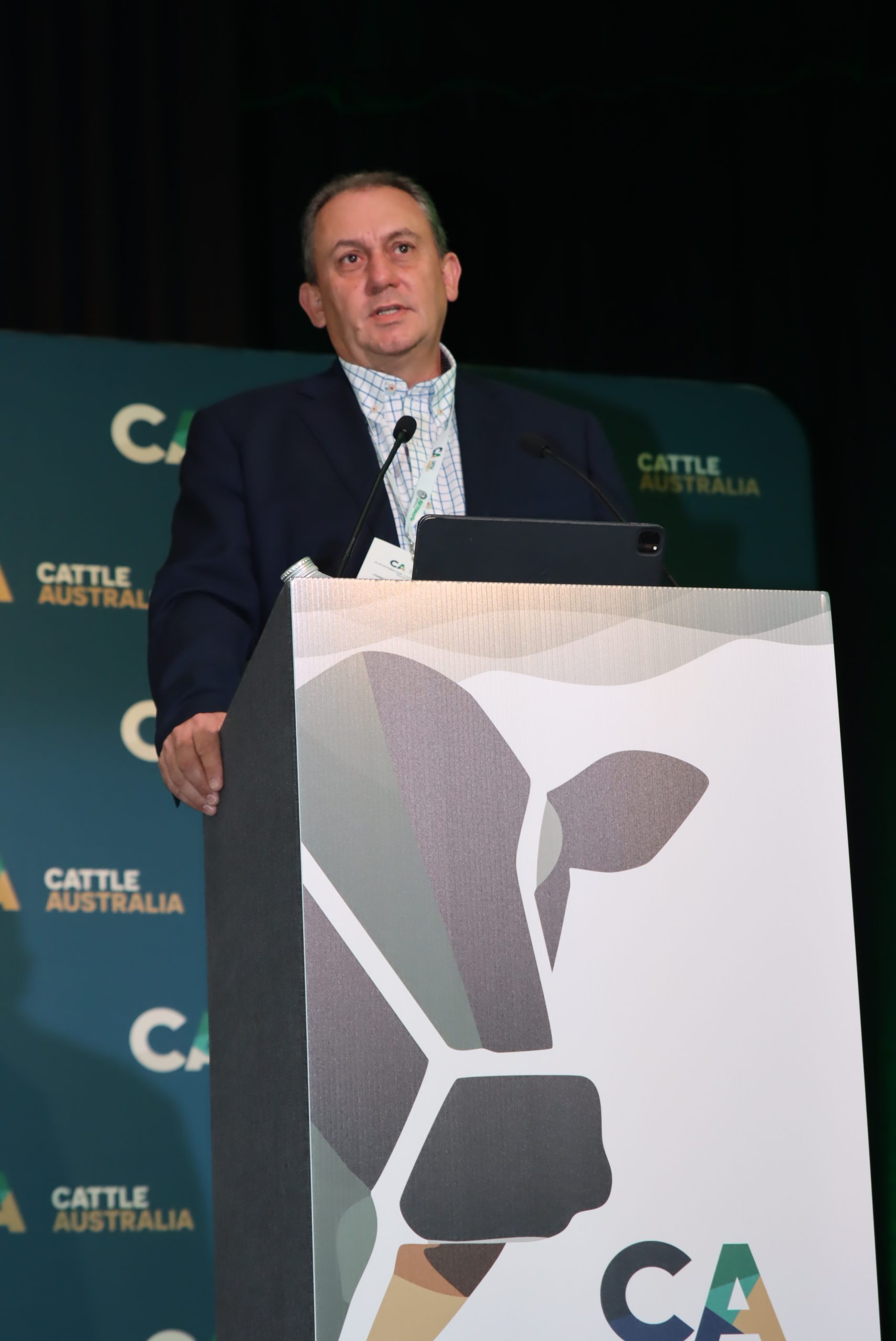
Cattle Australia chair Garry Edwards addressing the CattleConnect 2026 conference at Charles Sturt University at Wagga Wagga on Friday.
Mr Edwards said the industry continues to punch well above its weight, and is currently on track to produce more than three million tonnes of beef in a single year and another possible beef export record of potentially 1.6 million tonnes this year.
These were remarkable achievements for a country the size of Australia, he said, particularly in a year in which prices had been as strong and consistent as they have been in 2026.
“The last time we got anywhere near these type of volumetric records, the conditions were very different – it was a dry period, in fact, extended drought, and we obviously had cattle prices that were materially lower than what they are today.”
But he said an industry delivering record beef production and exports needed to take the resourcing of its representation more seriously.
“When you’ve got a grassfed sector that’s exceeding $22 billion, when you’ve got a whole red meat industry that is approaching $75 billion dollars in economic output, and we rely on so few people to volunteer their time, it’s about time we took this seriously and valued it seriously, and we actually attracted the people and compensated them appropriately for their expertise that they bring to it, because it is genuine expertise.
“It’s not amateur hour in this industry anymore.”
Mr Edwards paid tribute to the many people whose work over decades had helped build the industry’s current success to become the world’s leading premium beef exporter.
None of this had happened by chance, and rested on decisions made over many years through the commitment of people who often went unacknowledged.
“The amount of effort from a small people over decades that’s gone in to support this years is incredible,” he said.
While ‘volunteerism’ had built the industry, it was also a point of vulnerability.
“As I said at CattleConnect in Dalby last year, I do hope that one of the agenda items that we tackle in this industry is the end of volunteerism, because our greatest strength of those volunteers is our greatest weakness.
“We rely on too few people to tackle the interests of the industry.”
Despite the current strength of the industry, he acknowledged that producers remained exposed to rising input costs, interest rates and difficulty finding staff.
“While there is optimism, we do have our eyes wide open.”
“Don’t accept the word ‘no’”
Cattle Australia commenced operations as the national peak industry body representing grassfed cattle producers in November 2022, replacing the discontinued Cattle Council Australia as the prescribed industry representative body.
Mr Edwards said that from the outset new organisation had instilled a culture of “not accepting the word ‘no’.
“No is a word that’s too easily been used as an excuse to justify no action today.”
He said the approach had underpinned a commitment of “working forward to find solutions rather than taking the easy answer”.
The decision to take on an extensive review of the $5/head Cattle Transaction Levy was an example of challenging “long-held assumptions that have been holding the industry back, putting producers back in the driver’s seat and bringing everyone back into the conversation”.
 The levy review, which involved more than 30 face-to-face meetings with producers across Australia during July and August, culminated in a recommendation for the levy be increased by $1/head from July 2028, provided reforms designed to increase transparency and accountability of levy expenditure are completed and in place by that date.
Levy payers have the opportunity to vote on the recommendation leading up to and during the MLA AGM in Townsville next month.
Mr Edwards encouraged producers to support the levy recommendation, but added that, regardless of the outcome, it was his hope that the levy review process has helped to renew producer engagement in their industry affairs.
“So this is a moment, and I guess what we hope is a moment in regards to the changes that’s occurring around the levy hopefully, and even if those changes don’t occur, the fact of the changes of engagement hopefully set us up for better discussions,” he said.
“Because this is the opportunity to lean into some of these challenges and find a way to communicate and look for a brighter future.
“It’s never the fact that the glass is one percent empty. It’s the opportunity to fill it to the top and beyond.
“So this moment won’t come around very often that we have.
“So we are going to celebrate the success.
“And yeah, I am asking you and every one of our producers that are online or across the country, to lean into this and support these changes and these initiatives, because it doesn’t need to be a them and us culture between our levy recipient bodies and our peak industry bodies and industry.
“We have the power to make this the most incredible collaborative relationship and achieve wondrous outcomes, and working together to do that, where we’re all aligned on a single outcome, was where we’ll make the greatest gain.”
Mr Edwards also acknowledged retiring directors David Foote and George King, who had served on the board since Cattle Australia’s formation, for their “absolute commitment and support”, and welcomed incoming directors Jane McMillan and Erica Halliday.
HAVE YOUR SAY