
THERE’S been a sharp decline in the value of Australian export lean trimmings used for hamburger beef this year, falling around 17 percent since January.
With the US desperate for imported beef to fill the void left by a cattle herd still at 70 year lows, some have struggled to understand why prices have fallen as far as they have, at the same time as slaughter cow prices in Australia remain extremely buoyant.
Australian 90CL export price in A$/kg, past 12 months
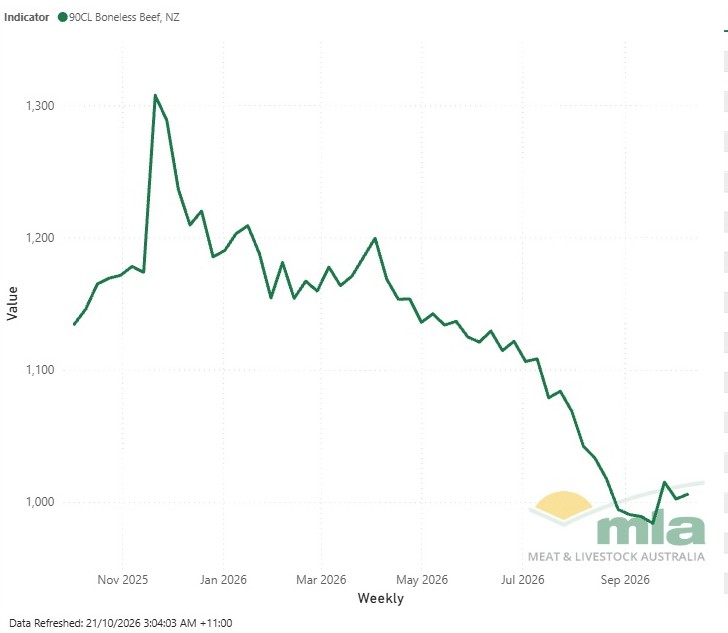
As this graph shows, lean 90CL trimmings being sold into the US last week were quoted at just over $10/kg. This time six months ago they were worth $11.42/kg, and a year ago, $11.65/kg. They peaked in between at above $13/kg.
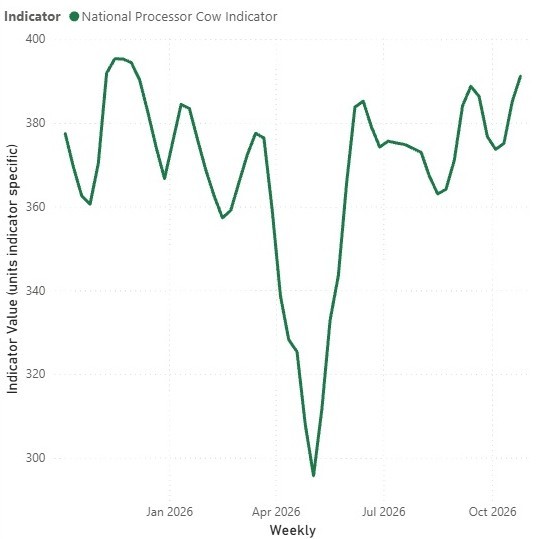
Over the same time frame, the NLRS slaughter cow indicator (see graph below) today sits at 402c/kg liveweight. Six months ago it was in the bottom of a short, deep trough due to drought turnoff in NSW and southern Queensland (see graph), worth 308c/kg, and this time last year, 361c/kg.
NLRS Processor cow indicator c/kg l/w, past 12 months
So what’s causing the big drift seen in lean trimmings values this year, given the demand that’s evident for Australian beef this year at record levels? Overall US beef imports this year are +15pc for Australia (year to date); +35pc for Brazil and +163pc for Argentina.
The first part of the answer is that there’s now ample pipeline supplies of beef heading into the US from South America and slower post-summer food service demand – all weighing on imported prices in the near term, analyst suggest.
Another part is that domestic US cattle slaughter is starting to trend higher again. Fed cattle slaughter is improving as US packer margins are now in positive territory again, while cow slaughter remains below this time last year. Higher non-fed slaughter is expected in November, adding to near-term lean beef supplies.
Steiner’s weekly US imported beef market report produced for MLA says it’s not unusual for a two-tier market to emerge for imported beef towards the end of the year.
“Time of delivery, quota availability and price trends in alternative markets all play a role,” Steiner says in its latest report.
This time around, however, the difference between nearby prices and forward deliveries is even more stark, given the additional imported supply that came into the US during the third quarter.
 This was primarily a function of China’s quotas and tariffs on imported beef, but aided by the additional US quota available to Brazil for September-November.
“Those quotas may not be filled, but Brazilian and Paraguayan product coming in during that period is very competitively priced relative to other suppliers (ie Australia), anchoring prices in the near term,” Steiner’s report said.
“However, as several market participants indicated last week, getting offers for product for delivery in 2027 has been particularly difficult, and significantly higher prices (relative to the spot market) may be needed to get offerings.”
For now, the ample supply of imported product, the seasonal uptick in domestic cow meat production and slowdown in fast food sales has caused lean beef prices to decline at a faster pace than the seasonal trend would suggest, Steiner said.
The average price of domestically-produced fresh 90CL boneless beef last week was US$393/cwt, down 12.5pc since the first week of September – about double the average decline for the same period in the last seven years, Steiner reported.
“And while imported beef continues to trade at a steep discount to domestic, the spread has narrowed, consistent with what we have seen in some previous years.”
Brazilian prices ‘anchoring’ Australian prices
Why would imported beef be valued differently in the fourth quarter this year versus the first quarter of 2027?
“Much has to do with the value of product coming from South America and how that tends to impact other origins,” was Steiner’s response.
“Sharply lower prices for Brazilian product has anchored Australian product, even as Australian beef still trades around US30-35c/lb (about A55c/kg) higher than Brazilian product. As the price of Brazilian product declined last quarter, so did the price of Australian beef competing for orders,” it said.
But with the tariff kicking-in at some point in early 2027, calculations have changed for Brazilian suppliers.
With the 26.4pc tariff for out-of-quota Brazilian product into the US in 2027 likely to fill by the end of January, 10c, 20c and even 30c/lb over current market values may not be enough for Brazilian suppliers, Steiner suggested – hence the ‘extremely quiet’ market at the moment.
“The Chinese beef quota will reset and Brazilian suppliers will once again have access to 1.1 million tonnes of low tariff quota in that market.
As seen also in Australia recently, another factor noted by market participants last week was availability of cold storage in the near term and how that has skewed the market for spot beef product and forward deliveries.
“Some US traders need to secure more product either because of storage challenges or cash flow. But that is not a concern for product that may be available in late January, February or March,” Steiner said.
A week earlier, Steiner said more lean trimmings offerings from New Zealand, especially for bull meat were coming at a time when US buyers are well positioned, at least in the near term.
“US buyer interest is more for later in the first quarter next year, as some of the larger buyers are looking to hedge late winter and early spring. For the moment, pipeline supply is ample and trading is more like pushing on a string, with ever lower asking prices needed to extract any additional bids.”
The steady decline in domestic beef values, especially with more fat trimmings showing up, was adding to headwinds for imports, even as it still traded at a notable discount to domestic supply, Steiner said.
“Still it is important to remember the seasonal factors at play. Lean US cow prices are down and some producers are likely looking at the surge in imports as the reason. The reality is most years, US cow prices in the fourth quarter are the lowest for the year. This year may be no different.”
HAVE YOUR SAY