
Pixabay, Canva, The Conversation, CC BY-NC
AS beef industry groups urge parliament to reject a free trade agreement with the European Union, opinions appear to be more divided in Canberra.
The agreement that was signed by Australian trade minister Don Farrell and European Commission president Ursula von der Leyen in March this year still needs to pass both the Australian parliament and European parliamentary processes to be ratified.
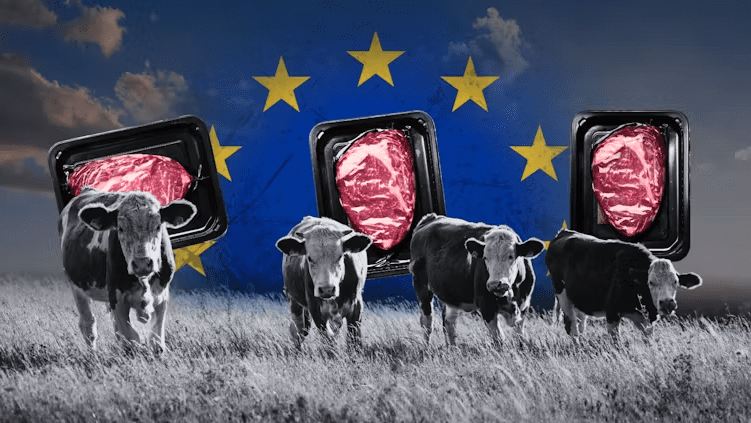
Ahead of the agreement entering the Australian parliament, beef industry groups have urged members of parliament to reject the deal. Cattle Australia chief executive officer Will Evans described the deal as a one-way street, rather than free trade – the main issues is the 30,000t quota for Australian that will be phased in over the next decade.
“To put that in perspective, in the last 12 months Australia exported about 30,000t of beef each week. So after a decade at the table with one of the largest trading blocs in the world, what we’ve gained is roughly one week’s worth of production,” Mr Evans said.
Similar points were made at the recent BeefEx conference, with concerns also raised about the Government cutting the industry out of negotiations to get it signed.
While the beef industry has been firmly opposed to the deal, opinions are varying among other political and industry groups.
Govt attacks the Liberals stance on free trade
The Government is unable to get the deal through the Senate without support from either the Coalition or the Greens.
Looking at its public comments, it has its sights focuses on members of the Liberal party going against their National party colleagues and passing the deal.
Trade minister Don Farrell was in the media over the weekend attacking the Liberal party’s free trade credentials.
“We need the Liberal Party to make a decision based on the national interests of Australia that we make agreements with friends around the world,” he told a press conference at the Sydney Fish Markets.
“Mr Taylor needs to come out and make it very clear that what he said in his maiden speech, that he supports free and fair trade, that he comes on board, he rejects the push by the National Party to keep those tariffs. We get one opportunity at this.”
Nationals leading push against the deal
The Nationals have described the agreement as the “worst deal ever” and have been actively campaigning to reject the deal.
The main issues the Nationals have with the deal are the lack of beef quota and possibility of Europe putting more green legislation onto Australian farmers.
Asked about it on News24 (Formerly Sky News), former leader and now backbencher David Littleproud said current leader Matt Canavan was right in railing against the deal.
“We just don’t sign up to a deal for the sake of signing up to a deal,” he told host Laura Jayes.
“The consequence that we are talking about has significant ramifications about tying Australia philosophically, ideologically, but then physically into much of the climate requirements that the European Union signed up to.”
Liberals divided on the deal
The Liberal Party’s official position at this stage is that it will not support the deal. Shadow treasurer Tim Wilson was asked about his stance on ABC news breakfast.
“We have not seen the legislation, it has not gone to the parliament yet. But we are certainly opposed to it while going through the parliamentary and Coalition processes that still need to be done.
“One of the key things is we want the best outcomes for our farmers. The National Farmers’ Federation is not out there calling for this FTA. Meat & Livestock Australia are not out there calling for this FTA. The trade minister, frankly, has made a complete hash of the negotiations.
“We support free trade and we particularly believe when it advances Australia’s national interest. The problem with the deal as it stands, and the trade minister is the one who signed this, is it’s one that doesn’t advance the interests of Australian agricultural producers.”
Media outlets have been reporting that some Liberal members would privately like to vote in favour of the deal.
Some former Liberal MPs have been more loudly campaigning for the deal to pass, including former Prime Minister Malcolm Turnbull and former frontbencher Mathias Cormann.
European farmers against FTA
In somewhat of a turnup, the agreement seems to have united both the Australian industry and the European agricultural industry in opposition to the deal.
Only the reasons for opposing the deal are the complete opposite. European farm lobby groups have concerns about the quota and are claiming that Australia has lower production standards than the EU.
“This is another deal with a large exporting nation with lower production standards and significant economies of scale. The proposed deal also includes sensitive products such as beef and sheep meat,” said Irish Farmers Association Francie Gorman earlier this year.
“The Australians walked away from an offer of 23k tonnes of beef in 2023. Now we are hearing that the EU Commission is likely to give further ground by offering an increase to 30k tonnes of beef and 20k tonnes of sheep meat as part of the revised draft,” he said.
While the European have expressed concerns about the deal, their bigger opposition has been to a trade deal with South American – which have prompted protests.
Business Council and industry groups support deal
Other industry groups have been supportive of the deal, including the Business Council of Australia, the seafood industry and AUSVEG have been publicly supporting the deal and urging the Coalition to back it.
AUSVEG CEO Michael Coote said supporting the passage of the A-EU FTA is particularly important in the context of the current severe operating challenges facing Australian vegetable growers.
“Even before the severe impacts and production cost surges flowing from the Middle East conflict hit Australian vegetable growers, four in five were telling AUSVEG they would leave the industry if they had a viable exit strategy, because of years of challenging operating conditions.
“Since the commencement of the war in the Middle East, the outlook for vegetable growers has only worsened. Production costs have surged, the consumer cost of living crisis has stifled returns to growers here in Australia, and vegetable export activities to the major Middle East market remain severely disrupted.
“Australian vegetable growers need every market opportunity they can get right now, and the European FTA is one of those rare, and possibly never-to-be-repeated opportunities.”
An academic at RMIT says the discussion about the agreement has become too politicised and heavily focussed on agriculture, while overlooking the broader economic and strategic benefits.
“Australia now predominantly a services economy”
Professor Bruce Wilson, Director, European Centre of Excellence at RMIT said: “The agreement with the EU has been described as the missing piece in Australia’s trade jigsaw. Australian negotiators should be commended for securing this outcome in a very difficult global trade environment.
“Much of the public debate has focused on agriculture and what Australia did not secure. But Australia is now predominantly a services economy, and the greatest opportunities may come from provisions covering business mobility, professional qualifications, digital trade and support for small business.
“The agreement will help Australian businesses gain better access to one of the world’s wealthiest and most sophisticated markets, creating opportunities that extend well beyond traditional agricultural exports.
“It also strengthens cooperation between Australia and Europe in areas such as critical minerals, research, innovation and strategic industries. These partnerships are likely to become increasingly important as the global economy evolves.
“At a time when global trade and geopolitics are becoming more unpredictable, agreements like this provide stability. They deepen economic ties with trusted partners and help diversify Australia’s international relationships.”
HAVE YOUR SAY