
THIS week’s rain event is pressuring supply for beef processors – both short and potentially, longer-term – pushing some direct consignment offers and saleyards markets higher.
As described in yesterday’s weather report, there’s been useful rain across a large patch of Central and Southern Queensland and Northern NSW over the past week, with the prospect of further blanket falls across large parts of eastern and southern Australia over the next eight days (see this morning’s BOM forecast map below.)
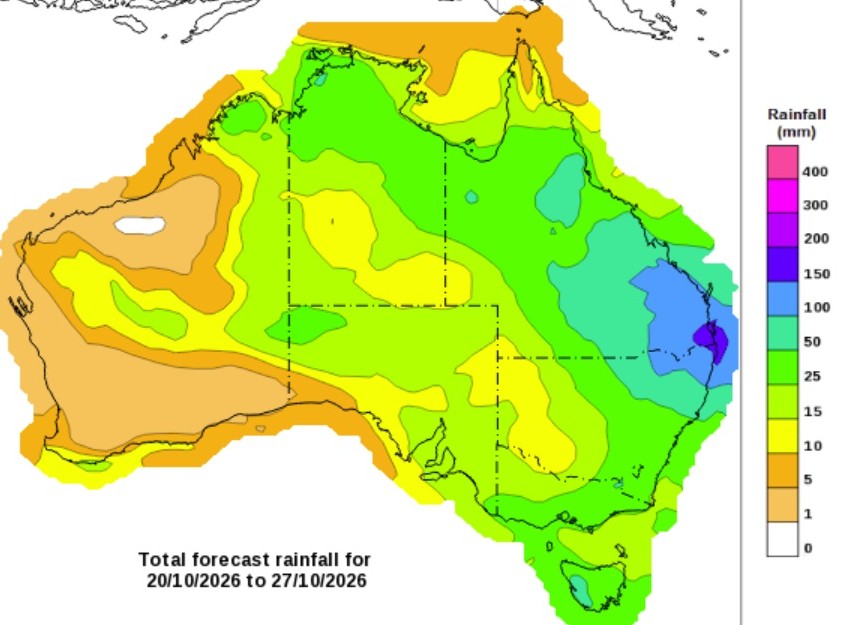
Anecdotal reports suggest Queensland cattle areas around Augathella, Tambo, Alpha, Blackall, Clermont and Ilfracombe saw the best of the recent falls, in place above 100mm. Further south, plenty of country around Roma has had good rain, in place 60-70mm and better.
As a result, many northern processors are now reporting reduced interest from vendors for kills in coming weeks (the 2026 season for many large operators will finish in eight weeks’ time – week ending Friday, 18 December – weather permitting).
Saleyards numbers in Queensland have also retracted, and three sales (Blackall, Clermont and Emerald) cancelled this week due to weather impact. As a result, the general saleyards price trend for meatworks cows and steers is higher.
Some Queensland plants now hold direct consignment bookings only 7-10 ahead, prompting some large operators to lift direct consignment rates 10c/kg this morning to elevate interest. Most of those changes appear to be about re-aligning with competitors who lifted their own grids a week earlier, in anticipation of the rain.
“The phones have stopped ringing a little, but this is hardly season-defining rain yet,” one Queensland processor contact said this morning. “Two or three weeks of hot weather without follow-up, and conditions will start to look ordinary again,” he said.
“But for those who have had solid rain, some may now elect to hold those ‘half-baked’ cattle back for kills early next year, to add weight. So much will depend on whether there is more rain to come after this event has passed.”
In a more immediate sense, some Queensland processors hold existing large bookings of western cattle that were described this morning as being ‘on the edge’ for delivery, if further rain eventuates. But at this stage no plants are reporting likely lost production time, being able to substitute other cattle (both grain and grassfed) to fill holes in rosters for the time being.
Upcoming Butchers’ Picnic holidays for some Queensland export plants will reduce the supply load a little.
Qld grids edge higher
Competitive direct consignment quotes seen for kills in southern Queensland plants in coming weeks have four-tooth grass ox 840c (some quotes plus or minus 10c for HGP cattle) and heavy cows 750c/kg.
Central Queensland plants are either 10c or 20c/kg behind those rates.
In extensive northern and western cattle areas, seasonal cattle work is approaching the ‘tidy-up’ phase, with most second-round musters drawing to a close with the onset of hot weather.
But the old adage, ‘money speaks all languages,’ may yet come into play over the next two months. It’s looking like the next price trend on slaughter cattle in the northern half of Australia will be up, despite the fact that slaughter cattle are a long way out of kilter with export beef markets at present. Weather over the next week will help determine that.
In southern Australia, some grids are up 10c/kg this week.
One large southern NSW grid is this week showing 890c/kg on four-tooth grass ox (no HGP) and 810c/kg on good heavy cows. Eastern regions of South Australia are showing 850c/kg on steers and 790c/kg on cows.
Good MSA steer in southern grids are currently around 900-920c/kg, with MSA cows 800-820c on some grids.
As country starts to dry out from earlier rain three weeks ago, Victorian and SA processors are anticipating more local numbers starting to flow, potentially pushing grids lower.
Weekly kills remain subdued
While NLRS weekly slaughter reports are currently out of sync with our weekly Tuesday kill report, the downwards trend in national slaughter numbers since June continues. The most recent reported week (ending 9 October) was impacted by public holidays, but recorded a national tally of 125,408 head. That’s down about 9000 head on the same week (also holiday exposed) last year.
While processor-ready cattle are now starting to flow in southern parts of Australia heading deeper into spring, it is not yet being clearly reflected in larger kills in Victoria, South Australia and NSW. The past three weeks has seen Queensland kills continue to represent well above 50pc of the national total.
Female slaughter ratio over the past six weeks has sat below the 47pc trigger point that represents the tipping point between herd expansion and contraction – in some weeks, as low as 43pc.
Saleyards channel:
Most northern sales held early this week are down in numbers, following rain, while NSW and Victorian sales edged higher.
Wodonga yarded 1500 this morning, up 300 on last week. Quality was very good with cattle across all classes carrying plenty of weight and finish. The market for heavy cattle was strong with bullocks enjoying the strongest bidding. Competition and price for feeder types was softer. Feeder steers in the medium weight category were limited making from 482-495c/kg, while heavy feeder steers sold from 460-506c. Heavy steers and bullocks suitable for processors sold to solid demand, making from 444-506c/kg. Heavy cows made up a large portion of the offering and bidding was solid throughout. The bulk of the better heavy cows were unchanged to slightly dearer making from 404-429c/kg.
Gunnedah yarded 3750 this morning, up 1400 on last week. Competition was strong, for an overall dearer market. Yearling steers to feed were 30c dearer and more in places, making from 510-656c to average 578c. Processor cows were 10-12c dearer. Score 3 cows made from 380-399c, score 4 prime heavy cows made from 395-424c/kg.
Roma numbers were well back, below 3500 this morning, with much-needed rain in and around the supply district. Yearling steers 280 to 330kg sold from 374c to 696c/kg for the better pens to backgrounders. Yearling steers +480kg made to 490c/kg to lotfeeders. Grown steers 400-500kg sold from 478-552c/kg, and those 500-600kg sold to 490c/kg. Score 3 and 4 cows averaged 389c and score 2s 400-520kg from 344-382c/kg.
Tamworth yarded 1880 yesterday, slightly higher than last week. It was a generally dearer market where prime heavy cows sold to 421c/kg, medium feeder steers averaged 561c/kg and similar heifers 511c/kg. Heavy processor steers sold from 488-501c, cows less than 520kg 382-396c/kg and prime heavy cows 392-421c/kg.
Wagga yesterday yarded almost 4400, up 300 on last week. Cattle quality was a highlight. Most were well conditioned, and even the lighter cattle less than 400kg carried plenty of condition. Competition was strong, particularly for well-bred Angus steers less than 500kg, with restockers outbidding feedlots on occasions. Most cattle bought to return to the paddock were steers, heading to Victoria, Dubbo and Tamworth. Export demand strengthened, with heavy steers to suit processors 500-600kg lifting 7c to sell from 476-514c/kg. Strong competition for bullocks pushed prices up 11c, with most making 450-509c/kg. The cow offering saw heavier cow lifted by 10c/kg, with sales from 388-437c/kg.
HAVE YOUR SAY