
THE impacts from China’s 55 percent tariff on Australian beef export plants since June are continuing to mount, with cold storage access leading to a number of operators dropping production days recently.
Beef Central is aware of at least two, and possibly three export beef plants that have lost production days simply because they have run out of cold storage – either for China, or other markets.
Worst impacted have been processors targeting high quality Wagyu or providing export service kills for other Wagyu supply chains, for which China is a major customer. The majority of Australian Wagyu heading for China is in frozen form.
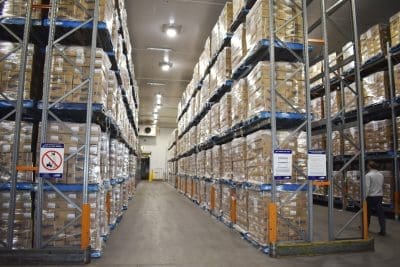 Beef Central has heard one plant is now 2000-2500 head behind its planned schedule as a result of the China cold storage challenges, although we’ve been unable to confirm that. For service kill customers, that means animals held in feedlot pens beyond their designated days on feed, adding to production cost.
The cold storage problem – especially for China-accredited facilities – has been around intermittently ‘for at least the past month,’ one export trade source said yesterday. He suggested that the problem may now be at the point of easing somewhat, as more product starts to leave these shores for delivery into China soon after 1 January (see ‘slow-boat to China’ references below).
It’s arguably the first time since the Port of Brisbane closed to commercial shipping due to Brisbane River flooding events in 2022 and 2011 that beef processors have been forced to halt production due to product building up in cold storage.
Most Australian beef processing plants have only limited cold storage on site, preferring a ‘just-in-time’ approach, shifting boxed meat into external cold storage within days of processing.
Product is now building up to ‘bursting point’ in China-eligible Australian cold storage facilities as exporters and their Chinese customers prepare for relief from the 55pc tariff from 1 January. Until that date, to avoid the tariff, product has to be held in China-approved cold storage – either in Australia or China. In some cases product is spending part of its time in a Brisbane cold store, then transferred to a bonded cold store in China, awaiting the lifting of the tariff, Beef Central has been told.
“They really only have two options to relieve the pressure: either send the beef to markets other than China (often has price implications) or don’t process the cattle until cold room space does become available,” one export trader said this morning.
“Large-scale cold stores in Brisbane, like Americold, are jammed to the eyeballs with frozen product – including a lot of Wagyu, but not exclusively – waiting to escape the China tariff,” the trader said.
While beef trade to China has not completely stopped since the tariff was triggered in June, volume is currently at a dramatically lower level than normal. Exports last month reached less than 7800t, about one third of the volume seen in September last year.
Slow-boat to China: ‘Floating cold stores’
Increasingly desperate Australian exporters and their Chinese customers are using some unusual logistics strategies to keep frozen product moving out of pressured storage in locations like Brisbane and Melbourne.
Contacts in the logistics industry reported container vessels being loaded recently in Brisbane, destined for Panama via the Pacific Ocean – from where they will turn around and deliver the frozen product to ports in China. That’s designed to deliberately extend the transit time to 60 days, in order to arrive after China’s 30 December tariff is lifted.
At least one other container vessel carrying Australian beef from Melbourne is destined for the port of Rotterdam in the Netherlands over the next month, only to turn around and head for China – effectively becoming a ‘floating cold store’, a logistics source said this morning.
Other logistical challenges are being seen, as a result. Empty reefer containers are now coming into short supply, partly due to slow shipping times, but also because of frozen product being stored at port or elsewhere in reefers.
All of this comes at a cost, and are examples of the desperate nature of the Australia-China beef trade at present. The issue has been around for several months, but trade sources approached for this report suggested the worst may now be behind us.
Cold storage infrastructure near Australia’s major beef export sea ports of Brisbane and Port of Melbourne have been under some pressure for years, but the latest China trade distortions have only inflated the problem, Beef Central was told.
On top of that, domestic beef market demand is lacklustre at present, pushing even more red meat into storage.
One NSW processor who toll-processes Wagyu for other clients was aware of the current challenges, but said in his plant’s case, customers had pivoted quickly to find alternative markets earlier this year, relieving some of the pressure.
Compounding the problem for the Wagyu sector is the extremely long days-on-feed in typical feedlot programs. When China announced its surprise 55pc tariff on all Australian beef shipments above 205,000 tonnes back in early January, there were already large numbers of Wagyu on typical 380-400 day programs.
Some of those are exiting feedlots now, at a time when the China market (the single largest customer for many Australian Wagyu exporters) is encumbered with the 55pc tariff.
One large Wagyu processor told Beef Central this morning that if Australia fills its 2027 quota rapidly next year (some stakeholders believe it will be exhausted by Easter) it may see less Wagyu placed on feed for exit during the May-November period 2027.
“The volatility isn’t going to change for Wagyu beef into China. If anything, next year could be worse,” he said.
Adding to challenges, the Middle East conflict in recent months has taken some Wagyu volume business off the table apparently, limiting options to markets other than China and the US.
Holding costs?
So who is up for the holding cost on stored frozen beef scheduled to arrive in China from 1 January, or bobbing around the Pacific on 60-day voyages? Beef Central asked.
“It’s negotiated between both parties,” an export trader said. “If a Wagyu seller had any brains at all, he’d extract a 50pc deposit, or 100pc pre-payment, because smaller supply chains don’t have the capital to hold product like this. It depends on whether that supplier likes to go to the Casino or not.”
New cold storage infrastructure
Having spent time in Brisbane’s cold storage precinct not far from Port of Brisbane this past week, one point in clear evidence is the sheer amount of new cold storage construction going on. While that might help relieve pressure like this in years to come, none of it looks ready to provide any pressure valve this year.
HAVE YOUR SAY