
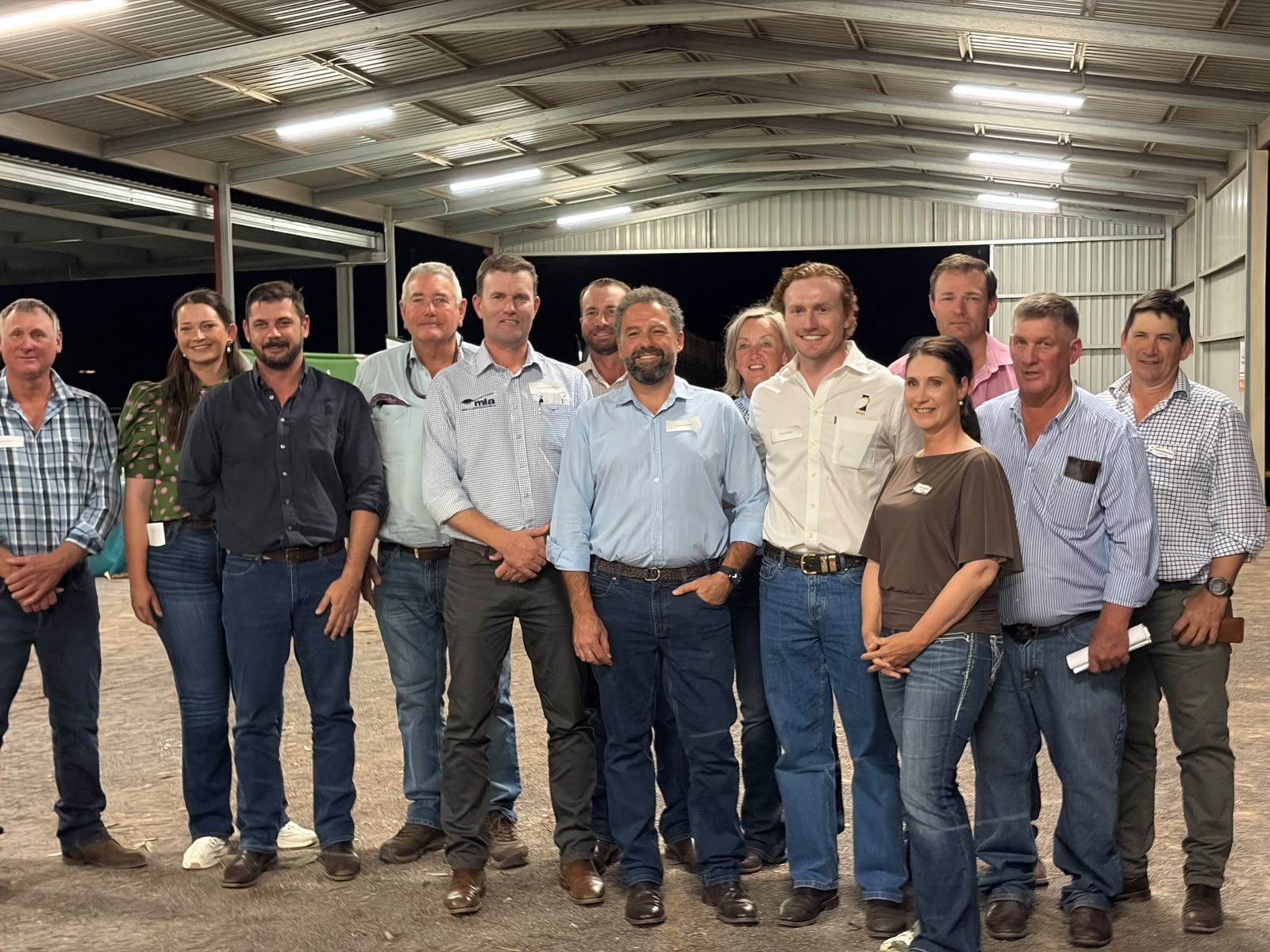
Representatives of the AgForce Cattle Board, Cattle Australia and Meat & Livestock Australia at the 2026 All About Beef event at Cloncurry. Picture: AgForce
GLOBAL turmoil and rising costs have not dimmed the outlook for Australian beef, with market experts telling a Cloncurry cattle forum that strong overseas demand and tightening global supplies should underpin stronger returns over the next two to three years.
“At the AgForce Queensland Cattle Board and Cattle Australia “All About Beef” event in Cloncurry, MLA managing director Michael Crowley and market analyst Simon Quilty each shared their toughts on the market outlook ahead.
The overlapping messages were that strong overseas demand, combined with tightening cattle supplies, should support Australian beef returns and cattle prices over the next few years.
Here are some of the key messages shared across both presentations:
US cattle shortage likely to support Australian beef demand for several years
In response to lower herd numbers the US cattle industry has been feeding cattle for longer and producing heavier carcases, which in turn produces more fatty trimmings which need to be blended with lean Australian beef for hamburger production.
Mr Quilty said recent policy moves by President Donald Trump to reduce tariffs on 300,000 tonnes of imported beef could serve to delay a US herd rebuild by weakening the price incentive producers needed to retain cattle.
“To grow again, the herd needs higher prices, not lower prices, and on the back of that announcement cattle prices fell,” he said.
“I think as a result of this announcement probably delayed the outcome of a rebuild probably for another 12 months.”
In effect this meant Australia’s largest beef market would continue needing imported beef through a prolonged period of constrained domestic supply.
American consumers continue to demonstrate strong demand for beef
It is no secret that US consumers love hamburgers, but even with that knowledge the sheer numbers can still take some comprehending.
Mr Crowley noted that on average each American consumer eats three hamburgers a week, which translates into about one billion hamburgers eaten every week across the US.
More than 200 producers and industry stakeholders attending the NW Qld event. Picture: AgForce
Mr Quilty also pointed to America’s “love affair with protein”, reflected in the fact that US beef demand has continued to strengthen since early 2023 despite record retail prices.
Underpinning that demand was the rise of weight-loss drugs and changing dietary guidelines which were both encouraging more protein in diets.
While the US has been a demand driven market in recent years, Mr Quilty is tipping it to become a “lack of supply driven market” over the next three years if and when the US finally moves into a herd rebuild.
“Prices continue to rise in America as supply falls away (and) with higher American prices, it means higher prices for Australia, because they are our number one competitor globally.
“The result is we’re going to see better returns for Australian beef not just in America but in Japan, Korea, and any where else American beef competes with us.”
Australia “back filling” gaps created by US supply shortage in other export markets
As touched on above, the implications for Australia of the US shortage of beef extend beyond direct sales of Australian beef to America.
Mr Crowley said Chinese retaliation against Mr Trump’s high tariffs last year effectively halted US beef exports to China, from which Australia benefited by being able to fill a share of the gap left by the absence of American beef.
Mr Quilty said Australia was supplying more beef at higher prices as American exports fell.
“Our role has been back filling America,” he said.
“So we have seen into Japan a fall of 27 percent out of America. And who was it that stepped up? Australia with 27 percent.
“Into Korea our shipments went up 50 percent and America’s fell 21 and the same holds in China. Everywhere all over the world, America’s shipments have fallen, and Australia has filled the void, with more beef at higher prices.”
In addition to the US, other key export markets such as Japan and Korea were also facing tightening domestic beef supplies.
Mr Quilty said Japanese slaughter was expected to decline over the next two years, while Korean slaughter and herd numbers have also fallen, which would in turn increase demand for Australian beef to fill the gaps in supply.
Despite tariffs, China’s demand for high-quality beef has not gone away
Mr Quilty also pointed to several signals that suggest China still values and needs Australian beef, in spite of the 55 percent safeguard tariff it imposed on Australian beef trade this year.
Australian beef has continued entering China despite the additional duty, Mr Quilty noted. Australia has continued shipping approximately 6500–7000 tonnes a month after triggering the safeguard in June, serving as evidence of how important particular Australian beef programs remain to Chinese customers despite the higher import costs.
Mr Quilty added that 15 Australian chilled-beef plants received approval in May, about a month before Australia reached its safeguard threshold, another signal China still needed quality Australian beef and wanted access to more suppliers, despite the approaching tariff barrier.
He also noted that China is due to finalise its review of beef imports in November, which could potentially result in increased Australian access, but only time would tell.
Growing South Asian market opportunities
Mr Crowley also pointed to strong longer-term growth occurring in South-East Asia where developing regional economies, large and increasing populations and rising household incomes are underpinning growth in demand.
He highlighted the development of a buzzing food scene in Vietnam, growth in Thailand and Malaysia and Indonesia’s large population and diverse customer base as important sources of continuing and growing demand for Australian beef – and particularly for live cattle in the case of Indonesia.
Tightening Australian cattle supplies
Mr Quilty’s forecast of higher Australian cattle prices over the next two to three years was also centred largely on Australia’s own herd dynamics.
A prolonged period of high female slaughter, particularly in southern Australia, had depleted breeding herds and tightened available cattle supply.
Saleyard yardings were currently falling, an early indication that cattle availability was tightening, and a forthcoming rebuild would mean fewer cattle available for processors and feedlots, while restockers would compete with both for a smaller pool of cattle.
Another key early indicator of a rebuild was the price of vealers. “We see at each previous rebuild young cattle go through the roof because they are harder to find and the market place is trying to shore up supply and they chase vealers”.
He said rising prices of vealers were reflecting that trend, while the reproductive value of heifers would see them probably move to a premium to feeder steers, he predicted.
Feedlot growth to maintain aggressive pace
Both Mr Crowley and Mr Quilty referenced the strong growth in Australia’s feedlot sector, which has seen overall capacity grow from around one million head recently to around 1.6 million head.
Mr Crowley said the expansion was underpinning a rise in Australian carcase weights with the growth in grain feeding helping Austrtalian to produce more beef from its available cattle.
Mr Quilty said he expects to see continued substantial increases in capacity as Australia responds to global demand and tightening beef supplies, offering his own forecast that national capacity will rise to about 2.1 million head in 2028, before growth levels off.
As expansions continue he said the feedlot sector would continue needing Brahman cattle as well as flatbacks.
Based on the prevailing dynamics Mr Quilty said he expects prices to rise over the next two to three years before moderating as rebuilt herds increase beef supplies around 2030–31.
Processing capacity has also expanded
Mr Quilty also noted that increased processing capacity and improved labour availability has strengthened Australia’s ability to take advantage of growing export demand.
Plant builds and upgrades had seen processors add capacity for almost 2000 additional cattle a day in southern Australia and 600 in northern Australia.
Foreign worker availability had also improved he said – During COVID Australia had only 75,000 foreign workers in the country, but today was sitting at near double the number at 126,000.
“So we have both bricks and mortar and we also have the workers,” he said.
Forum brings together northern cattle industry
In total about 200 cattle producers producers, industry leaders and stakeholders gathered in Cloncurry for the All About Beef forum, jointly hosted by the AgForce Queensland Cattle Board and Cattle Australia.
AgForce Cattle President Lloyd Hick said the strong turnout reflected the value producers placed on coming together and looking ahead as an industry.
“Queensland beef has a great story to tell, but we also have some big issues to work through. All About Beef puts producers at the centre of those conversations, giving them direct access to industry leaders and the opportunity to have frank discussions about where our industry is heading.”
HAVE YOUR SAY