
THE gap in the financial performance between the industry average and the top 25 percent of cattle producers has remained consistent over the past three years, even with record high prices and greater price volatility, the latest edition of the three-yearly Australian Beef Report, which has just been released, shows.
Prepared by Bush Agribusiness, the Australian Beef Report analyses the performance of beef producing businesses across Australia, comparing industry performance in the past three years against performance over a 12-year average.
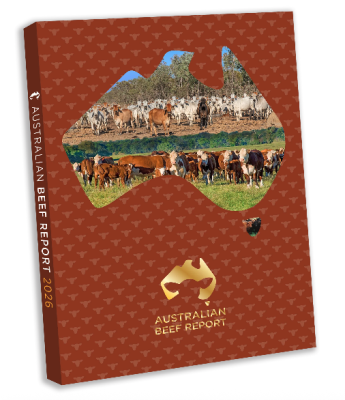
Released every three years, the latest edition is the fourth since the inaugural Australian Beef Report was published in 2017.
As with previous editions, the latest 156-page report draws on data from two primary sources – ABARES annual national farm surveys of specialist beef producers with more than 200 head and Bush Agribusiness’ extensive commercial client base across Australia, some of whom now have 15 years of financial performance data.
By drilling into the factors that separate the top performers, the report provides numerous insights which can be used by industry stakeholders to better understand key drivers that improve beef business performance.
Some of those insights are touched on in this overview article, but to gain the complete picture the full report is now available for purchase from Bush Agribusiness at this link.
According to the latest edition, the three-year period since the last report saw a reduction in profits and profitability across the industry for average and top 25 percent performers in both the north and the south.
“However, the profits in the most recent three-year period are higher than they were for the preceding 12-year period (average and top 25pc, north and south), but profitability was lower, due to higher land values.”
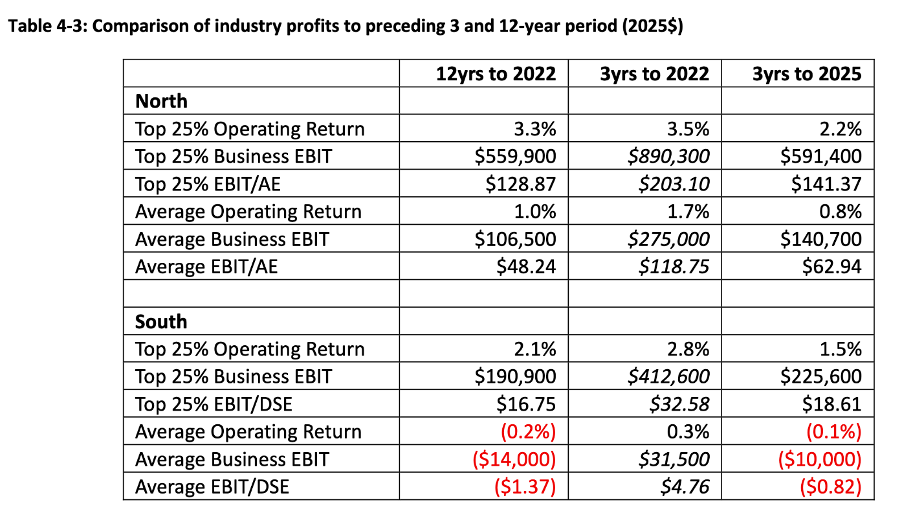
Source: Australian Beef Report 2026, Bush Agribusiness
This was heavily influenced by the “yield compression effect” of rising land values, which occurs where increased asset (land) values mean that increased profits do not result increased profitability.
Land appreciation key driver of wealth creation
The latest data confirms an ongoing trend in the Australian beef industry in which more wealth is created by cattle producers from land appreciation than from beef production.
The average operating return in the south over the last 12 years was effectively breakeven, the report shows, but there has been an average total business return of 5.8pc, all of which has come from increase in land value over that time.
In the north, the average return in the same period is similar at 5.9pc. Within this, 1pc came from operating returns and 4.9pc from land value increases.
“This means on average, all or close to all, of long-term industry returns are from land value increases,” the report says.
This raised questions about the industry’s capacity to fund future working capital.
Overall northern beef business, with average total assets of $18 million, generated an average profit after interest of $73,000 over the three years to 2025. Southern business overall recorded a $40,000 loss, from an average of $11 million in total assets.
This means, as the report points out, that the availability of funds is very limited for the big-ticket, long-term items that need to be funded after operating expenses, such as debt reduction, capital expenditure, provisioning for succession and retirement and expansion.
“Even the top 25 percent with long term average operating returns of 2-3 percent cannot afford to have too much debt before all their working capital is used to service debt and none remains for the big-ticket items.
“The fact that around half of the industry have minimal working capital available after paying their running costs and interest presents a significant risk to the human and environmental capital that they represent of manage.
“If land values were to stabilise, or if there were a correction, then their financial capital would be at risk also.”
Herd productivity is the main profit driver
Focusing on having a productive herd and a competitive cost base is usually the most effective pathway to profits, the report states.
An important message is that higher income explains more of the variation in profit across beef businesses than lower costs do.
“Costs are not unimportant, but income is more important,” the report notes.
“Costs need to be competitive, but the lowest cost is not necessarily the best.
“The businesses with higher income achieve this through more productive herds, resulting in more beef to sell per animal unit, not from higher prices.”
Cost of production often misunderstood
As touched on above the report reinforces the message that cost of production is not always correctly understood.
The report notes that the higher productivity and competitive costs of the top performers result in them having a lower-than-average cost of production, which locks in a higher margin for them through the full price cycle.
While the “cost of production” is a critical measure for all commodity producers, the report argues that that term, and specifically having ‘cost’ upfront, can create a perception that the path to reducing cost of production is to reduce costs.
“For most businesses, this is not the case,” it says.
“Increasing production so that there are more kilograms to spread the costs of the business over is usually the best way to reduce the cost of production.”
“Increasing production so that there are more kilograms to spread the costs of the business over is usually the best way to reduce the cost of production.”
The latest report shows that the Top 25pc of producers by financial performance in northern Australia have a cost of production of $1.79/kg liveweight compared to the northern average of $2.49/kg lw.
In South the corresponding figures for the Top 25pc are $2.35/kg lw compared to the southern average of $3.40/kg lw.
The 2026 report suggests beef businesses should be aiming for a cost of production of less than $2.00/kilogram live weight, and within this, high performing breeding operations should be aiming for $1.50.
“This isn’t an easy target, but is achievable if the business has scale, discipline and an unrelenting focus on herd productivity, targeted herd expenditure and labour efficiency,” the report states.
Scale
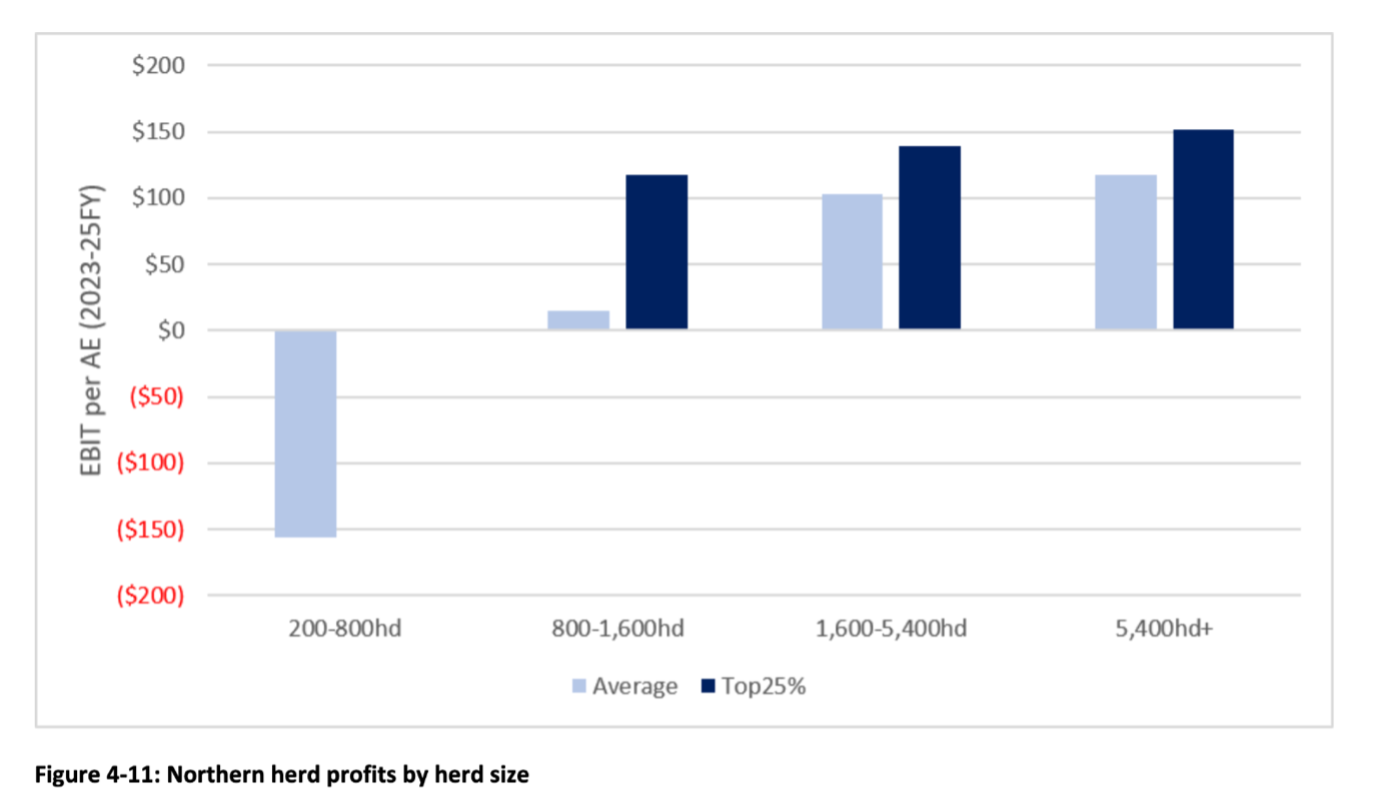
As touched on above, the latest report also continues to highlight the significant role that scale plays in business performance.
Herd profit generally increases with scale, reflecting economies of scale and the resulting reduction in overhead costs per animal unit.
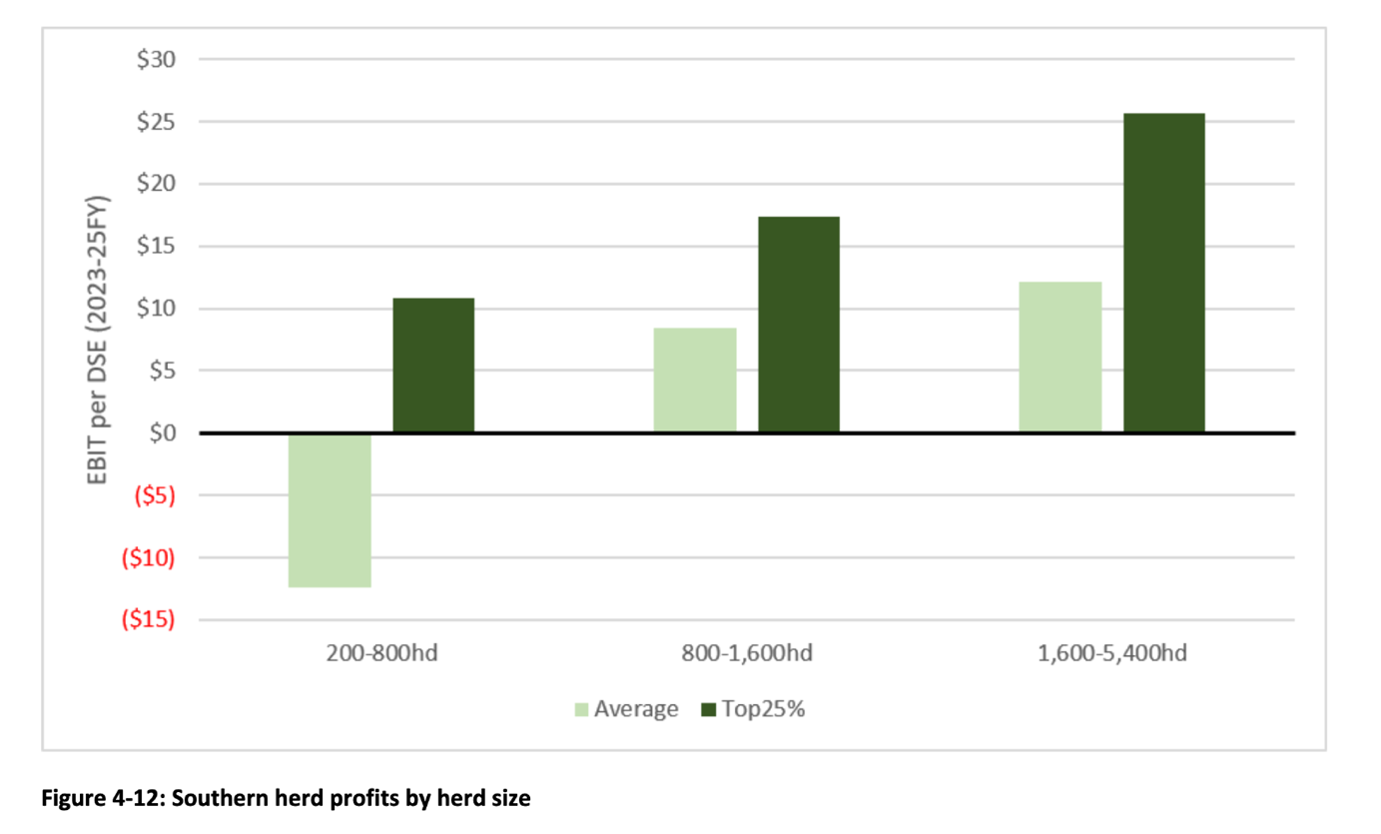
Source: Australian Beef Report 2026, Bush Agribusiness
Source: Australian Beef Report 2026, Bush Agribusiness
“Smaller producers generate higher income per animal unit, which on average is a function of their being situated in more productive regions.
“However, their higher income is consumed by their higher costs per animal unit, resulting in an overall loss.
“Income per animal unit reduces as herd size increases, but costs reduce by a greater amount, resulting in increased profits. “
The report pinpoints operating scale is an industry-wide impediment on performance, with more than 50 percent of northern producers and 75pc of southern producers running less than 800 head. The average performance for that herd side was a loss in both regions.
But importantly it also notes that scale alone is not enough.
An interesting point is that producers in the top 25pc of performers who have smaller herds consistently outperform the average performs in the category of herd sizes above them – reinforcing the point that increased scale must be combined with superior operating efficiency and competitive costs to perform profitability.
Breeding versus growing
Source: Australian Beef Report 2026, Bush Agribusiness
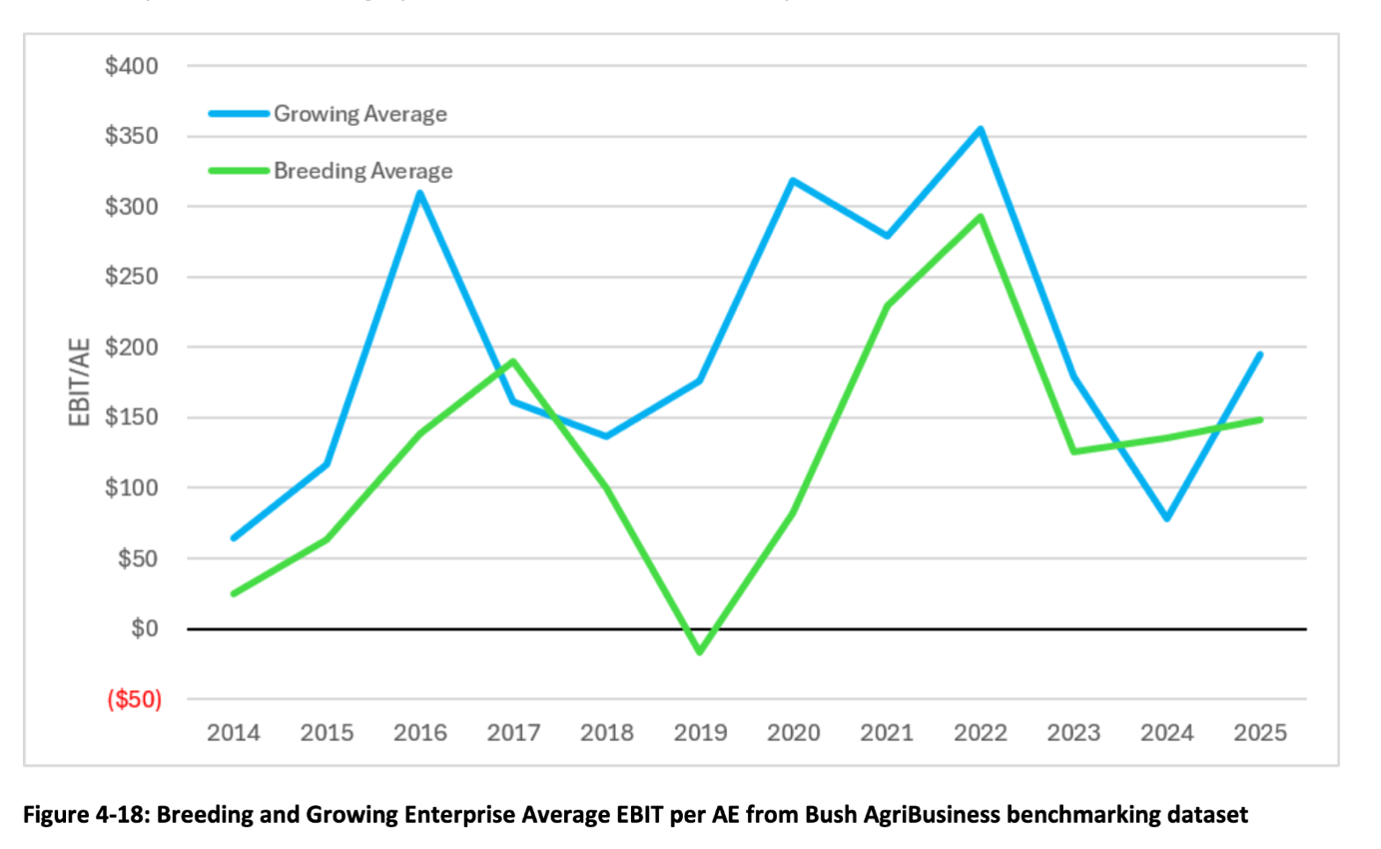
In addition to comparing enterprises from the northern and southern regions, and across different scales, the latest report also analyses the performance of growing enterprises versus breeding enterprises.
It found that growing enterprises have generally achieved higher EBIT per AE than breeding enterprises over the past 12 years.
It notes that growing enterprises are typically undertaken on more productive land better suited to growing enterprises. “This land is generally more valuable because of its higher productive capacity, meaning the additional EBIT per AE does not necessarily translate into a higher return on assets (operating return).”
The report also documents an increase in productivity across both breeding and growing enterprises over the last 12 years. Average growing enterprises produced 126kg beef/AE compared with 93kg beef/AE for breeding enterprises while turnover averaged 111 percent compared with 45pc.
Part of this productivity difference reflects the nature of the production system, with growing animals generally converting available feed into saleable weight more directly than breeding animals.
The data shows growing enterprises generate higher EBIT per AE through a combination of greater productivity, faster turnover and slightly higher prices received and income per kilogram produced.
The data suggests growing enterprises have on average generated sufficient additional production and turnover to more than offset their higher cost base, resulting in greater EBIT per AE.
Overall picture
A key message is that producers who maintain competitive expenses per animal unit and strong productivity achieve superior long-term performance.
By definition, three-quarters of producers at any given time are not in the Top 25 percent.
But the case for making the adjustments to business measurement and management required to lift your business out of the bottom 75 percent has never been compelling, as the results of the latest Australian beef Report show.
“Despite equal exposure to the highs and lows of the cycle, the top performers consistently outperform the average,” the latest edition of the report states.
What are the factors separating the top performers form the average?
The authors of the report are strident in their view that the answer is consistent and straight forward – and clearly backed by the evidence:
The Top 25 percent:
- Have more productive herds, generating more kilograms of beef and more income per animal unit;
- Target their herd expenditure more effectively, generally spending less on direct expenditure, but achieving higher herd productivity;
- Use labour more efficiently, managing more animal units per FTE of labour than the average, which results in lower overhead costs of animal unit; and
- Have more operating scale.
The increasing volatility of beef prices and its impact on industry profitability was another trend highlighted by the latest report – keep an eye out for a follow up article on that issue in coming days.
The full 156-page Australian Beef Report 2026 includes detailed regional financial benchmarks, enterprise size analyses, the complete People Management 101 guide, and verbatim insights from the Top Performers Pastoral Panel. Purchase your copy directly from Bush AgriBusiness at www.bushagri.com.au
HAVE YOUR SAY