
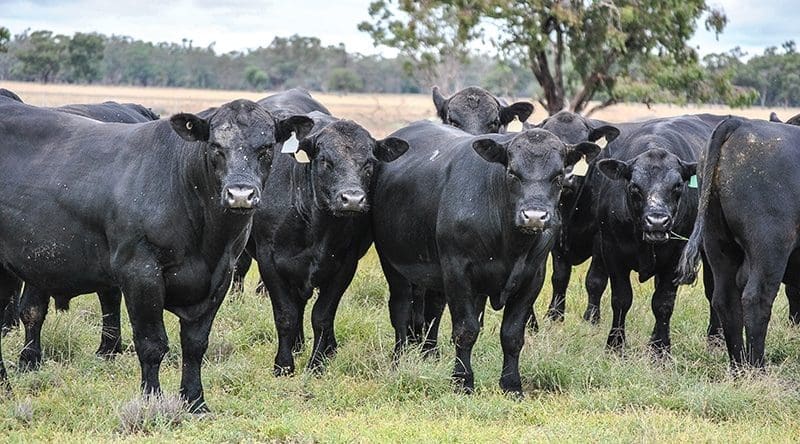
THROUGHOUT this year’s spring sales there have been a number of standout bulls offered by breeders.
These are not only the bulls that have topped an individual sale or perhaps set a new breed record, but many others highly sought after for their genetic merit.
Many of these bulls will be collected for artificial insemination, with semen to be offered to the industry. For commercial producers who could not justify their purchase price, AI is a practical way to access these genetics, and it allows a bull’s influence to extend well beyond the one or two herds he could serve naturally.
While Fixed Time AI (FTAI), can introduce new genetics into a herd more widely in one season than a new bull, realising that opportunity takes some planning.
Producers preparing for a FTAI program need to set realistic expectations. An FTAI program may be well structured around female synchronisation, preparation and insemination, however not every female will conceive within the program.
Back-up bulls
In some programs, producers may address this result through a second round of AI. However, regardless of one or two rounds of AI, there are often females that have not successfully conceived.
In practice this means producers will still need to utilise natural mating to ensure that those females which have not conceived can still have an opportunity to fall pregnant and contribute to the following year’s calf numbers.
This is an important consideration. While FTAI is a way of introducing new genetics into a herd more widely and at a lower cost than using a very expensive bull naturally, the purpose of any breeding program is to achieve the optimum calving rate for the herd.
This means that FTAI and natural joining are two parts of a successful program. It is important in evaluating the success of the program to recognise that pregnancy to FTAI and pregnancy at the end of joining are different measures.
As part of managing expectations, producers need to measure the proportion of females that conceive through insemination. They then should measure those pregnancies achieved through subsequent natural service.
The reason for this is that a satisfactory final pregnancy rate can conceal a disappointing AI result unless pregnancies are identified by conception period. Because AI and natural service pregnancies may be only a few weeks apart, this requires early pregnancy testing by an experienced operator able to age the foetus.
This measurement is essential for producers wanting to improve their FTAI programs for following years.
Knowing the number pregnant to FTAI is also essential in planning the number of bulls to be used for back-up or natural mating. After an FTAI program the total number of females in a paddock is not the same as the number requiring service.
For example, in a group of 100 females with 55pc pregnant to AI, about 45 remain available for natural joining. Applying the same bull allocation used for 100 naturally joined females may provide more bull capacity than is required.
The challenge is that the AI pregnancy result is generally unknown when back-up bulls are introduced. There are producers who are prepared to pregnancy check as early as possible before introducing back-up bulls.
However, even doing a pregnancy check as early as possible, often extends the joining period and dilutes any advantage in timing or condensing calving, which is a benefit of FTAI programs.
Because the AI result is usually unknown when bulls go in, producers need to develop a plan for the use of back-up bulls which is based on a realistic expectation. In many cases it is better to plan numbers based on a lower FTAI result rather than assuming that the best outcome will always be what producers enjoy.
Relationship between bull ratios and pregnancy following FTAI
Research published in Translational Animal Science in 2021 presented results from a Virginia Tech project led by Dr Claire Timlin which examined the relationship between bull ratios and pregnancy following FTAI.
Her team analysed records for 14,868 females across 17 farms in Virginia, covering 13 breeding seasons between 2010 and 2017. The cattle were predominantly Angus × Simmental, and the back-up bulls were mature animals that had passed breeding soundness examinations.
Bulls entered the groups ten days after FTAI and remained for 70 days of natural joining.
Across the groups, pregnancy to FTAI averaged 54.9pc. The average allocation was one bull per 31 females in the total group, but only about 14 non-pregnant females per bull actually required service.
The researchers found that bull allocation generally explained relatively little of the variation in pregnancy at the first return to oestrus. However, there were weak negative relationships in autumn breeding groups, driven by groups where a single bull was used. In single sire joining, pregnancy rates declined as the number of non-pregnant females per bull increased. Where more than one bull was used, no relationship was found.
As a result of this analysis, the research team proposed an allocation of one bull per 50 females originally enrolled in FTAI. On the assumption that about half of the group would be pregnant as a result of FTAI, this would leave around 25 females requiring service per bull.
It is important to note that while these findings provide a basis for reviewing back-up bull requirements, it was an analysis of existing herd records, rather than a controlled experiment assigning different bull ratios. It also involved mature, sound bulls under the conditions of the Virginia herds.
Paddock size, terrain, cattle distribution and bull age may create different demands in Australian systems. However, the results do provide a useful starting point for realistic planning of back-up bull numbers.
Some producers may question the recommendation of one bull per 50 females. However, it’s important to note the results found in the project when relying on single sires, particularly if there are more females to be mated than expected.
It is also important to factor into any plans the challenge that females that fail to conceive after synchronisation and FTAI can return over a relatively concentrated period.
Although they will not all return on the same day, the bull team may face a greater short-term workload than in an unsynchronised group.
Planning therefore requires consideration of both the number of females likely to need service and how closely their returns may occur. A breeding soundness examination is an important part of that preparation.
However, a satisfactory examination does not guarantee that a bull will remain sound throughout joining. Injury or other problems can develop after introduction, making observation during the return period particularly valuable. Producers who do choose to use single-sire matings also need to have a clear alternative plan in the event of bull breakdown.
It is easy to give considerable attention to the AI sire and then regard the back-up bulls mainly as insurance against empty females. Yet, if 55pc conceive to AI, a substantial proportion of the eventual calf crop may still be sired through natural service. Those calves contribute to sale performance, and their daughters may enter the replacement herd.
The back-up team should therefore support the same breeding objective as the AI sires. Structure, temperament, calving ease and relevant EBVs and indexes remain part of the decision. Using a carefully selected AI sire followed by back-up bulls with substantially different genetic merit can create a calf crop that moves the herd in different directions. The aim should be a coordinated breeding program across both stages of joining.
FTAI may offer scope to reduce the number of bulls required, helping offset some program costs. Whether that opportunity can be realised depends on expected AI success, bull capacity and the conditions in which the bulls must work. The practical question is how many sound, suitably selected bulls are needed to serve the females likely to return, within the joining period available.
 Alastair Rayner is the Strategic Account Manager for Southern Australia with Vytelle and Principal of RaynerAg. He has over 30 years’ experience advising beef producers and graziers across Australia. Alastair can be contacted here or through his website: www.raynerag.com.au
HAVE YOUR SAY