
AROUND 30 years ago, legendary US feedlot operator Paul Engler visited Australia to speak at the Australian feedlot industry’s BeefEx conference.
The principal of Cactus Feeders in Texas, one of the largest privately owned lotfeeders in the country at the time, created headlines when he floated the notion of importing Australian feeder cattle to help manage a US beef herd severely depleted by drought.
Exchange rates at the time mounted a compelling financial case for the trade, based on prevailing Aussie and US feeder cattle prices, but the concept was shot down after heavy opposition from the cattle industry and other stakeholders in the US.
Scroll forward to the same event in 2026, and the US beef industry again finds itself with a beef herd at 70-year lows and little sign of herd rebuilding. Throw in the lengthy closure in live trade out of Mexico due to screwworm fly, and US lotfeeders are clearly struggling to find suitable feeders, almost at any price.
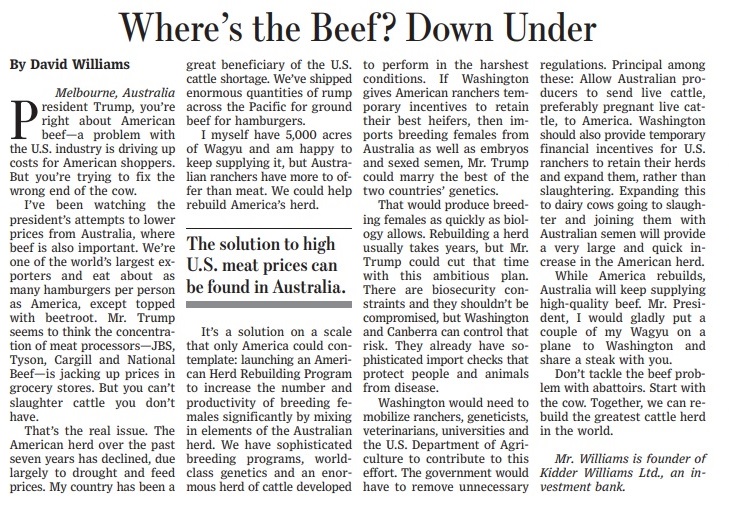
On Friday last week, an opinion piece published in the hallowed Wall Street Journal saw the author, respected Australian financial deal maker and part-time Wagyu cattle producer David Williams make a somewhat similar call.
The colourful Williams, sartorially inclined to occasionally wear sports jackets that look like re-purposed saddle blankets, suggested the importation of Australian breeding females and genetics to help get the US herd back on its feet. Not quite the feeder cattle floated decades earlier by Paul Engler, but heading on the same trajectory.
An image of Mr Williams WSJ article made the ‘big screen’ at yesterday’s 2026 BeefEx feedlot conference on the Gold Coast.
Click on image for a larger view
In his opinion piece, he suggested that US president Donald Trump seemed to think the concentration of US meat processors—JBS, Tyson, Cargill and National Beef— was jacking up beef prices in grocery stores.
“But you can’t slaughter cattle you don’t have,” he said. “That’s the real issue. The American herd over the past seven years has declined, due largely to drought and feed prices. My country has been a great beneficiary of the US cattle shortage. We’ve shipped enormous quantities of beef across the Pacific for ground beef for hamburgers.
“I myself have 5000 acres of Wagyu and am happy to keep supplying it, but Australian ranchers have more to offer than meat. We could help rebuild America’s herd.
“It’s a solution on a scale that only America could contemplate: launching an American Herd Rebuilding Program to increase the number and productivity of breeding females significantly by mixing in elements of the Australian herd. We have sophisticated breeding programs, world-class genetics and an enormous herd of cattle developed to perform in the harshest conditions.
“If Washington gives American ranchers temporary incentives to retain their best heifers, then imports breeding females from Australia as well as embryos and sexed semen, Mr Trump could marry the best of the two countries’ genetics. That would produce breeding females as quickly as biology allows.
“Rebuilding a herd usually takes years, but Mr Trump could cut that time with this ambitious plan. There are biosecurity constraints, and they shouldn’t be compromised, but Washington and Canberra can control that risk. They already have sophisticated import checks that protect people and animals from disease.
“Washington would need to mobilise ranchers, geneticists, veterinarians, universities and the US Department of Agriculture to contribute to this effort. The government would have to remove unnecessary regulations.
“Don’t tackle the beef problem with abattoirs. Start with the cow. Together, we can rebuild the greatest cattle herd in the world.”
While David Williams’ suggestion varies a little from the concept floated by Paul Engler three decades earlier (ie breeding heifers versus feeder cattle), the ultimate objective is similar.
US and Canadian lotfeeder Kee Jim at BeefEx yesterday
Politics biggest barrier
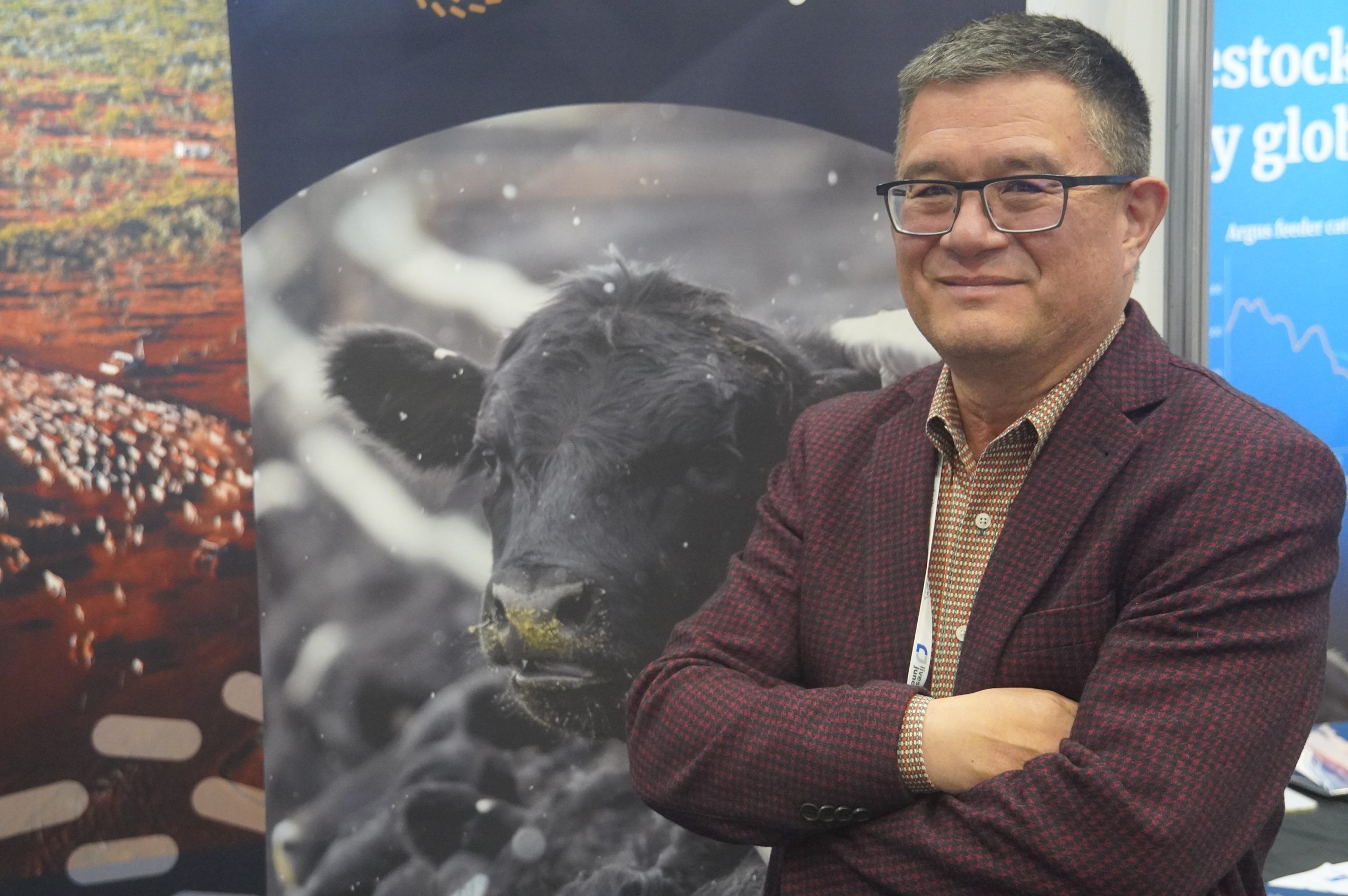
One of the keynote speakers at the 2026 BeefEx conference yesterday was prominent North American cattle feeder Kee Jim, whose Blackshirt Feeders business manages 750,000 head through 16 facilities in the US and Canada. We will outline Blackshirt’s latest project involving the completion of a new 200,000 head yard in Nebraska in a later story.
Beef Central asked Dr Jim, a cattle veterinarian by training, for his thoughts on Australian feeder (or breeder heifer) cattle entering the US market, due to the current severe US cattle shortage.
“The shortage of cattle is really a North American problem – its not just the US alone, it also extends into Canada, for the same reasons,” Dr Jim said.
“But historically, this (importation from countries other than Canada and Mexico) has been a politically-charged concept, despite the simple logic in sourcing feeder cattle from elsewhere during times of shortage.
“Everybody believes in free trade – until they don’t,” he said. “But you either believe in free trade, or you don’t.”
“Realistically, from first principles, if you look at this (North American’s desperate feeder supply situation), if there are feeder cattle available from countries that have appropriate animal health standards, then what’s the reason for not importing them?”
“The answer is, there shouldn’t be any, provided all the animal health requirements are met. And the answer is, Australia can meet those standards.”
Australia had proven its ability to carry out large-scale live exports of breeding cattle – most recently to Russia.
“It’s logistically possible, when they economics favour it – and they clearly would today, into the US and Canada,” Dr Jim said.
However there were clear challenges. Canada recently banned the importation of all livestock by sea transport, on animal welfare grounds.
“So it’s clearly off the table for Canada, at the moment,” Dr Jim said.
“In the US, when we try to look into the potential opportunity (and as cattle feeders, we certainly have), the US authorities are saying there is no import protocol, and basically, there never will be.”
But this was essentially a political or agripolitical response, and was not based on science, Dr Jim said.
“Politically, nobody in the US wants it to happen.”
Could the import of breeding heifers instead of feeder cattle be a more palatable solution? Beef Central asked.
“Probably not,” was Kee Jim’s response.
“The decision has been made not to import cattle from anywhere – regardless of the science or the economic imperatives. If we were allowed to import Australian breeder or feeder cattle into North America, it would be happening right now.
“And the Aussie dollar is way under the US$, making it even more economically attractive. Depending on weight and description, I would say US feeders are worth 1.5 to 1.6 times those in Australia (before exchange rate).
“There’s no question we could pay the sea freight to get them home, and it would still be very attractive to do. It would work equally well out of New Zealand, but NZ has banned the live export of all livestock, by sea.
Carcase weights approaching ‘biological limits’
One of the impacts of the extreme shortage of feeders in the US market had been retention of feeders for longer, and finished carcase weights pushing to heavier and heavier levels, Dr Jim said.
“It’s taken some time to get there, but this year we’ve taken carcase weights about as close to their biological limits as they can go,” he said.
“It’s also affecting feeding efficiency. We are getting to the point we call negative feeding margin, where regardless of consumption, you can’t get them any bigger.”
Despite that, pounds of beef harvested from each scarce animal is clearly the objective in the US – even if it is inefficient.
There were also other compromises – with higher mortality rates as cattle get ever bigger.
With average US fed steer carcase weights now above 930-940lb, it was likely that the next trend in carcase weight would be down, because corn had become more expensive, Dr Jim said.
Asked whether any US feedyards had yet started to close down due to the scarcity of feeders, he said a few had closed, here and there – especially as access to feeder cattle out of Mexico had stopped due to screw-worm.
“Just recently, some of that Mexican access has been restored, but it takes time.”
US feedlot ‘house of cards collapsing’
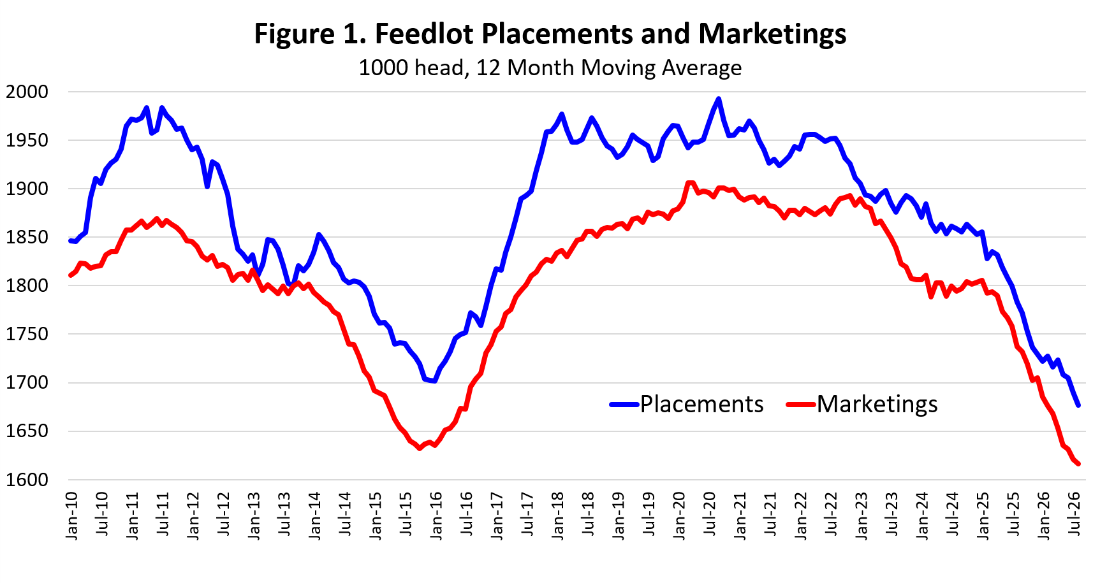
Last week’s Cow Calf Corner report by Nebraska’s Derrell Peel, titled The feedlot house of cards is collapsing, illustrated the current dire US cattle position, and included the following graph.
Source: Derrell Peel, OSU
Through the current cattle cycle, the US calf crop had peaked in 2018 at 36.29 million head and has declined for eight consecutive years, with the 2026 calf crop estimated at 32.5m, down 3.79m from the cyclical peak, Dr Peel said.
“The decreases in average placements and marketings are generally consistent with the declining calf crop,” he said.
However, cattle on feed inventories have remained relatively high in recent years, as cattle remained on feed longer – down just 4pc over the four years to April.
“Feedlot inventories have remained elevated due to a slow marketings rate. The feedlot marketings rate – the percentage of inventory marketed each month – was at 16pc in July 2023, having averaged 16pc since 2018,” he said.
The average marketings rate began declining and dropped below 15pc in October 2025. The twelve-month average marketing rate in August 2026 was a record low 14.1pc.
Several consequences have emerged resulting from the ever-lower US feedlot marketing rate, Dr Peel said.
“The low marketing rate is accomplished mostly by extending days on feed. This has led to a dramatic increase in carcase weight since 2023. For example, steer carcase weights increased 23 pounds (10kg) in 2024, 11kg in 2025 and are up 15kg thus far in 2026.
From 1960-2022 the average annual increase in US steer carcase weights was 1.5kg/year.
“There have never been multiple years of much heavier carcases like this,” Dr Peel said.
“The 34kg increase in steer carcase weights in the last three years is equivalent to the increase over the previous 18 years. The dramatic increase has also resulted in sharply decreased average yield grades,” he said.
Going forward, it would be increasingly difficult to maintain US feedlot inventories, Dr Peel said.
Feeder supplies are expected to tighten into 2027 with a smaller calf crop.
“Resumption of Mexican cattle imports may relieve some of the pressure, at least regionally. Delayed beef cow culling over the past three years means that more replacement heifers will be needed just to stabilise the cow herd with additional heifers needed for any potential herd rebuilding.
“The feedlot marketing rate may stay low, but is unlikely to keep dropping as it has in the past 18 months. In that case, lower placements will push feedlot inventories lower in the coming months,” Dr Peel said.
HAVE YOUR SAY