
AUSTRALIAN agriculture needs to be careful not to assume that the Chinese market will solve all of our future demand problems – whether that be for chilled and frozen beef, or other commodity exports.
That’s the advice of respected economist Saul Eslake, delivering one of the opening addresses at the grainfed beef industry’s biennial BeefEx feedlot conference on the Gold Coast this morning.
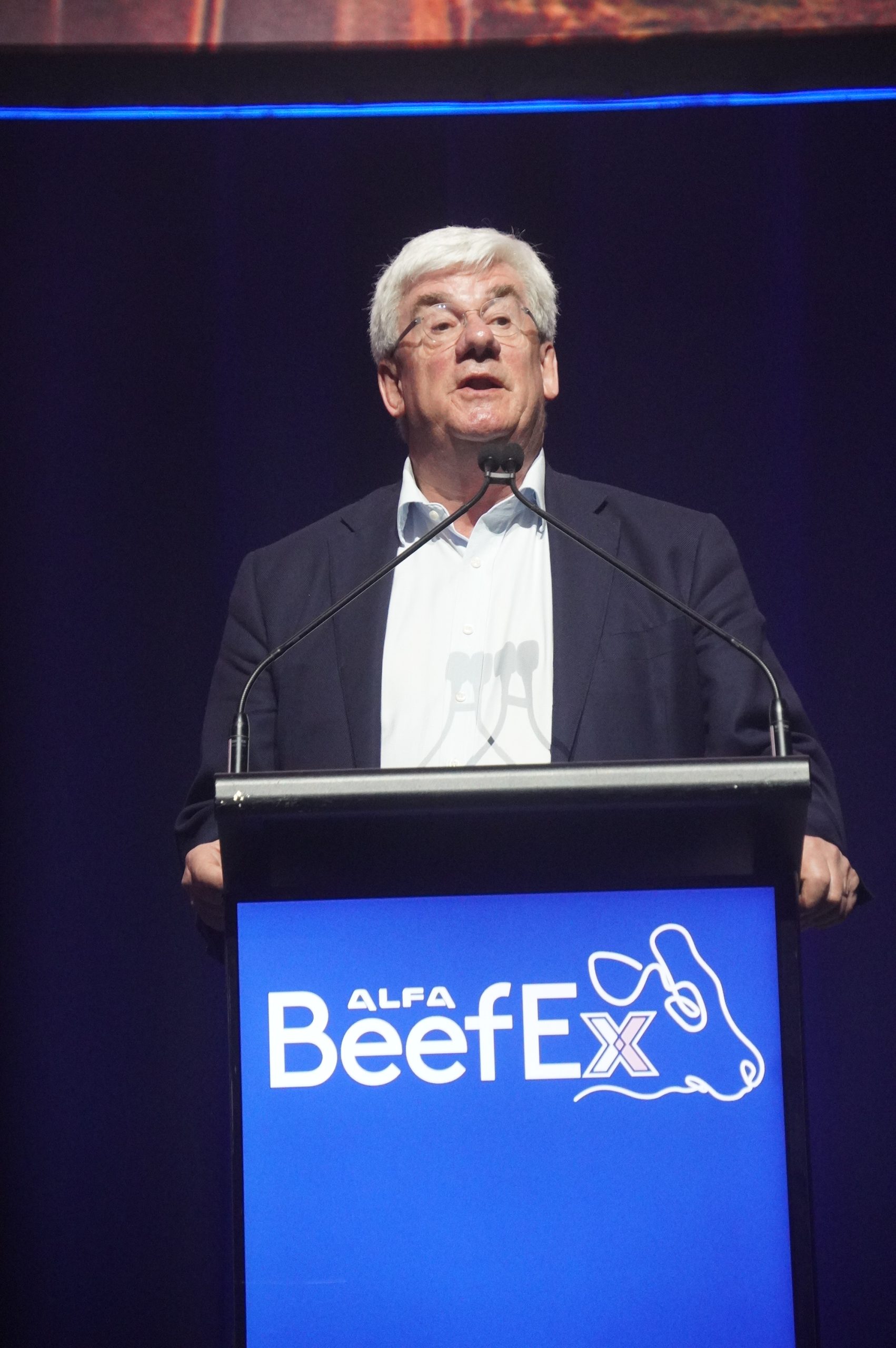
Saul Eslake addressing this morning’s BeefEx conference
“Yes, the average Chinese individual is still getting richer – and at an impressive pace – but there are fewer Chinese now, because of the echo effect of the one-child policy that was in force from the late 1970s and about ten years ago,” Dr Eslake said.
“China’s population is going to shrink by more than 500 million over the next 60 to 80 years, and that decline has already begun, having peaked about 2015.
Partly for that reason, and partly for other economic reasons, China’s economic growth is slowing quite markedly, Dr Eslake said.
“For 30 years, the Chinese economy grew at about ten percent per annum. Over the last couple of years, it has grown at less than 5pc, and it’s more or less inevitable that over the next couple of years, it will slow further to 3pc or less.
“And from what we can see from readily available figures, its the smaller role that consumer spending is playing in driving China’s economic growth. China’s consumers have been in a funk since the onset of the COVID pandemic, as a result of a peak in their property market bubble in 2018-19, and the unwillingness of Chinese authorities to revive it.”
Retail sales in China have slowed almost to a halt, and the Chinese are saving an increasing proportion of income, as the population ages – because they do not have a social security net, Dr Eslake said.
A key driver of the funk that Chinese consumers are in is the fact that property prices have fallen, and that’s really the only source of potential wealth gains that the Chinese have, given that they cannot invest overseas.
“In contrast with previous periods of weak growth in the Chinese economy, the authorities are very reluctant to do anything to reverse it, to do anything to stimulate new sources of growth – either by cutting interest rates and encouraging new areas of lending, or by providing a fiscal stimulus package. This they can’t do, because China is now running persistently large budget deficits as a result of the ongoing slowdown in the economy.
The Chinese government no longer had the capacity to do those ‘big ticket’ stimuli that they most recently did in response to the global financial crisis of 2007-09.
“So China isn’t going to be the growth market for beef – or anything else – that Australians have become accustomed to assuming that China is going to be,” he said.
Emerging markets
In the context of beef exports, maybe this meant looking beyond traditional markets, Dr Eslake suggested.
He used figures on smaller, emerging export markets, expressed as per head of population, to illustrate his point.
“There’s some hypothetical illustrations to highlight the potential that might be there for diversification of Australia’s beef exports – not necessarily in the next 1-2 years, but perhaps 5-10 years ahead.”
“For example if Australia could export as much beef to Indonesia, Vietnam, the Philippines and Malaysia on a per head of their populations basis, as we do to Thailand, we could sell an additional 120,000t of beef a year,” he said.
“If we could export as much beef to the Middle East, per head of their population, as we do to Taiwan, then we could sell almost 200,000t more of beef to the region.
“Perhaps a little more speculatively, if we could export half as much beef to Mexico, per head of population (130 million people), as we do per capita to the USA and Canada, we could sell almost 300,000t more beef.”
“And if we could export just one quarter per head of population to Africa, as we do to the Pacific Islands (also relatively poor countries), then we could sell an additional 180,000t of Australian beef,” Dr Eslake said.
“I’m not saying that that is something that could happen overnight. There are lots of potential obstacles to increasing exports to those markets.
“But I’m simply offering those as a way of thinking about potential alternatives that could be open to Australian beef exporters, if China’s economy continues to stagnate, or if governments (like China, with its latest round of 55pc tariffs) continue to go down the protectionist path.”
His references to potential growth in southeast Asia aligned with the recent decision by JBS to sell a 25pc share in its Australian operations to an Indonesian sovereign fund to fuel expansion in the Southeast Asia region.
The move has widely been interpreted as a medium term strategic play to embrace the emerging region for protein supply, with Australia playing a key role as a launchpad for protein sales into the region.
- More from Dr Eslake’s BeefEx address in a separate story to come
HAVE YOUR SAY