
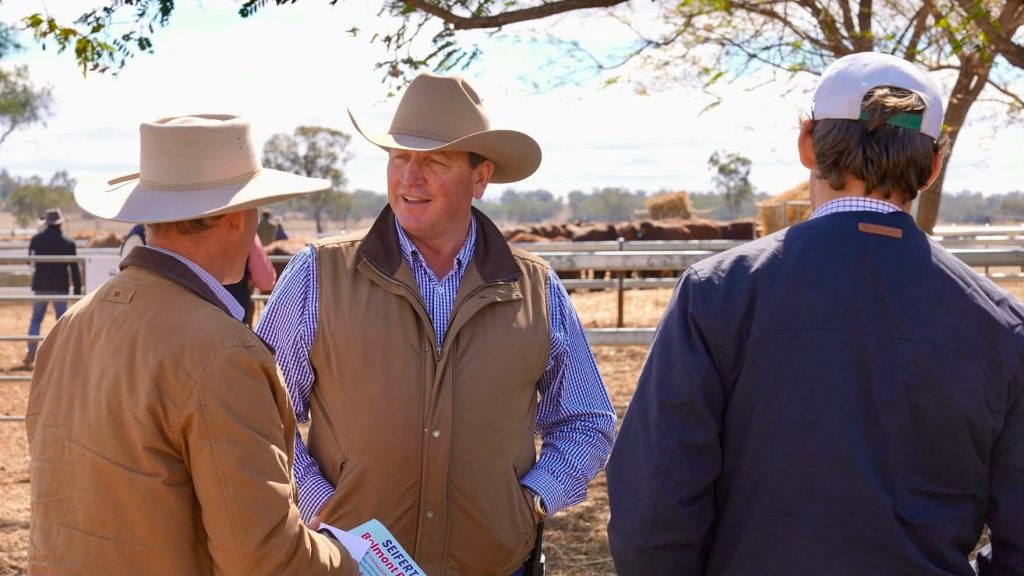
Seifert Belmont Reds co-principal Ian Stark with buyers at the stud’s annual sale near Dalby last month
ATTENDING a bull sale offers plenty of insight into how producers approach a major decision.
For most bull buyers, a purchase represents not just the cost of the animal on the day but an investment in the herd’s future. Learning to recognise buyer behaviour is a skill that can help producers manage their bull purchasing decisions with greater confidence.
Producers rarely turn up without a plan for the bulls they want to consider. But those plans can change after they arrive at the sale.
A visual inspection can rule a bull out, leaving a producer to weigh up the alternatives. Perceived interest in a bull can lead a producer to drop a preferred lot before bidding even starts, assuming it will run past their budget.
And once the auction starts, the pace, and sometimes the excitement, can push a bidder to spend more than planned, or to drop out and wait for the next suitable bull. That pressure to buy only builds as the sale season runs down and joining starts to loom.
A producer may still leave with a sound, functional bull. However, there can be a question in many cases if they have the bull they planned to buy, or the bull the sale persuaded them to buy.
Selecting and purchasing a bull aren’t always the same decision. Selection ideally happens over time, weighing the herd’s position and its breeding objectives, often across several catalogues, in a calmer setting than sale day.
A purchase, by contrast, is made in seconds. In three recent online sales, a bull sold on average every 75 seconds, including the time in the ring and the announcement of the successful buyer, and that pace was typical of most sales.
That pressure, on top of competing bids and reacting to other buyers, is why producers can end up weighing immediate signals from the sale more heavily than the criteria they set beforehand.
Using bull selection information
Research confirms that producers do not all use bull-selection information in the same way. Meat & Livestock Australia’s 2023 Genetics Insights Survey found 59pc of commercial beef producers used BreedPlan EBVs, up from 18pc in 2016.
Other Australian research found that while 60pc of producers consistently considered EBVs, temperament and visual appraisal remained among their highest-rated selection criteria.
While there is a growing understanding of how producers combine objective data, physical assessment, experience and trusted advice, less studied is what happens between preparing the shortlist and making the final bid. This also extends to understanding how the sale environment shapes which bull is ultimately bought.
Six categories that bull buyers fall into
Despite a lower level of understanding of these factors, it is possible to identify several distinct approaches used by producers at bull sales. Although these are not formal or scientifically validated categories, they do offer an insight into the considerations that have the strongest influence on a producer’s initial purchasing decisions:
- The objective-led buyer has a clear focus on their breeding objectives and the traits that matter most to their program. They set a preferred range of EBVs for those traits, and any bull outside that range is not considered for physical assessment. The risk is that a genuinely suitable bull can be overlooked this way, particularly one sitting just outside the preferred EBV range.
- The balanced evidence user weighs several sources of information together, drawing on EBVs, phenotype, fertility data, pedigree and their own knowledge of the breeder, rather than screening bulls on any single measure. The risk is holding that balance once bidding starts, when personal preference can end up carrying more weight than any of the other information.
- The visual traditionalist judges bulls mainly by what they can see: structure, muscle, movement, temperament, maturity and overall type. The risk is that some of the genetic differences that drive profit can’t be seen, so a bull can appear acceptable while his daughters’ fertility, his progeny’s carcase performance, or the genetic component of their growth stays unknown.
- The relationship buyer returns to a breeder who has supplied good bulls before, trusting the cattle and valuing the after-sale support that relationship brings. The risk is that loyalty replaces comparison, and a bull is bought without checking whether another breeder’s cattle would better suit the current breeding objective.
- The sale-driven opportunist stays flexible, buying whatever is on offer at a price that suits rather than chasing a specific bull. The risk is coming home with a bargain rather than the genetics the herd actually needs, since a bull priced below the sale average is only good value if he can genuinely contribute to that business.
- The status or competition buyer can be swayed by pedigree, presentation, fashionable bloodlines or strong bidding from other buyers. The risk is mistaking someone else’s enthusiasm, or a high price, for evidence that a bull suits their own herd or market.
Other factors in play
While these categories explain the thinking behind a decision, other factors come into play once the auction starts. Behavioural economics from other industries offers some useful explanations for what happens in the ring.
- Anchoring happens when an early figure shapes what follows. Last year’s sale average or the price paid for the previous bull can set what feels like a reasonable price, even though it has little real connection to the value of the next animal.
- Social proof happens when the actions of other buyers shape our own judgement. Strong bidding from a respected buyer can make a bull look more desirable than he otherwise would.
- Scarcity builds as the suitable bulls sell. A bull who was only the fourth or fifth choice before the sale can suddenly feel like the one to have once just two options are left.
- Commitment escalation sets in once bidding starts. After several bids, it becomes harder to walk away, even once the price has gone past the limit set beforehand.
- Loss aversion can make missing out on a bull feel worse than paying too much for him. The disappointment of losing him is immediate, while the cost of overpaying only shows up later.
None of this points to poor judgement. These are normal responses to competition, uncertainty and limited time to decide. Understanding them is a good start, and a clear plan made before the sale can help producers stay on track once bidding begins.
That plan needs to be anchored in the herd’s breeding objective. Selection criteria work best when they’re written down and tied directly to the breeding objective. Criteria that only exist in a buyer’s head are much easier to let slip once bidding begins.
The first job is working out what the bulls actually need to deliver, given the cows they’ll join and the market the progeny are heading to. From there, criteria can be sorted into three groups, each one tied back to that objective.
- ‘Must have’ are the non-negotiables. These include structural and reproductive soundness, suitable temperament, acceptable calving risk, and minimum or maximum EBVs for priority traits.
- ‘Prefer to have’ are those traits that add value without being essential. These might include a preferred pedigree, stronger secondary traits, additional testing, or a particular visual type.
- ‘Will not accept’ are the limits that hold regardless of what else a bull offers. These include poor structure, excessive birth weight, unsuitable mature size, poor temperament, or EBVs outside set limits.
Price limits
Price limits should come from the same objective. Set an absolute limit for each short-listed bull rather than a general sale budget. A bull that strongly addresses a priority trait may justify a higher limit than one that only meets the minimum, but the limit should reflect his expected contribution to the herd, not the level of competition when he enters the ring.
The best time to review the buying process is after the sale, once the pressure has passed.
For each bull bought, it’s worth asking whether he was on the original shortlist, met every must-have requirement, and sold within the price limit. If the limit changed, what justified it?
The real test is whether he’d still be picked from the catalogue tomorrow, away from the atmosphere of the auction. A bull can look impressive, come from a respected breeder and draw strong competition, and still be the wrong bull for a particular herd.
Objective information doesn’t replace judgement. Visual appraisal, knowledge of the breeder, experience with particular bloodlines and an understanding of the production environment are all important factors that should be considered.
However, these subjective considerations, along with the atmosphere of the sale, can slowly pull a buyer away from the breeding objective without them noticing.
Before the sale, the question is, “Which bulls could do the job?”
Once bidding starts, it needs to become “… at this price, is this still the right bull for my business?
 Alastair Rayner is the Strategic Account Manager for Southern Australia with Vytelle and Principal of RaynerAg. He has over 30 years’ experience advising beef producers and graziers across Australia. Alastair can be contacted here or through his website: www.raynerag.com.au
HAVE YOUR SAY