
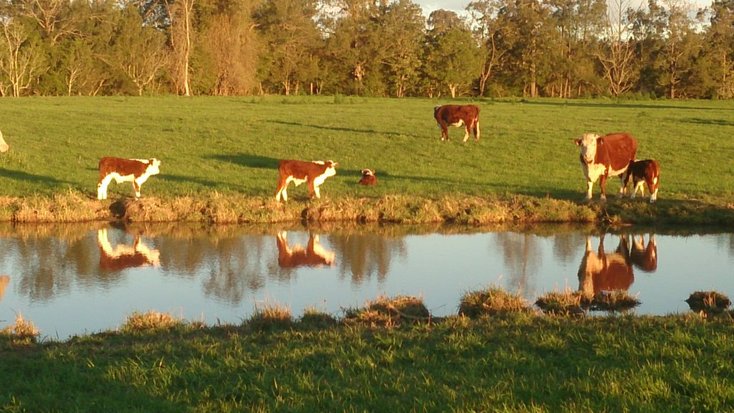
Image: Cotmore Herefords
AN Australian cattle breeder has taken his campaign to have Traditional Hereford cattle recognised as a distinct native breed to the UK High Court.
Peter Hall is seeking permission to bring a judicial review against the UK Department for Environment, Food and Rural Affairs (Defra) over its treatment of Traditional Herefords under the country’s Native Breeds at Risk framework.
At the centre of the case is whether Traditional Herefords should be recognised as a separate breed or as a sub-population of the wider Hereford breed.
Mr Hall argues that the UK Government has failed to distinguish between two genetically and physically distinct groups: the original British Hereford population, which dates to the 18th century, and a larger North American type introduced to the UK during the 20th century.
In court documents, Mr Hall described the North American type as “a longer-legged, larger framed animal” which usually lacks horns and is “substantially heavier” than the original Hereford.
He said the original type was characterised by “a uniformly rich deep red and curly coat on its body; horns; a pure white face, save for, on occasion, red around the animal’s eyes; short ears; and full and prominent eyes”.
Mr Hall argues that classifying the two populations together makes his cattle ineligible for UK Government funding intended to support the maintenance of native breeds.
He has also argued that Defra’s approach inflates the apparent size of the Traditional Hereford population and risks diluting its genetics through crossbreeding.
“This is hastening the eventual disappearance of the original Hereford cattle breed from the British countryside,” he said according to media reports.
Defra and the Hereford Cattle Society do not support Mr Hall’s interpretation, maintaining that Traditional Herefords are a sub-population of the wider Hereford breed rather than a separate breed.
In its written submissions, Defra said the UK Government’s position was consistent with that of the United Nations Food and Agriculture Organisation and the UK Genetics for Livestock and Equines Committee.
“The claim is no more than a disagreement with the conclusion of the defendant’s reasonable, evidence-based approach,” the Defra submission stated.
“It is an attack on the exercise of the defendant’s broad, evaluative discretion, without advancing any proper basis for concluding that such exercise was irrational.”
A Defra spokesperson said: “Native breeds of livestock, like Hereford cattle, are an important part of our rural heritage and we are supporting them, including through grants for grazing under our farming schemes.
“We have followed the latest scientific advice to protect Hereford cattle for generations to come, and ensure there is genetic diversity in the population, a factor that is critical for the long-term survival of the breed.”
The Hereford Cattle Society is supporting Defra as an interested party in the proceedings.
The society maintains that Traditional Herefords form an important part of the wider Hereford breed and says its position is supported by pedigree records, international breeding standards and expert advice.
Seth Wareing, general manager of the Hereford Cattle Society, said: “The hearing on Thursday is an application in which Mr. Hall seeks to obtain the Court’s permission to proceed with a Judicial Review against Defra in respect of two decisions.
“Firstly, Defra’s decision to class Traditional Herefords as a sub population of Herefords, rather than a separate breed. Secondly Defra’s decision not to exercise its investigative or enforcement powers against the Hereford Cattle Society.
“The Hereford Cattle Society is robustly defending its position alongside Defra. The Society has maintained a closed Hereford Herd Book since 1886 and has continuously adopted advances in science and DNA technology to protect the integrity of the breed.
“The Society and Defra do not accept that the Aberystwyth genetic test relied upon by Mr. Hall provides a basis for defining Traditional Herefords as a separate breed.”
Ted Loveday, representing the society, reportedly told the court that evidence relied upon by Mr Hall was “deeply flawed” and “not published in a peer-reviewed journal”. He said it had been commissioned by a company of which Mr Hall is now a director.
Mr Loveday said the society’s position was instead “based on the highest quality scientific evidence and international best practice”.
During discussion about whether a cap should be placed on Mr Hall’s legal costs, Mr Loveday said: “The claimant is a millionaire with at least two houses, a seven-figure sum in savings, a generous pension and herds of cattle on two continents.”
Laura Mackain-Bremner, a partner at Clarke Willmott representing the Hereford Cattle Society, said: “The Hereford breed has a long and proud history, and the Society takes its responsibility for maintaining the integrity of the Herd Book extremely seriously.
“This case is not simply about genetics; it is also about breed governance, conservation policy and the role of recognised breed societies.”
Other UK media reports have highlighted that Mr Hall’s Australian-born cattle have reportedly not been registered by the Hereford Cattle Society as purebred Herefords.
Historic connection
Beef Central has attempted to contact Mr Hall for comment but had not been successful prior to publishing this article.
Mr Hall’s Cotmore Herefords website says his family was involved in the development of the Hereford breed in the late 18th century.
According to the website, Mr Hall’s ancestor Richard Hall was among a small group of Herefordshire farmers who recognised the potential of the cattle that became known as Herefords around 1780.
Richard Hall and his descendants bred and registered Hereford cattle for almost 150 years. The family’s Cotmore herd was listed in Volume 1 of the Hereford Herd Book and, according to the website, was the oldest recorded Hereford herd in the world.
Mr Hall’s father, Norman, had been expected to take over the herd but migrated to Australia after the Great Depression began in 1929.
Mr Hall subsequently sought to recover the family bloodline, locating it within England’s Traditional Hereford population.
“In our retirement we set about tracking down the bloodline. Eventually we found it among the “Traditional” Hereford population in England where it is very strong.
“Traditional Herefords, ones that contain only English Hereford bloodlines (as distinct from Modern Herefords that have emerged since the 1970s and contain North American Bloodlines with short pedigrees) are an endangered breed of native English farm animal, nominated on the register of the Rare Breeds Survival Trust. In 1992 there was only about 200 breeding females remaining. In 2013 we imported over 100 Traditional Hereford embryos into Australia that are descended from the family herd. The first of these calves were born in the spring of 2014 with more to come in each of the next two years. On learning of our project, the Rare Breeds Survival Trust of the UK asked us to participate in the recovery of the breed as they wanted an “insurance” population to protect against disease, especially Mad Cow and Foot and Mouth disease, neither of which exist in Australia. Cotmore Downs was specially selected for the breeding of these cattle.”
The hearing before Deputy High Court Judge Clare Padley will determine whether Mr Hall’s challenge can proceed to a full judicial review. A judgment is expected at a later date.
Beef Central also approached Hereford Australia for its perspective on the issues raised by the UK court case.
“Herefords Australia is a member-based organisation whose role is to ensure the integrity of the Hereford breed in Australia while promoting its commercial benefits and ensuring its ongoing advancement. We are responsible for the maintenance of the Herdbook for the Hereford breed in Australia and the management of pedigree records, genetic information and performance records needed for the advancement of Hereford and Hereford-based cattle,” Herefords Australia CEO Hamish Chandler said.
“We take these responsibilities very seriously and adopt new technologies to help us manage our services as they become available. Our regulations for managing the Herdbook align with every other major Hereford producing country around the world. Cattle are only accepted into the Herdbook where it can be demonstrated that they meet the requirements of the regulations.
“Our members determine the direction of the breeding programs within their own businesses. It is their choice whether they breed animals with a traditional focus or a more progressive approach. The strength of the Hereford breed is the genetic diversity within the breed that gives commercial cattle producers the ability to select animals that are productive and suit modern market requirements. We are focussed on producing cattle that are efficient, fertile and hit industry specifications at an early age at the same time as having good longevity and great temperament.”
HAVE YOUR SAY