
151st Edition: September 2026
Key Points:
- Thailand has declared that it is developing a seaborne live cattle export channel to China at a stated target of 100,000 head a month.
- Thai cattle have become scarce across the region and prices have moved up fast.
- Jakarta continues to scout elsewhere for breeder cattle supplies.
Regional Trends and Overview

Dr Michael Patching
Thailand’s Ministry of Agriculture and Cooperatives has been working since June on a plan to ship live cattle to China by sea at 100,000 head a month, and a government update on 13 August put it in firmer terms, describing a public-private partnership with Chinese capital behind it running through Bang Saphan port in Prachuap Khiri Khan. At 1.2 million head a year, the target is around one and a half times Australia’s entire 2025 cattle export program of 792,077 head.
We have seen similar ambitious proposals like this in the past, the most recent being the establishment of Chinese approved quarantine areas in northern Laos and semi official trade from Myanmar to China where Chinese companies invested significant amounts of money and built large abattoirs in Xishuangbanna Prefecture, none of these ever operated at commercial scale. The protocol with China is still unfinished, nothing has shipped officially, so this is definitely a plan rather than a trade. The movement of cattle into China from Thailand (via barge), Myanmar and Laos is well documented and is supported in theory by the Chinese government, however the endemic disease status in these countries and Chinese claimed freedom of disease makes official trade challenging without creating barriers through expensive quarantine protocols.
Regional Price Graph
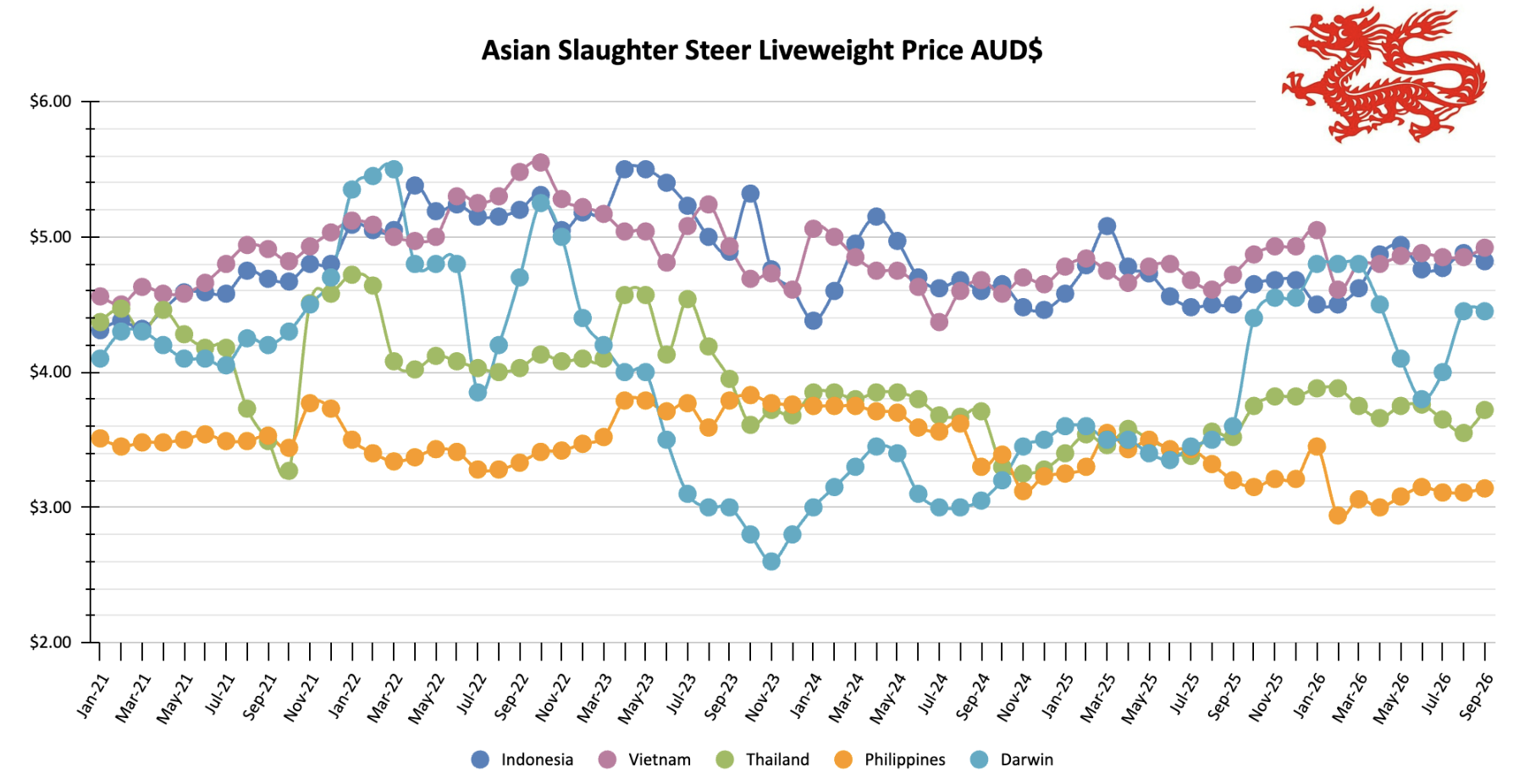
Thailand: Slaughter Steers $3.72 AUD per kg live weight (THB 23.75 = $1 AUD)
Thai cattle values are climbing fast
Thai slaughter steers have lifted to $3.72 a kilogram liveweight, up from $3.55 in August and the strongest they have been since May. Malaysian contacts tell me availability of Thai cattle has fallen away and prices have moved up fast, and buyers from Vietnam report the same thing. That is a five per cent move in a month in a market that had been drifting lower earlier in the year.
Thailand plans a million-head cattle trade to China
The Thai agriculture ministry announced on 17 June that it is targeting the collection of Thai beef cattle for export by ship to China at 100,000 head a month, or 1.2 million head a year, through a quarantine hub to be built at Bang Saphan, a privately owned deep-sea port that Australian exporters used to discharge cattle back in 2015. The recent August update went further, saying the Chinese investment group has committed capital, and that China’s customs administration has cut its list of veterinary questions from more than 40 down to four. A first shipment is targeted within twelve months. The specification is reported as crossbred cattle above 450 kilograms for the premium chilled market.
Why 3,300 cattle a day is the hard part
Thailand’s beef herd is not built the way ours is, and that is the reason to be sceptical about the timetable and size of the numbers. Roughly 1.38 million Thai households run beef cattle, and most keep fewer than 20 head. There is no equivalent of a northern station turning off a few thousand weaners in a season, and no feedlot sector of the size that would let one buyer place a single order and fill a boat. Indigenous and Brahman-cross animals make up more than 90 per cent of the herd, so the pool of 450 kilogram-plus crossbreds is a small fraction of a national herd that already produces less beef than Thailand eats, with a shortfall of 30,000 to 50,000 tonnes a year and production growing at nought to three per cent.
Assembling cattle in that system means buying them one small mob at a time, from villages, through local agents, across a country the size of France. To sustain 100,000 head a month you have to find, test and quarantine more than 3,300 export-specification animals every day. My read is that the aggregation problem, not the port and not the protocol, will decide whether this trade ever runs at all, let alone at even a fraction of the reported rate.
What 1.2 million head would do to the neighbours
It is an interesting exercise to think what the full stated number would mean, even though I do not expect it to come to fruition. If China pulled 1.2 million head a year out of Thailand, the first cattle to go would be the ones that currently truck north and south into Vietnam, Malaysia and Laos. Those three took better than 50,000 head in the first half of 2024, essentially the whole of Thailand’s official export trade, and plenty more were moved unofficially. Prices through the Mekong and up into Malaysia would rise, and rise fast, because none of those markets has a domestic herd able to fill the hole.
Oddly enough, that is where Australia could come out ahead. Vietnamese and Malaysian buyers have spent the last few years buying Thai cattle precisely because they were cheaper than ours. Take the Thai cattle away and those buyers have nowhere else to look, because we are the only seaborne supplier of scale within reach.
There is however a risk that sits on the other side. Once Thailand has the health protocols, the quarantine capacity and the port to ship cattle at volume, Indonesia becomes reachable in a way it is not today, and Indonesia is three-quarters of our live cattle trade. Disease status has been the wall, since Thailand has foot-and-mouth and we do not, but Indonesia has lived with foot-and-mouth itself since 2022 and buys Indian buffalo meat from an endemic source, so the case for keeping that door shut is weaker than it was.
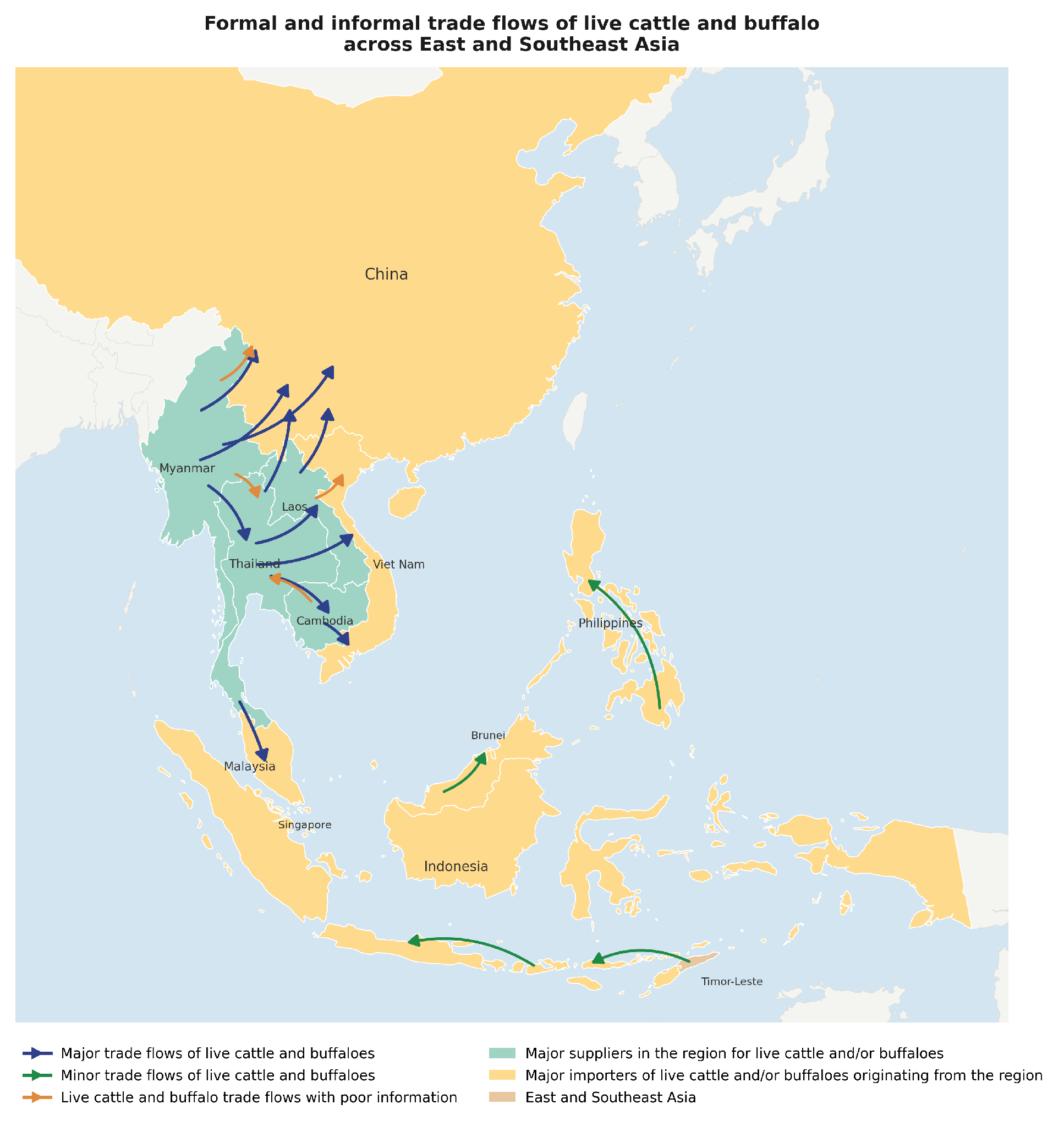
Live cattle and buffalo trade flows across East and Southeast Asia
Even a tenth of it would change the region
Australia has been the only notable seaborne live cattle exporter in this region for as long as the trade has existed (sorry NZ). Beyond small inter-island movements within Indonesia and the Philippines there is no one else. Even at a tenth of the Thai target, 120,000 head a year, that stops being true, and that is more cattle by sea than we send anywhere other than Indonesia at the moment.
Shipping is the first place it would show. Australia ran 245 livestock voyages in 2025. A hundred thousand head a month is roughly 30 voyages a month, more in a year than our entire program. Even the tenth-scale version needs close to 40 a year, potentially pulling vessels from the same small pool of purpose-built carriers our exporters charter.
What I will be watching between now and Christmas is whether China signs off those last four veterinary points, and whether the quarantine station build actually gets off the ground. If either happens then this may be possible in the region in years to come.
A trade like this would need building carefully
Thailand has no history of moving cattle long distances by sea. Its export trade has run overland, and the skills that it builds are not the skills a sea voyage needs. Loading facilities, pre-export preparation, feed and water systems, ventilation management and stockmanship on board are all things the Thais will be short of. Standing up a live export trade by sea from nothing would require building that capability deliberately and early, and the sensible course would be to draw on the countries that have already done it.
Vietnam: Slaughter Steers $4.92 AUD per kg live weight (VND 18,794 = $1 AUD)
The gap to Thai cattle has narrowed
Australian slaughter cattle are weighing in at Vietnamese abattoirs at around 98,000 to 100,000 dong a kilogram liveweight for good lines, with Thai cattle at about 94,000. That is a gap of four to six per cent, and it has closed as Thai cattle have become dearer.
Hoa Phat turns to Thailand and finds the cattle hard to buy
Hoa Phat signed in August to bring in Thai Brahman slaughter cattle at about 1,300 head a month from December, rising to roughly 36,000 a year in 2027, alongside its Australian supply. A source in Vietnam tells me the company has staff based in Thailand full time and they are buying in dribs and drabs, staying weeks at a stretch to accumulate a few hundred. The people buying Thai cattle at commercial scale are finding it slow, expensive work.
Two months of shipments, and the second was feeders
Vietnam took 2,859 head in August after 2,635 in July, its first back-to-back months since the trade stalled. The August lot was feeder cattle rather than slaughter stock, and that matters more than the volume. Slaughter cattle are a spot purchase. Feeders are a commitment to feed them out, so someone has pen space, a ration and a view on where prices land in four months. Year to date Vietnam sits at 7,508 head against 71,979 at the same point last year, a flicker rather than a recovery, but two flickers now.
Indonesia: Slaughter Steers $4.82 AUD per kg live weight (IDR 12,688 = $1 AUD)
Jakarta widens its search for breeders
Food Coordinating Minister Zulkifli Hasan said on 14 August that the government will seek a presidential regulation to speed up herd building through imported breeding stock, working with European countries, Brazil and Australia. Europe and Brazil are named ahead of us. Set that against the trade itself. Indonesia’s statistics agency reported on 1 September that the 92,700 tonnes of live cattle landed between January and July came, every tonne of it, from Australia. The supplier field is widening in policy documents faster than on the water.
El Nino hardens into a very strong event
BMKG now rates the event very strong, with the ENSO index averaging 2.2 across June to August, and about 81 per cent of the country carrying drought risk through to November. Barantin, the quarantine agency, followed on 6 September by asking farmers to lift their guard against foot-and-mouth, African swine fever and avian influenza. The disease part concerns me most. Feedlotters have absorbed higher feed costs all year, but an FMD flare in a bad dry season, with quarantine staff already stretched, would make conditions very difficult.
Australia: Feeder Steers Darwin $4.45
Exports, and the question the Thai plan raises
August was the strongest month for live exports so far at 71,711 head, Indonesia taking 58,966 of them. Darwin and Broome did most of the lifting, at 40,845 and 14,718 head, so better than four in every five cattle shipped in August left from a northern port.
Northern producers came into this season off a good wet and have been turning cattle off well, and the trade is expecting the usual November and December lift as feedlotters build numbers for Lebaran. The thing I would watch is the next wet season, because a strong El Nino that pushes it back would tighten northern supply just as those orders land.
Year 2026 cattle exports up to end of June – comparison across SE Asean markets
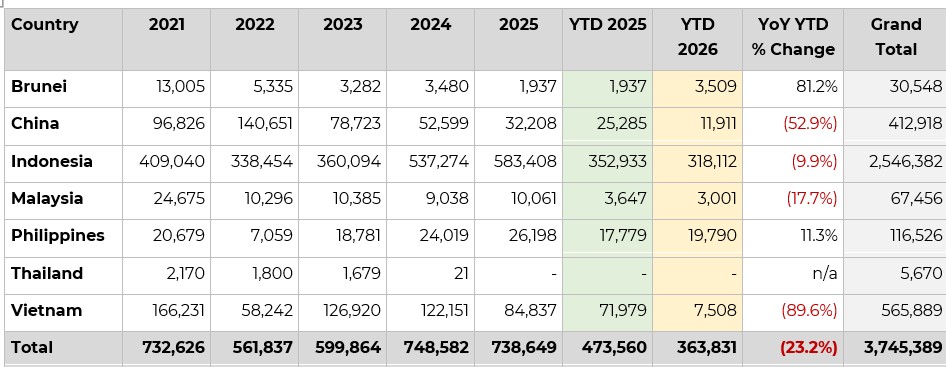
Source: DAFF website
HAVE YOUR SAY