
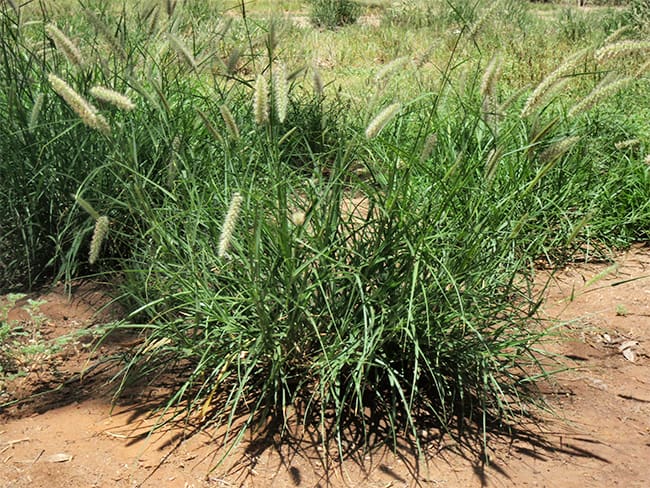
Buffel grass in the Northern Territory. Image source: NT Govt
THE Northern Territory Cattlemen’s Association says it has identified serious concerns with the methodology, calculations, assumptions, stakeholder balance and quality assurance processes underpinning a recently released Economic Impact Assessment of Buffel Grass.
Prepared for the NT Government by Charles Darwin University, the report provides a Territory-wide analysis of the economic impacts of buffel grass and a more focused assessment of buffel grass around the Alice Springs area.
A media release from NT Minister for Lands, Planning and Environment Joshua Burgoyne said the assessment examined current, active and proactive management approaches, finding that proactive management delivers the most cost-effective long-term outcomes.
“This report reinforces the need for the Federal Government and Alice Springs Town Council to work together with our Government to manage buffel grass into the future,” Mr Burgoyne said.
“The assessment recognised the economic importance of existing buffel grass pastures, with grazing on these pastures remaining an important land use across many NT pastoral regions.”
However the Northern Territory Cattlemen’s Association said after reviewing the assessment in its current form it was clear that it should not be relied upon to direct government policy or regulatory decisions.
“This assessment reaches significant conclusions about the economic value and cost of buffel grass to the Northern Territory. Those conclusions must be supported by transparent, balanced and reliable analysis,” NTCA Chief Executive Officer Romy Carey Carey said.
“The fundamental concern is that the assessment appears to apply different standards to each side of the ledger. Pastoral benefits are treated narrowly, while environmental, cultural, fire-management and other costs are considered much more broadly.”
She said the pastoral contribution of buffel grass was largely reduced to an annual production value, despite the report acknowledging other material benefits including drought resilience, standing feed security, reduced reliance on supplementary feeding, enterprise stability and increased productive capacity of pastoral land.
“You cannot credibly present an economic assessment as balanced while materially narrowing or excluding benefits on one side and adopting a broader approach to costs on the other,” Mrs Carey said.
“The issue is not whether every benefit or every cost can be assigned a dollar value. The issue is whether the same evidentiary standard is being applied consistently and transparently.”
Mrs Carey said the economic contribution of pastoral production also extended well beyond an individual leaseholder.
“The cattle industry supports regional employment, contractors, livestock transport, exporters, local businesses, infrastructure investment and government revenue. If an assessment is intended to inform economic policy, those broader regional and supplychain impacts cannot simply be omitted from one side of the equation.”
She said NTCA has arranged a meeting with Charles Darwin University to seek clarification on the methodology and calculations and to provide the University with an appropriate opportunity to respond to the concerns identified.
“NTCA recognises that buffel grass presents complex environmental, cultural and landmanagement challenges. Acknowledging those challenges does not remove the obligation to assess the pastoral, economic and regional consequences accurately and fairly.”
“Government must be able to have confidence that scarce public funding is being directed by sound evidence. Poor analysis risks producing poor policy, misdirecting limited funding and diverting effort from practical management measures capable of delivering genuine outcomes.”
“Until the significant methodological and analytical concerns identified by NTCA are satisfactorily addressed, this report should not be relied upon to direct government policy or regulatory decisions.”
Source: NTCA
HAVE YOUR SAY