
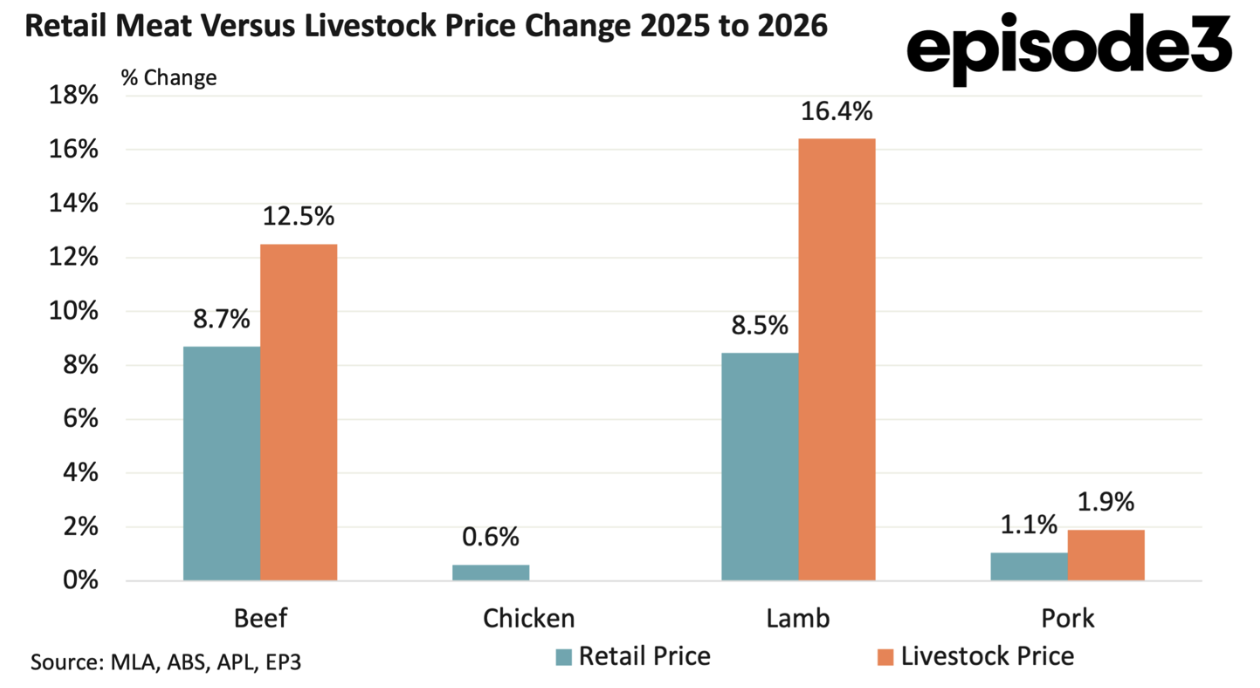
AUSTRALIAN domestic retail beef and lamb price inflation has been underpinned by genuine and substantial increases in livestock costs.
At the same time, pork and chicken have seen far greater price stability, with both livestock and retail pork prices moving only marginally and retail chicken prices almost unchanged.
These are two of the key findings from a recent analysis carried out by Matt Dalgliesh from Episode 3 for the Australian Meat Industry Council.
Australian meat prices have taken two very different directions between 2025 and 2026, the report found.
Beef and lamb have recorded strong increases at both the livestock and retail levels, while pork and chicken prices have barely moved. For meat retailers, the distinction matters because the red meat increases are being driven from the farmgate up, rather than reflecting widening margins at the retail level.
Beef livestock prices increased by an average of 12.5 percent between 2025 and 2026. Over the same period, average retail beef prices rose by 8.7pc, increasing from $27.32/kg to $29.69/kg.
The stronger increase in cattle prices than in retail beef prices suggests that some of the livestock cost pressure has been absorbed through the supply chain.
An animal price increase does not translate directly into the same percentage rise at the butcher counter. Processing costs, freight, wages, packaging, rent and the value of different cuts all sit between the farmgate and the final customer, the report found.
There can also be a lag factor before higher cattle prices are fully reflected in retail pricing.
For butchers, the important point is that the underlying raw material has become substantially more expensive, and the lift is not confined to premium cuts.
A higher carcase cost must eventually be recovered across the full animal, including grilling cuts, roasts, mince, sausages and trimmings, and slower-moving secondary cuts. Businesses that hold back prices on popular lines may need to recover more value elsewhere in the carcase.
Lamb trend even more pronounced
The same pattern is even more pronounced in lamb. Trade lamb livestock prices increased by 16.4pc since 2025, the largest rise of the four meat categories examined. Over the same period average retail lamb prices increased by 8.5pc, moving from $20.18/kg to $21.89/kg.
Again, the livestock market moved almost twice as quickly as the retail price, the report found.
This points to margin pressure for butchers, unless retail prices continue adjusting.
Stronger saleyard and processor competition for lambs raises the cost of the entire carcase, but consumers tend to notice increases most clearly on familiar lines such as cutlets, legs and loin chops.
The challenge is spreading that higher input cost across the carcase without making individual products appear prohibitively expensive, the report found.
Timing
There is also a timing issue. Livestock markets can move rapidly when seasonal supply tightens or processor demand strengthens, while retail pricing often adjusts more slowly.
Butchers may therefore feel the cost increase before customers see the full movement at the counter. The gap between a 16.4pc livestock increase and an 8.5pc retail increase suggests that the lamb supply chain has not passed through the full rise on a percentage basis.
Pork and chicken behave differently
Pork has behaved very differently. Slaughter pig prices increased by only 1.9pc over 12 months, while average retail pork prices rose by 1.1pc. Retail values moved from $15.03/kg to $15.19/kg, an increase of just 16c/kg.
This relatively flat result reflects the more intensive nature of pork production. Supply can be less exposed to the large seasonal swings seen in grazing livestock, although feed prices, energy, labour, processing capacity and disease risks still matter.
The close relationship between the livestock and retail movements indicates that there has been little major price shock moving through the pork supply chain.
Chicken was flatter still, at the retail level. Average prices increased only 4c/kg in value to $6.63/kg over the 12 months, a rise of only 0.6pc.
A direct comparison with chicken livestock prices cannot be made reliably, the report found. Australia does not have a transparent national market price for slaughter-ready chickens equivalent to cattle, lamb or pig indicators.
Commercial chicken production is predominantly vertically integrated. Processors generally own the birds and feed, while contracted farmers are paid a growing fee rather than selling finished chickens into an open livestock market.
As a result, no reliable publicly available dataset accurately shows the change in slaughter-ready chicken prices from 2025 to 2026. Gross poultry production values or implied values per bird can be calculated and these have shown a slight decline of 2.6pc in the value of chickens from 2025 to 2026, but they are not the same as an observable farmgate prices.
Beef and lamb retail inflation has been underpinned by genuine and substantial increases in livestock costs. Pork and chicken have offered far greater price stability, with both livestock and retail pork prices moving only modestly and retail chicken prices almost unchanged.
The divergence observed between beef/lamb and chicken/pork in livestock versus retail price may continue to shape consumer purchasing, the report found.
“As beef and lamb become more expensive, households may shift more meals towards pork and chicken.”
“Butchers will need to balance passing on unavoidable red meat costs with presenting value through carcase utilisation, portion size, secondary cuts and prepared products. The livestock market is placing real upward pressure on beef and lamb, but the same pressure is not yet evident in the intensive meat sectors,” the report said.
Source: AMIC
This article does not mention or take into consideration the effect that the strong export demand for beef and lamb has been a major driving force in increasing livestock prices (terrific news for producers). Chicken and pork have not increased as very little, if any is exported. What this does demonstrate is that the domestic retail market for beef and lamb struggles to keep up with the global demand pressure for the product.