
AUSTRALIA’s benchmark cattle price indicator has continued its climb this week, closing at 971.41c/kg carcase weight equivalent on Wednesday, which is up 35c/kg on this time last week.
Smaller yardings in some major selling centres in the last three weeks, plus rain in some area has helped push the Eastern Young Cattle Indicator on an upward trajectory, after falling from its recent high of 1022c/kg last month.
T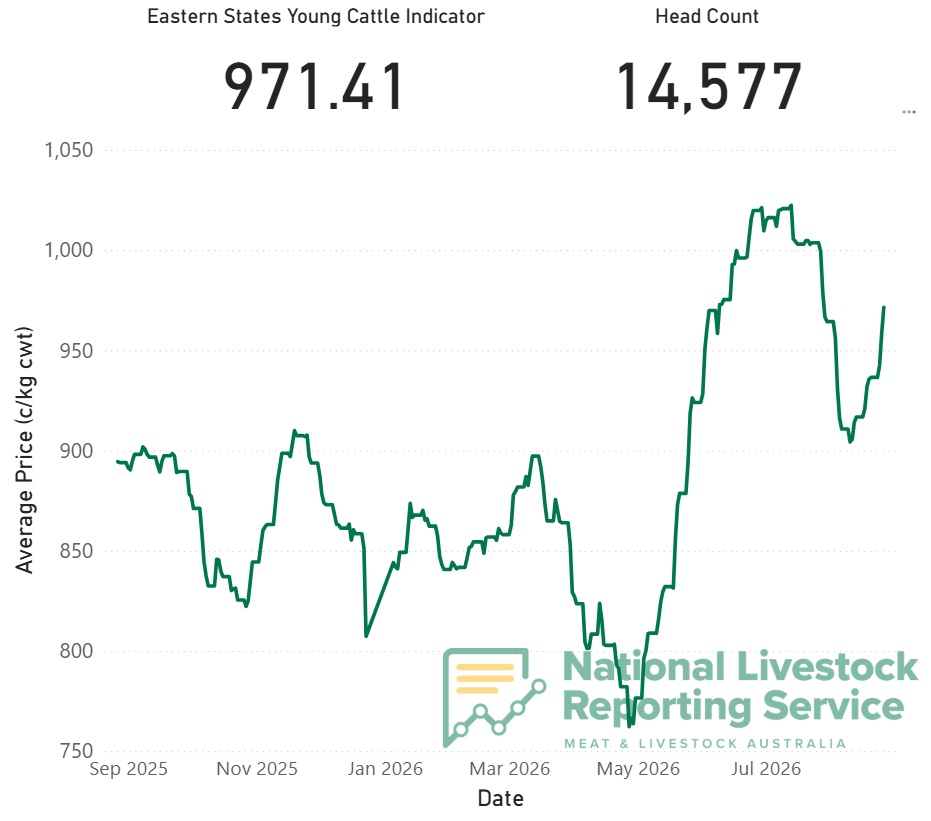 he EYCI cracked 1000c/kg carcase weight at the end of June and maintained its four-digit figure for a month, before losing nearly a dollar through August.
The forecast of rain helped slow numbers in saleyards with 5684 head yarded in Roma this week, compared to the 11,255 yarding Roma held at the start of the month.
The country’s second largest selling centre has also seen reduced yardings with Dalby selling over 4000 head for the last two weeks, compared to its 8000 plus head yardings at the end of July and start of August.
Numbers contributing to the EYCI each day have fallen sharply. The seven-day rolling average calculated today included 13,800 head* (*see NLRS EYCI parameters below) down 5800 head or 30pc from 19,600 a fortnight ago.
“When Roma and Dalby had those big yardings, the reports made note of the mixed quality of the cattle and the dry conditions in the region so there was some turn off pressure from producers,” Meat & Livestock Australia market information analyst Alex Fry told The Week in Beef podcast.
“Whereas this week both selling centres have seen a 50pc drop in the number of cattle compared to the start of the month and there was quite good quality in the yard.
“When you isolate the EYCI by saleyard from the first week of August compared to this week, Roma has lifted by 7pc and Dalby by 10pc, whereas in Wagga it’s flatlined, there’s been no increase.
“So that points to the turnoff pressure in Queensland being a driver of the dip in the EYCI that took place at the end of July and start of August.”
Historically the EYCI is still high, sitting 81c higher than it was at this time last year and over 200 cents above its low point of 762c on 27 April this year.
Mr Fry said there was too much volatility in the market with geopolitical influences and high input costs to say if April was the bottom of the market for 2026, but was confident the demand for Australian beef would see strong prices continue.
Strong demand from lotfeeders and restockers driving the rise
The return of lotfeeders operating in saleyards has also helped boost the EYCI with prices for heavier cattle driving the lift.
“When the China quota was triggered, we saw feedlots step away, but in the last four weeks they have started stepping back into the market targeting mid-range programs (120-150 day programs),” Mr Fry said.
“So, the cattle they are purchasing now would be slaughtered towards end of year or start of next year when the tariffs lift.”
The other major influence driving the EYCI is the strong interest from restockers in southern New South Wales and Victoria who are coming into spring with an excellent season in front of them.
Dave Benson is a director of Ray White Rural at Albury and said the lack of cattle in the south was sending buyers into Queensland to find cattle.
“Some of the store sales have been cancelled because of lack of numbers. Here at Northern Victoria Livestock Exchange (NVLX) we’ve seen a lot lighter numbers than we would seasonally see,” Mr Benson said.
“We’ve had good follow-up rain and we’ve got fantastic conditions going into spring so producers are hanging on to a lot of cattle and putting more weight on them with the favourable conditions in front of them.
“And we are sourcing a lot of cattle out of the north, and it looks like southern Qld is really the only place at this point with numbers of suitable cattle.”
* About the EYCI
The Eastern Young Cattle Indicator (EYCI) is the general benchmark of Australian cattle prices. The indicator is a seven-day rolling average produced daily by MLA’s National Livestock Reporting Service. The EYCI includes vealer and yearling heifers and steers, grade score C2 or C3, 200kg+ liveweight from saleyards in NSW, QLD and VIC. The results include cattle purchased for slaughter, restocking or lotfeeding and are expressed in c/kg dressed weight equivalent.
HAVE YOUR SAY