
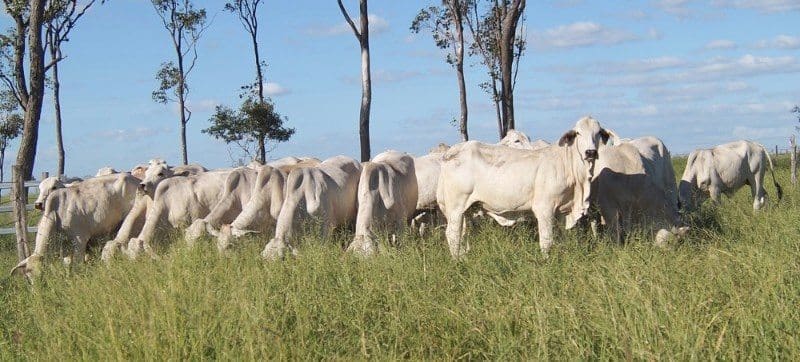
IN extensive production systems, property scale, paddock layout and labour often mean breeders are run in a few large mobs.
The same mob may contain dry-empty cows, females at different stages of pregnancy, lactating cows and first-calf heifers. Although they share a paddock, their nutritional requirements and reproductive risks can differ widely.
Without knowing their reproductive and lactation status, it is difficult to match cattle to available country, feed, water and supplementation.
Resources are allocated across the mob, even though some cows may be approaching their greatest nutritional demand. Where intake falls short, declining body condition can delay return to oestrus, reduce conception at the next joining and increase risks to cows and calves.
Targeted management therefore depends on identifying which cows need additional resources.
Calving segregation
One option is calving segregation.
In a client paper shared by FutureBeef Longreach veterinarian Dr Max Woods of MPW Veterinary Services, he outlined how pregnancy testing with foetal ageing, considered alongside lactation status, can be used to group cows according to expected calving period and management requirements.
The CashCow project did not test calving segregation directly, but its findings help explain the basis for Dr Woods’ recommendations. It monitored about 78,000 cattle in 78 commercial northern Australian beef breeding herds and examined reproductive performance alongside nutritional, environmental and management factors.
A key measure was P4M, which records whether an individual lactating cow became pregnant again within four months of calving. Across the project, 42pc of cows achieved this outcome, although the proportion varied markedly with calving time and available nutrition.
Among cows calving in December and January, 61pc became pregnant again within four months, compared with only 15pc of cows calving from July to September. Cows with adequate wet-season pasture protein recorded a P4M result 13pc higher than cows without adequate protein.
There was a 20pc difference between cows with adequate and inadequate phosphorus.
This doesn’t mean December and January are the best calving months for every property. Instead, the results showed how performance can change when the demands of calving and early lactation are not matched by feed and mineral supply.
Body condition at pregnancy diagnosis, later changes in condition and expected calving period were also associated with performance. First-lactation females carried the greatest combined risk of lower pregnancy rates, calf loss and mortality, reflecting the need to continue growing while supporting pregnancy or lactation.
Environment and management
Environment and management are major influences on calving rate and whether cows achieve P4M, but there is also a genetic contribution. Producers can therefore select animals more likely to achieve these targets, provided their nutritional requirements are met.
Commercial genomics products give producers access to predictions for some of these difficult to measure traits.
Base Pair Genomics reports Genomic Breeding Values for P4M, heifer puberty and body condition through its RePRO BI service. BreedPlan users can also consider EBVs including Days to Calving and Scrotal Size when selecting for reproductive performance.
Data from Northern Repronomics and breed society Beef Information Nucleus projects have strengthened the reference populations used in BreedPlan, with documented improvements in the accuracy of Days to Calving.
Angus Australia also reports a Mature Cow Body Condition EBV, while research continues on an objective cow body-composition EBV for northern cattle.
Importantly, these tools don’t replace nutrition or management. Genetic selection changes the future herd, while pregnancy testing and segregation guide decisions for the herd being managed now.
A cow with higher genetic merit can still fail to rebreed if available feed does not meet her requirements.
The Calf Alive Project showed what targeted feeding before calving can achieve, particularly where pasture is unlikely to meet requirements.
While the project didn’t test segregation, it did measure the response when additional nutrition was directed to selected females. Across ten operations in Queensland and the Northern Territory, selected cows and heifers received an additional 300–400 grams of protein per head each day, beginning six weeks before peak calving.
Across several years, subsequent conception rates improved by around 10pc, while early-calving cows had higher re-conception rates and heavier weaners.
The response depended on the season. During the wet conditions of 2022, pasture crude protein was above 10pc. The control cows were already well fed, which narrowed the response to supplementation. This highlights the need to confirm that a nutritional gap exists before spending money on additional protein.
Three commercial herds
Dr Woods has worked with producers in three Central Western Queensland herds, using pregnancy testing, foetal ageing and lactation status to establish management groups.
In a Tambo herd with a three-month joining, cows due to calve in October and November were separated from those due in December. A herd near Isisford used a five-month joining, with December–February calvers separated from March-April calvers. In a continuously mated herd near Winton, cows were divided into four expected calving periods, along with wet-empty and dry-empty groups.
The aim of segregation is to manage each group according to its requirements. Cows close to calving can move onto better country with adequate feed and reliable water, while first-calf heifers can be managed separately.
Other groups may remain on less preferred country where their pregnancy stage, lactation status and body condition allow.
Expected calving dates can also help with planning branding and weaning by reducing the number of mixed-age calves handled at each muster. If the season deteriorates, producers can identify which cows would benefit most from having their calves weaned early.
Dry-empty cows can be considered for sale, while wet-empty cows need to be assessed against recent calving and pregnancy-testing dates.
In practice, the number of groups depends on paddocks, water, labour and cattle numbers. For many businesses, three groups, early-calving, later-calving and empty, may provide sufficient flexibility.
There is little value in creating more groups than the property can maintain. Foetal age also needs to be considered alongside lactation status, body condition, cow class and the timing of pregnancy testing.
This is particularly important in continuously mated herds, where recently calved cows may have pregnancies that are not yet detectable.
It is important to recognise that this approach depends on accurate foetal ageing and enough paddock flexibility to maintain the groups. Pregnancy testing, handling and additional paddock movements have a cost, so the information needs to support a decision about country allocation, supplementation, early weaning or the sale of non-productive cows.
In an extensive breeder herd, better nutrition does not mean feeding every cow more. It means identifying the cows approaching their greatest demand and matching management to their requirements.
Genetic selection can lift the potential of future females for fertility and body condition, but that potential is difficult to realise if the cows in highest demand are not matched to the country available.
 Alastair Rayner is the Strategic Account Manager for Southern Australia with Vytelle and Principal of RaynerAg. He has over 30 years’ experience advising beef producers and graziers across Australia. Alastair can be contacted here or through his website: www.raynerag.com.au
HAVE YOUR SAY