
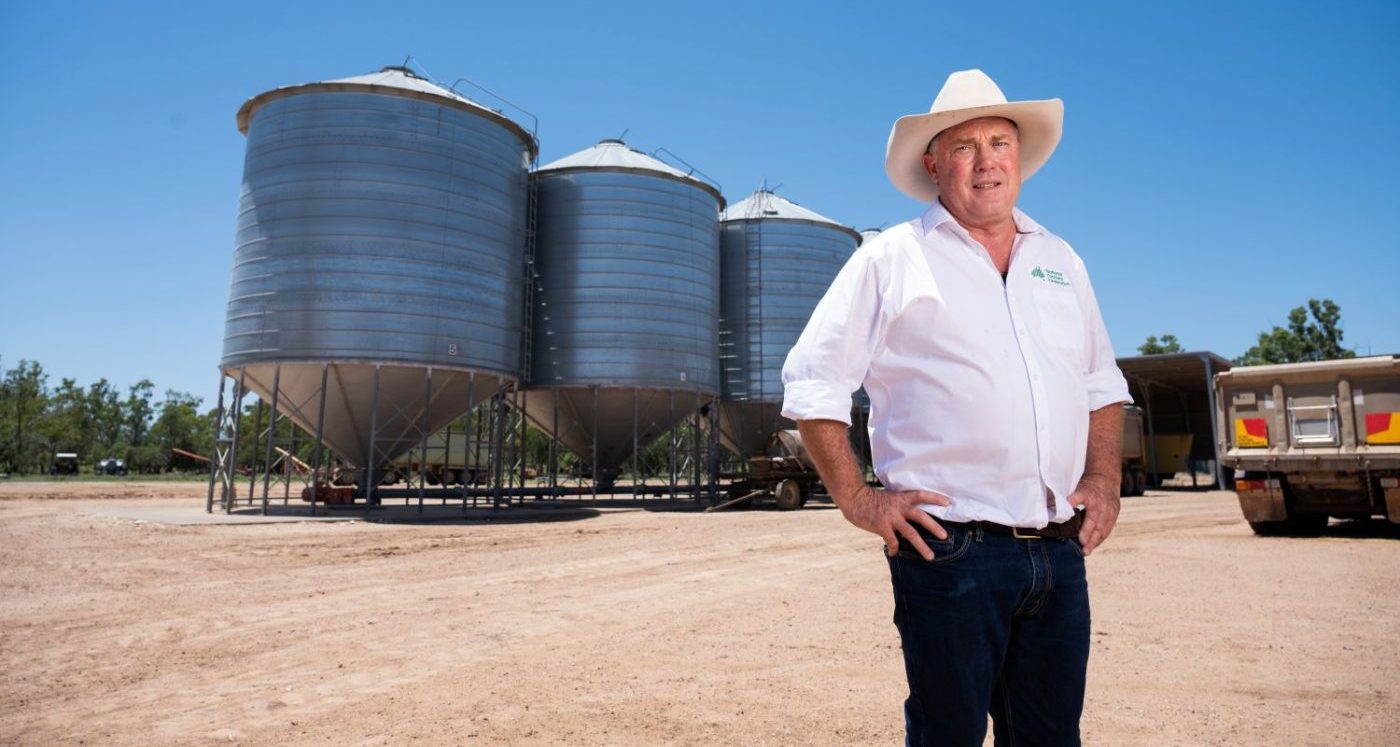
Hamish McIntyre, National Farmers Federation President.
THE latest Australian business data has delivered contrasting signals for agriculture, with the sector the only industry to record a decline in business numbers over the past financial year, while also recording the highest four-year survival rate of any industry.
Australian Bureau of Statistics figures released this week show business survival rates across the broader Australian economy have dropped to a decade low, with 460,000 new businesses opening in the 12 months to June 30, 2026, while 375,331 businesses closed.
That equated to a net increase of 85,130 actively trading businesses, or 3.1 percent, taking the total number operating in Australia at June 30 to 2,814,778.
In sector specific terms, agriculture was the only industry to record a decrease in business numbers during 2025-26, falling 0.5pc to 170,185 businesses.
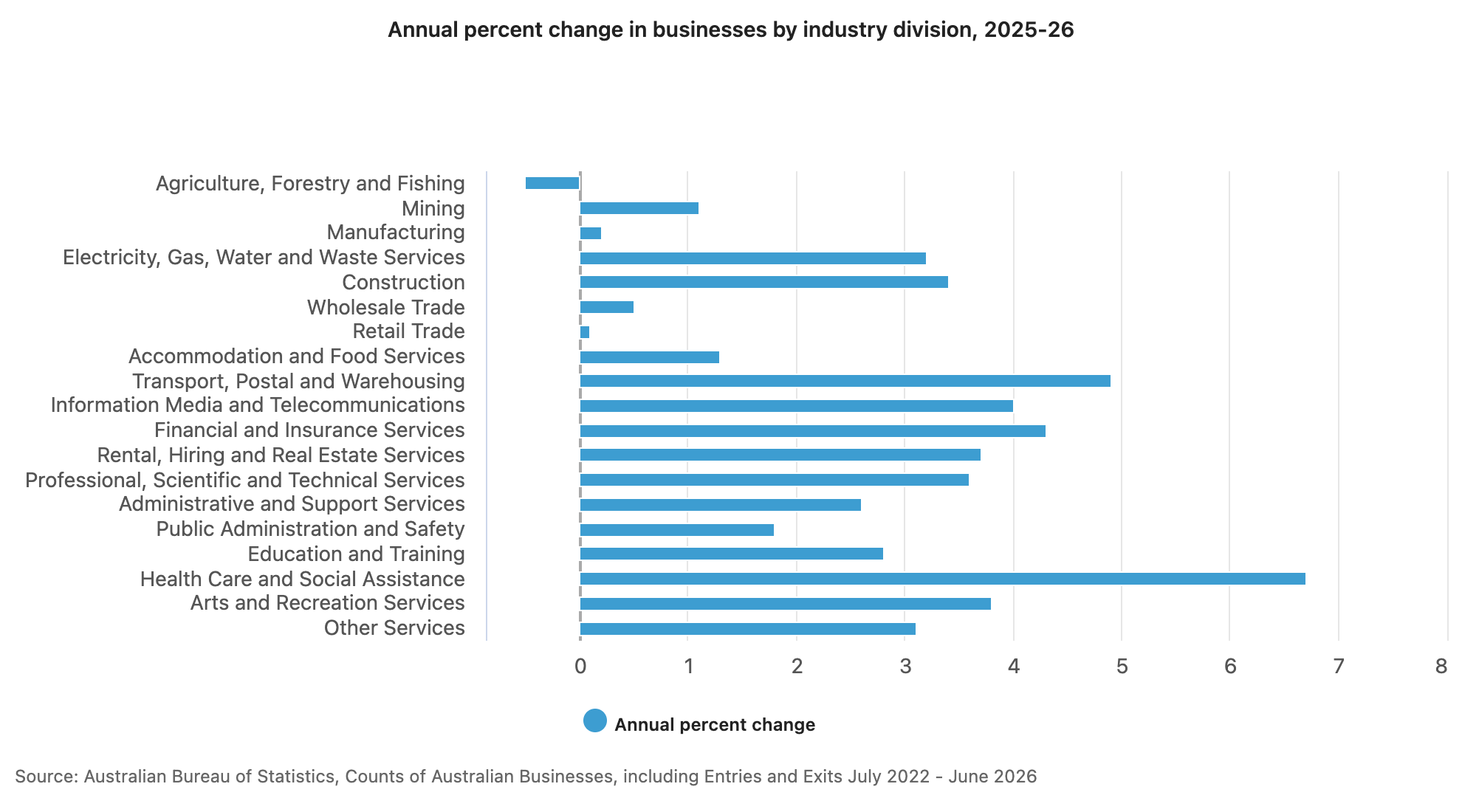
The three industries recording the largest percentage increases were health care and social assistance (up 6.7 percent to 227,702 businesses), transport, postal and warehousing (up 4.9pc to 261,109) and financial and insurance services, (up 4.3pc to 139,417).
But agriculture leads on business survivability
But in contrast to other industries nationally, the agricultural sector had the highest four-year business survival rate, with 60.2 percent of the new businesses that entered the sector in 2022/23 still active in 2025/26.
The next sectors with the highest four-year business survival rates in Australia were health care and social assistance (with 59.2pc of the 29,722 new business entrants four years ago surviving to 2025/26); rental, hiring and real estate services (58.1pc of 32,553 entrants still active) and mining (52.2pc of 980 entrants still active).
The ABS data shows that across all sectors, 49.2 percent of new businesses survive four years or more.
The sector with the highest business closure rate in the past year was cafes and restaurants at 12.03 percent, almost double the national average.
More than one in eight cafés, restaurants and takeaway food businesses closed in the 12 months to July 2026, according to CreditorWatch’s data.
“Put another way: of every 100 cafés and restaurants trading a year ago, 12 are no longer operating. It’s a clear illustration of a sector caught between rising costs it has limited ability to control and households that are dining out less,” a CreditorWatch report said.
NFF hosts ag leaders summit
The figures come as the National Farmers’ Federation this week marked Australian agriculture reaching a target milestone of $100 billion in annual farmgate output.
Speaking at the NFF Leaders’ Summit at Parliament House in Canberra, NFF president Hamish McIntyre said the milestone reflected the willingness of Australian farmers to take risks, innovate and adapt through difficult conditions.
“This milestone did not happen by accident. It happened because Australian farmers backed themselves, took risks, adapted, innovated and kept producing some of the best food and fibre in the world through some tough conditions,” he said.
Voices at the table
Mr McIntyre said the theme of the summit, which was attended by political leaders including Prime Minister Anthony Albanese, Agriculture Minister Julie Collins, Federal Opposition leader Angus Taylor and Shadow Agriculture Minister Darren Chester, was “the national table”, chosen to reflect the tables around which farmers discussed issues of importance every day.

Ag Minister Julie Collins, PM Anthony Albanese and NFF President Hamish McIntyre.
“On our property in south-west Queensland, most of the important conversations happen around our kitchen table,” Mr McIntyre said.
“Mary and I built our farming business from our first property near Dirranbandi. These days we run cropping, cattle, feedlots and poultry across a fair stretch of Queensland. Our three sons are involved too, so there is always plenty to discuss.
“Around our table, we talk about cattle, crops, water and what the bank manager might say about our next big idea.
“It is not a boardroom. But it is where plans are made, problems are sorted and the future of our business is decided.
“And nothing stays theoretical for long.
“A shipping disruption can mean fuel or fertiliser does not arrive when we need it. A decision made overseas can change the price we receive for our cattle or cotton, and a regulation written in Canberra can change what we do in a paddock thousands of kilometres away.
“These are not distant policy debates. They are playing out around farmers’ kitchen tables right now.
“Today, in this room, we are deliberately building a bigger National Table.
“We will each leave here and return to other tables – be it board tables, council tables, industry tables and kitchen tables. Each has its own role, and each matters.
“But wherever we are sitting, the questions are much the same – What is changing? What does it mean in practice? Who needs to be part of the conversation? And how do we make good decisions early?”
‘Overall value does not mean every farm is profitable’
ABARES has forecast the value of Australian farm production will reach $101.4 billion in 2025-26, surpassing the NFF’s target four years ahead of the original 2030 deadline, set in 2018 when farm production was worth around $60 billion.
The NFF president said reaching the target demonstrated what could be achieved when farmers, governments, researchers and businesses worked towards a common national ambition.
But he cautioned that the headline value of agricultural production did not necessarily reflect conditions at individual farm level.
“A strong national target does not mean every farm is profitable. It does not mean every regional community has the services, infrastructure or people it needs. And it does not mean the next generation automatically has the confidence to build its future in agriculture,” he said.
“Productivity without profitability does not keep a family on the land.”
He said the real test was whether farmers, fishers and foresters could remain productive and profitable through future seasons, market cycles and policy changes – and whether they saw a future worth continuing to invest in.
Agriculture needs seat at the ‘national table’
The central theme of the NFF summit was the need for agriculture to become involved earlier in national policy discussions that ultimately affect farms and regional communities.
Mr McIntyre said risks facing agricultural businesses were becoming increasingly interconnected, with geopolitical conflicts capable of affecting fuel and fertiliser supplies, trade disputes potentially closing export markets and biosecurity emergencies threatening production.
At the same time, major national priorities such as housing construction and renewable energy development were competing with agriculture for limited regional workers, infrastructure and accommodation.
Australia was targeting 1.2 million new homes over five years while working towards 82pc renewable electricity by 2030.
Infrastructure Australia expects the shortage of infrastructure workers in regional areas to increase fourfold by 2027, driven largely by energy and utility projects.
That could leave farms, food processors, councils and energy developments competing for the same electricians, mechanics and truck drivers, the summit heard.
The NFF president said agriculture therefore needed to be involved in national discussions about housing, energy, infrastructure, trade, technology, national security and food security before decisions were made, rather than responding after their impacts reached the farm gate.
He pointed to recent pressure on fuel and fertiliser supplies as an example of how early agricultural involvement could work.
The NFF had been included in separate government working groups on fuel and fertiliser alongside departments responsible for agriculture, industry, foreign affairs and the national fuel response.
“The discussions were practical – where would the next shipment of urea come from? How could it clear our ports faster without weakening biosecurity? And how do get access to diesel as well as distribute it to the regions and industries that needed it most?
“That is very different from hearing about a decision after it has already been made,” he said.
“It is also a sign of a sector maturing beyond a narrow agricultural policy conversation. Agriculture must now continue to build momentum around how Australia thinks about food security, supply chain resilience and sovereign capability. That is the opportunity we have before us today, to help prepare our sector to increasingly be part of those conversations.”
Growth brings new pressures
The summit also focused on the growing demands being placed on regional infrastructure and communities as agriculture, energy, housing and other industries expand.
Australia’s domestic freight task was forecast to grow by 26pc between 2020 and 2050, potentially putting grain and livestock trucks, mining equipment and renewable energy components onto the same regional roads and bridges.
He urged industry leaders to look for connections between issues rather than treating each as an isolated problem, and said the success of the summit should ultimately be judged by whether it produced practical action.
“If we leave with a better description of the challenges, but no clearer sense of what needs to change or who we need to work with, we will not have used this opportunity well,” he said.
“But if we leave with stronger relationships, a better understanding of the choices ahead, and a few practical things we can do together, today will have mattered.”
The NFF said the next national ambition for Australian agriculture will be launched at its AgXchange national conference in Adelaide from 23 to 25 August.
HAVE YOUR SAY