
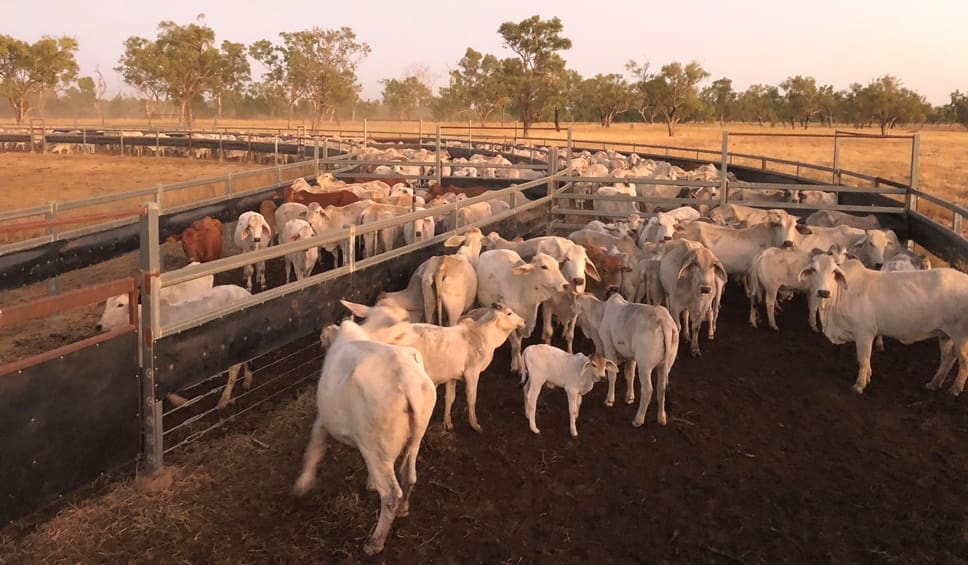
GESTATION length is a figure that can easily be taken for granted. Many planning decisions around calving are based on an assumed bovine gestation length of 283 days.
However, most producers also know that gestation can vary, with shorter and longer pregnancies occurring within most breeding herds.
Data collected through the northern Repronomics project demonstrates the extent of this variation, particularly among tropically-adapted cattle. The results also show that gestation length is a highly heritable trait that can influence birthweight without necessarily changing subsequent growth to weaning.
These findings were published in Animal Production Science in December 2025. Dr Kirsty Moore and Dr David Johnston from the Animal Genetics and Breeding Unit and Tim Grant from Queensland DPI analysed records from Brahman, Droughtmaster and Santa Gertrudis cattle at the Brian Pastures and Spyglass research facilities.
Their analysis included 2346 gestation-length records, 7044 birthweights and 6248 weaning weights from animals born between 2014 and 2022.
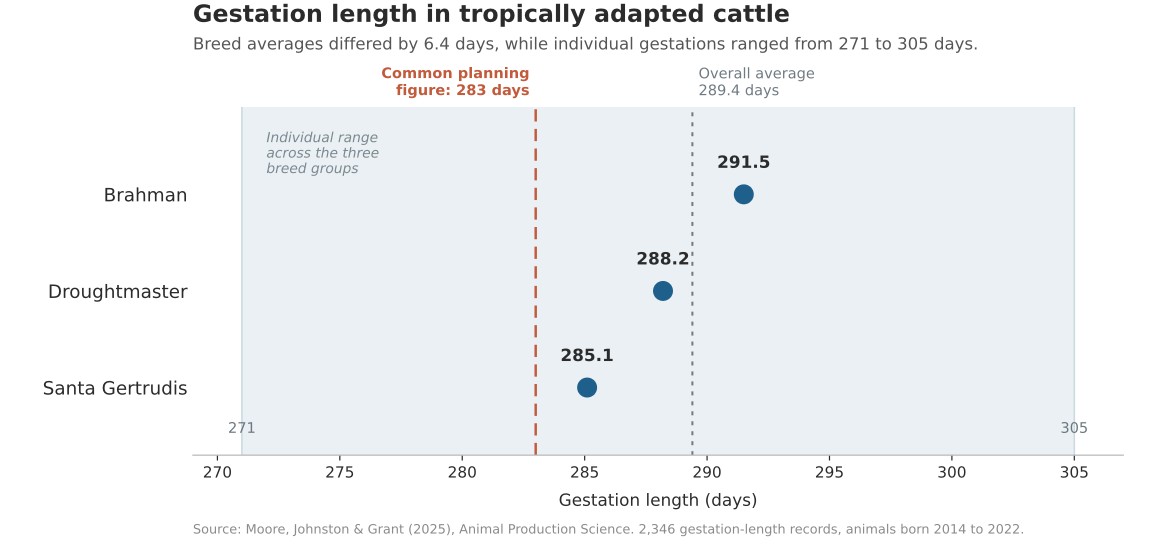
The average gestation length across the dataset was 289.4 days, but individual gestations ranged from 271 to 305 days.
Click on image for a larger view
There were also clear differences among breeds, as can be seen above. The adjusted breed mean figures were 291.5 days for Brahman calves, 288.2 days for Droughtmasters and 285.1 days for Santa Gertrudis.
Male calves had longer gestations than females in all three breed groups. The difference was 3.1 days in Brahmans, 1.9 days in Droughtmasters and 2.4 days in Santa Gertrudis.
Explaining differences
These breed and gender differences may help explain some of the variation producers see at calving.
For breeding decisions, however, the more useful finding was the genetic variation among sires within each breed for gestation length, because this is the component that can be changed through selection.
The source of that variation is more difficult to identify in naturally-mated herds, because the conception date is usually not known precisely. A calf born late in the calving period may have been conceived later than its herd-mates, may have had a longer gestation, or both. Unless the mating or conception date is known, those effects cannot easily be separated.
Firmer starting point
Producers using assisted breeding techniques have a much firmer starting point for determining gestation length.
Artificial insemination provides a known insemination date, allowing gestation length to be measured more accurately. Embryo transfer also provides a defined transfer date, but the age of the embryo must be taken into account when estimating the calving date.
In multiple ovulation and embryo transfer (MOET) programs, embryos are generally recovered six to eight days after the donor is inseminated. IVF embryos are usually transferred or frozen around seven or eight days after fertilisation.
If an embryo is frozen, its developmental age remains unchanged during storage. When it is transferred, the recipient’s reproductive cycle is synchronised with that stage of development.
When calculating the expected period from embryo transfer to calving, the embryo’s age needs to be deducted from the expected gestation length. Under the general 283-day assumption, approximately 276 days would remain after the transfer of a day-seven embryo.
A breed-specific expectation is preferable where one is available. Based on the adjusted breed means from this study, the expected period from transfer to calving would be approximately 285 days for a day-seven Brahman embryo, 281 days for a Droughtmaster and 278 days for a Santa Gertrudis.
Why does it matter?
This distinction matters, because the period from transfer to calving does not represent the calf’s total gestation length.
For example, a Brahman calf completing a 291-day gestation from a day-seven embryo would be born approximately 284 days after transfer. Including the seven days of development before transfer provides the calf’s total gestation length, which can then be compared with the expectation for its breed and sex.
US study finds birth weight/gestation length relationship
An earlier study from Colorado State University’s Animal Reproduction Laboratory also found a relationship between gestation length and birthweight.
Using records from 1139 ET calves born in the US and Canada, the researchers found that birthweight was about 0.29kg (290g) higher for each additional day of gestation relative to the average for the embryo’s breed.
The Repronomics results support this relationship genetically. Gestation length had a positive genetic correlation of 0.30 with birthweight, indicating that genetics associated with longer gestation also tended to be associated with heavier calves at birth.
Gestation length was also highly heritable, with an estimate of 0.79. This suggests that the trait should respond strongly to selection where accurate records and sufficiently reliable Gestation Length EBVs are available.
Importantly, the researchers found no significant genetic relationship between gestation length and weaning weight. Selection for shorter gestation may therefore indirectly reduce birthweight without producing a corresponding reduction in weight at weaning.
The study did not directly demonstrate a reduction in calving difficulty because very few difficult births occurred in the research herds.
While lower birthweight is associated with reduced dystocia risk, the Gestation Length EBV should still be considered alongside Birth Weight and Calving Ease EBVs rather than used as a substitute for them.
Gestation length should also be distinguished from days-to-calving. Gestation length measures the period from conception to birth, while days-to-calving measures the period from the beginning of a natural joining until the female subsequently calves.
A shorter Days-to-Calving EBV is primarily associated with females conceiving earlier, although gestation length also contributes to the eventual calving date.
BreedPlan calculates Days-to-Calving EBVs from natural-joining records, while Gestation Length EBVs are calculated from known AI or hand-mating dates and subsequent birth dates.
The two traits therefore describe different components of reproductive performance. Days-to-calving largely reflects how early a female conceives, while gestation length describes how long the resulting pregnancy lasts.
Both traits can influence when calves are born, but they do so in different ways.
In AI and IVF programs, understanding gestation length also improves the calculation of expected calving dates and helps determine when closer observation should begin.
The practical message is not that 283 days gestation in cattle is ‘wrong’. It remains useful as a general planning figure, but it may not be the most appropriate expectation for every breed or mating.
Whether calves are conceived naturally, by AI or through IVF, Gestation Length EBVs provide producers with another way to balance birthweight, calving ease, reproductive efficiency and growth in their breeding decisions.
 Alastair Rayner is the Strategic Account Manager for Southern Australia with Vytelle and Principal of RaynerAg. He has over 30 years’ experience advising beef producers and graziers across Australia. Alastair can be contacted here or through his website: www.raynerag.com.au
HAVE YOUR SAY