
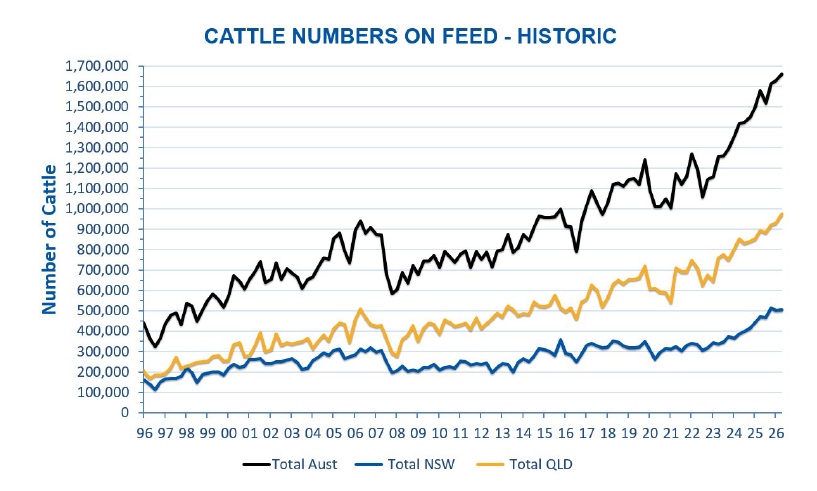
Click on graphs for a larger view
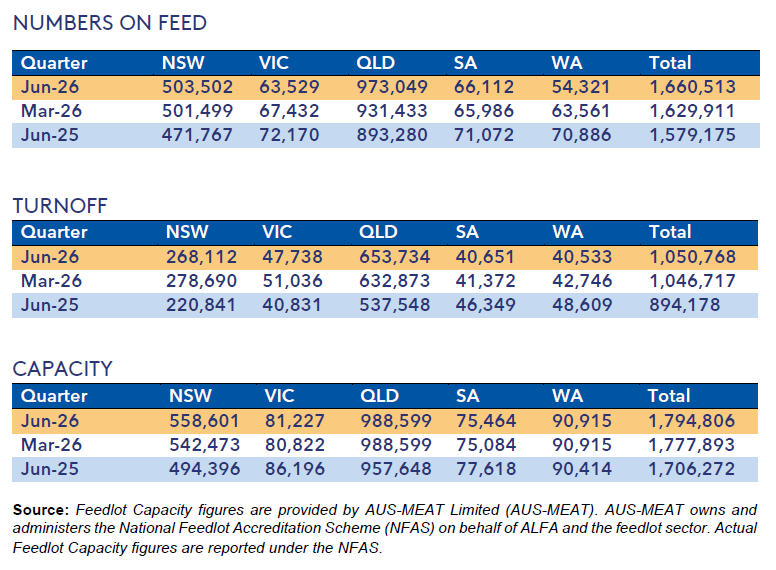
NUMBERS of cattle on feed in Australian feedlots continued its recent trajectory in the June quarter, setting a new record of 1.66 million head – up another 30,000 head or 1.8pc since the March quarter.
Year-on-year cattle on feed have risen almost 81,000 head in the June quarter industry survey result released this morning, due mostly to expansions at existing feedlot sites, plus some new facilities coming on stream.
Capacity, utilisation hit records
National feedlot capacity also continues to trend higher, reaching a record 1.795 million at the end of June, up almost 89,000 head on this time last year.
Feedlot utilisation in the June quarter continued at recent very high levels, reaching 92.5pc – identical to this time last year. Utilisation rates above this level are difficult to achieve in commercial feedlots, because of pen cleaning, maintenance and other requirements.
In a state-by-state breakdown of numbers on feed, Queensland is rapidly approaching one million head at any given time, reporting 973,000 in the June quarter, up 80,000 on the same time last year.
The state’s utilisation rate lifted from 94pc to an unprecedented 98.4pc over the quarter, with turn-off rising 3.2pc to 653,734 head. The extent of Wagyu feeding may partly explain the extreme high utilisation rate in Queensland
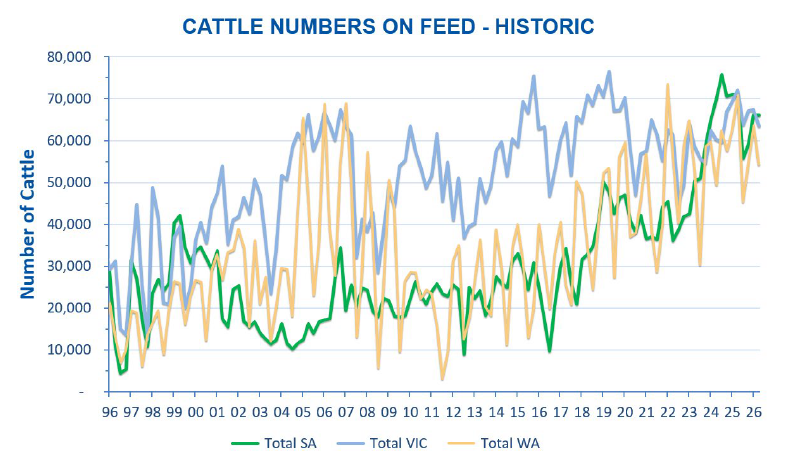
NSW has now gone past half a million on feed, reporting 503,502 last quarter, up 32,000 on last year, with utilisation at 90pc. Victoria showed negative growth, falling 8600 since June last year to 63,500. NSW drove most of the national capacity growth, increasing 3pc to 558,600 head, while turn-off eased 3.9pc to 268,112 head.
The further rise in numbers on feed last quarter surprised some grainfed stakeholders, with expectations that rising feedgrain prices and flat international trading conditions for quality Australian red meat might produce a soft decline in numbers, going against recent trends. Forward contracts on December delivery 100-day grainfed cattle have declined from recent highs of 900c/kg.
Grain fed beef export volume reached a record 121,750 tonnes for a June quarter, driven by strong international demand. However within that figure, Australia’s July grainfed beef exports fell 15pc year-on-year to 36,661t, as the 55pc China tariff took full effect. Grainfed exports to China dropped 69pc year-on-year to just 5041t in July. This was offset by a 5pc y-o-y increase to Japan (12,028t); +51pc to South Korea (10,517t) and (+4pc to North America (2389t).
Australian feedlots turned off a record 1.05 million head in the June 2026 quarter, up 0.4pc on March and 17.5pc higher than June 2025.
Feeding duration
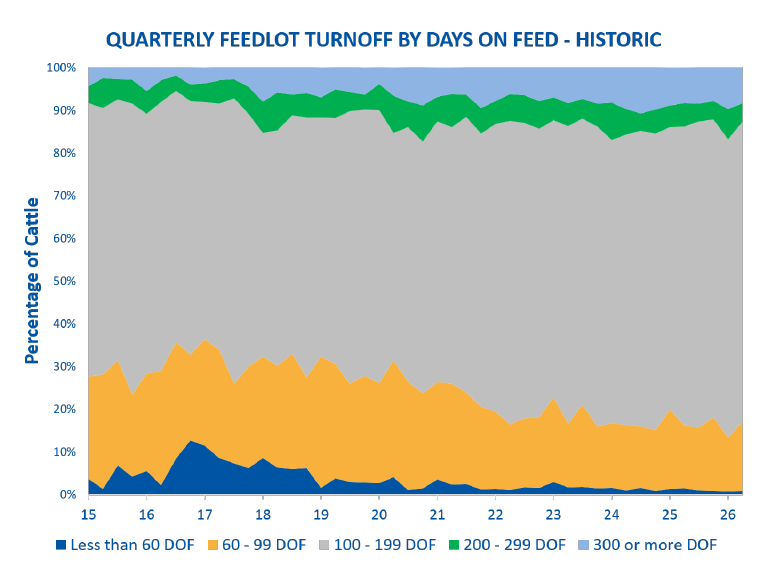
As seen in the graph below, feeding duration showed some minor variances last month, with slightly fewer longfed Wagyu +300 days (measured as a percentage), slightly fewer 200-299 day feeding programs, and slightly more feeding activity in the domestic 60-99 day category, compared with the March quarter.
Australian Lot Feeders Association president Grant Garey said the results reflected the strength of global demand for Australian grainfed beef and continued investment across the feedlot sector.
“The continued growth of Australia’s feedlot sector reflects growing demand for a product that delivers consistency, quality and reliability,” he said.
“Grainfed beef allows producers to achieve the marbling, eating quality and carcase specifications premium customers expect, whether they’re dining in Tokyo, Seoul or Sydney,” Mr Garey said.
“Feedlots also provide an efficient production system, with carefully formulated rations supporting cattle performance and helping producers meet market requirements with confidence. That is why we are continuing to see record numbers on feed, ongoing investment in feedlot capacity and strong demand from global markets.”
“Strong international demand has supported increased placements into feedlots, while continued investment in infrastructure has lifted national capacity to another record level.
“With recent growth, the sector remains well positioned to supply premium grainfed beef to customers around the world.”
MLA senior market information analyst Emiliano Diaz said export demand remained a key driver of feedlot performance.
“Australian grainfed beef exports reached 121,750t during the June quarter, making it the largest June quarter export volume on record and 7.7pc above the same period last year,” Mr Diaz said.
“Growth in demand from key markets including Japan and Korea more than offset challenges in China, highlighting the diversification and resilience of Australia’s grain fed export sector.”
Exports to Korea increased 29pc over the quarter to 25,027t, while exports to Japan lifted 21pc to 32,656t. Exports to China declined 16pc to 35,884tonnes as market access challenges created disruption.
Domestic feeder cattle markets strengthened during the June quarter as supplies tightened. The National Livestock Reporting Service reported feeder steer throughput fell 11pc to 76,707 head, while feeder heifer throughput declined 13pc to 67,412 head.
The Feeder Steer Indicator lifted 2.5pc to 485¢/kg liveweight, while the Feeder Heifer Indicator rose 4.7pc to 439¢/kg liveweight.
Mr Diaz said improving seasonal conditions were influencing supply decisions across key production regions.
“Reduced feeder cattle availability, combined with improving on-farm conditions across parts of New South Wales and southern Queensland, contributed to stronger feeder cattle prices during the quarter,” he said.
“At the same time, higher grain prices have increased feed costs, reinforcing the importance of operational efficiency across the supply chain.”
Mr Garey said the record results highlighted the sector’s ability to respond to growing global demand while continuing to deliver high-quality grain fed beef.
“Australian feedlots continue to play a critical role in supporting beef production, export growth and regional economies,” he said.
“These record capacity and production figures provide a strong foundation as the industry continues to meet the needs of customers both domestically and internationally.”

Early bird registration discounts for BeefEx about to close
Meanwhile ALFA has issued a last call for those wishing to benefit from early-bird registration discounts for the upcoming BeefEx feedlot industry conference taking place next month.
BeefEx takes place at the Gold Coast Convention Centre from 22-24 September.
Early bird bookings close tomorrow, 15 August, saving intending delegates up to $275 for ALFA members on the full program, and $275 for non-members. Click here to learn more and make a registration.
HAVE YOUR SAY