
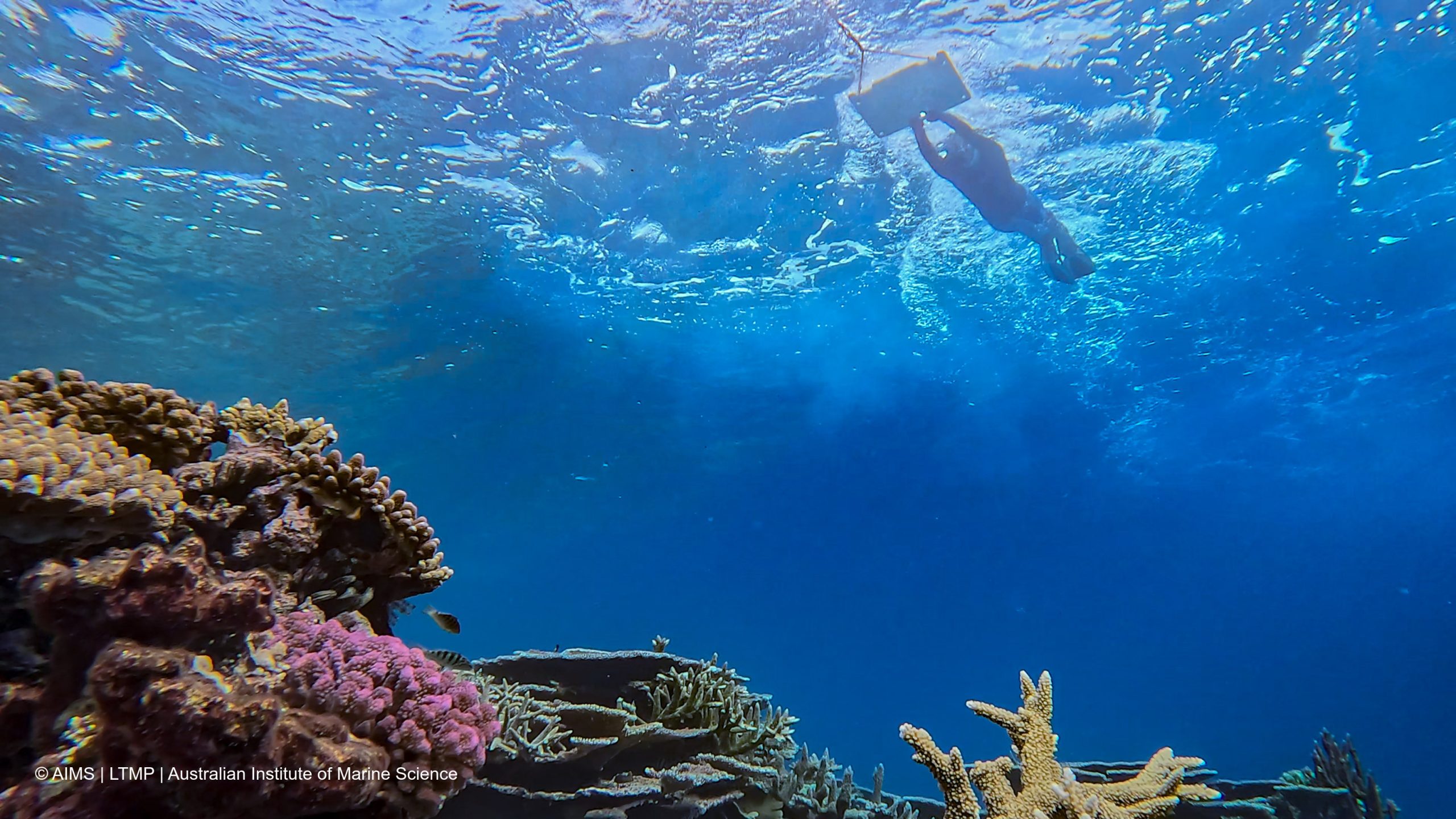
Drivers conducting Manta Tow surveys of the Great Barrier Reef. Image: Australian Institute of Marine Science.
TWO weeks after activist groups launched billboard campaigns in South Korea accusing Australian beef production of destroying the Great Barrier Reef, two official reef health reports have documented rebounding coral cover and improved water quality across the iconic ecosystem.
A joint three-year Reef Water Quality Report Card released on Thursday by Federal Environment Minister Murray Watt and Queensland Environment Minister Andrew Powell showed improvements in catchment health and “progress towards all water quality targets”.
The statement said the improvements had been driven by strategic government funding and the positive work of landholders and industry to implement practical, sustainable practices that improve water quality.
“The strong commitment of Queensland’s sugarcane, banana, grain and grazing industries, alongside targeted gully and streambank restoration projects, has helped deliver measurable improvements in water quality across reef catchments.”
Additionally, the latest Australian Institute of Marine Science’s (AIMS) annual survey of the ecosystem released this week showed Great Barrier Reef coral cover has rebounded to near record levels in the northern and central sections following mass bleaching events in recent years.
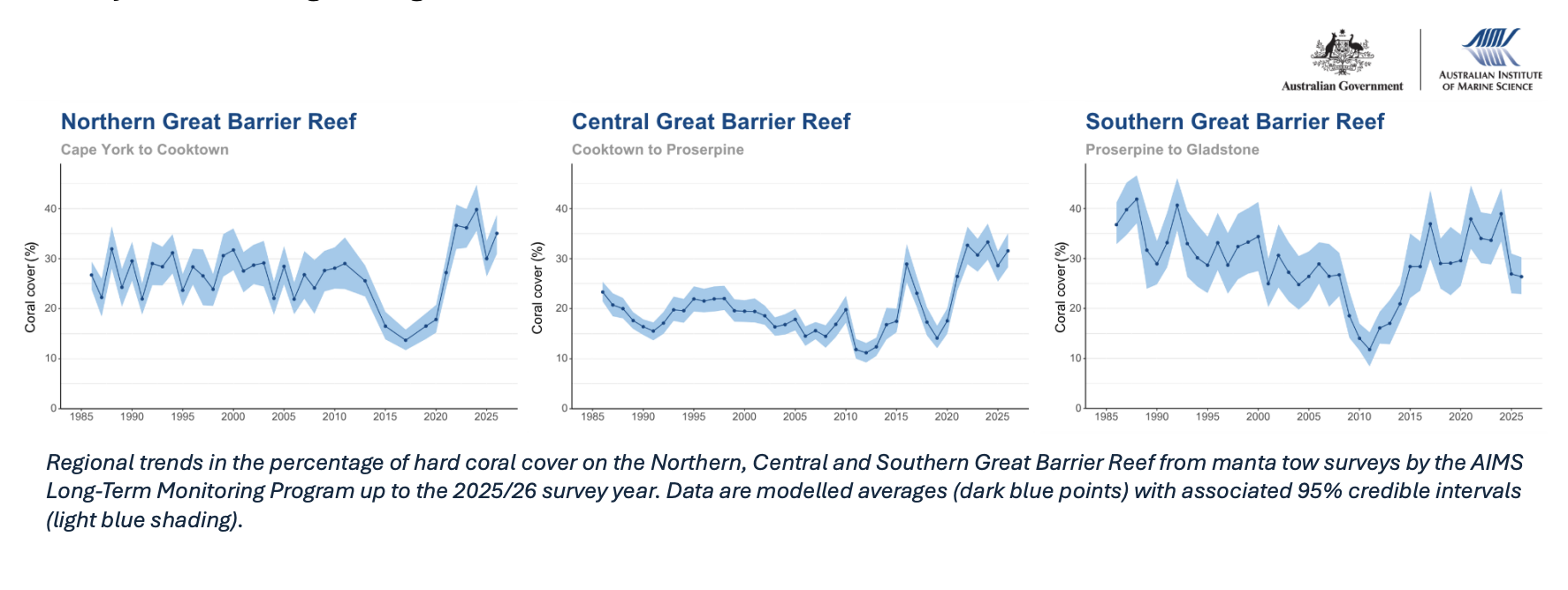
Charts showing coral cover over 40 years of monitoring across the three regions of the Great Barrier Reef. Source: AIMS
Coral cover across all three regions of the reef increased slightly or remained at similar levels to those recorded last year, indicating limited impacts from the 2025 mass bleaching event and the regional bleaching event in the Northern and Central regions recorded earlier in 2026.
Speaking to The Australian about the latest AIMS report, marine physicist Peter Ridd said the results showed that, for each of the past five years, raw coral cover on the Reef had been higher than in any of the previous 35 years.
He added that AIMS data showed the major causes of temporary coral loss over the decades had been cyclones and crown-of-thorns starfish outbreaks, both of which were entirely natural.
“There is no evidence that these are any worse than in the distant past,” he said.
AIMS’ latest annual snapshot of coral cover showed a 16.7pc increase relative to 2025 levels in the northern region from Cape York to Cooktown, a 10.2pc increase in the central region from Cooktown to Proserpine and a 2pc decrease in the southern region from Proserpine to Gladstone.
An AIMS media release said this year’s results provided evidence of initial recovery and that coral cover levels were higher than those of many coral reef ecosystems globally.
It added, however, that the Great Barrier Reef remained “a system under pressure” from the increased frequency and escalating impact of unprecedented bleaching events, compounded by damage from cyclones, floods and outbreaks of crown-of-thorns starfish.
Activist campaign accused Australian beef of killing the reef
In July, activist groups including the Australian Conservation Foundation and Mighty Earth targeted a UNESCO meeting in Busan, South Korea, with a series of billboards carrying the slogan “I’m killin’ it with Aussie Beef” alongside imagery of bleached coral and McDonald’s iconic arches.
The campaign was coordinated around a UNESCO World Heritage Committee meeting in Busan from July 20-29, where delegates met to assess the health of the Great Barrier Reef.
The UNESCO meeting declined to place the Reef on the World Heritage “in danger” list, noting continuing concerns over climate change, water quality and coral bleaching, while also acknowledging Australia’s ongoing investment in reef management.
Misleading campaign slammed
Responding to the South Korean billboard campaign, Dale Stiller from landholder representative group Property Rights Australia said the activist campaigns purposely failed to acknowledge that farmers were subject to strong environmental laws, were monitored by satellite and investigated for possible infringements, could only manage regrowth vegetation on land that had previously been cleared, and had collectively made significant investments over two decades in programs aimed at improving groundcover and reducing sediment runoff in the Great Barrier Reef catchment.
“These fanatical environmental groups should end up in court and their charity status revoked over their claims about the Great Barrier Reef and beef cattle,” Mr Stiller said.
Senator Susan McDonald also criticised the campaign on social media, saying that accusing farmers and graziers of harming the environment was “lazy and wrong” and calling on activists to stop targeting Australian food producers.
Water quality report highlights landholder efforts
Releasing the latest three-year Reef Water Quality Report Card this week, Federal Minister for the Environment and Water Murray Watt said the report card was an important tool in measuring action taken by the Australian and Queensland governments to improve the quality of water flowing to the Great Barrier Reef.
“The Great Barrier Reef is one of our greatest natural assets and it’s important that we continue to manage the quality of water flowing into it,” Minister Watt said.
“Poor water quality can kill seagrass ecosystems and reduce sunlight that is needed to help coral to grow and thrive.
“Together with the Queensland Government we have committed more than $2 billion to improve Reef water quality, and these results demonstrate the important progress that we’ve made.
“But we know there is more to be done, and we will keep working with industry, Traditional Owners, scientists and local communities to safeguard the Great Barrier Reef and those who depend on it for generations to come.”
Queensland Minister for the Environment and Tourism Andrew Powell said the results demonstrated the power of coordinated action.
“Protecting the Reef requires governments, councils, industry, landholders and local communities working together, and we’re committed to that collaborative approach to ensure the Reef remains healthy and strong for generations to come.”
The statement said the Reef Water Quality Report Card 2023-2025 highlighted how locally tailored solutions were tackling key pollutants, including fine sediments, nutrients and pesticides, that affect coral and seagrass ecosystems.
Updated reporting framework
It also said the three-yearly Reef Water Quality Report Cards would now be replaced by the Reef 2050 Catchment Water Quality Strategy.
“This report card reflects an updated framework by introducing:
A whole-of-catchment systems approach to evidence-based targets and indicators
A sharper focus on wetland condition and inshore marine health
New performance measures that reflect ongoing landholder efforts to improve the quality of water reaching the reef “
For more information, see the latest Reef Water Quality Report Card.
In a case like this where blatant lies are being advertised to the detriment of an entire industry our government must step up and demand the immediate removal of the content of these billboards and exchanged for an apology for misinformation in the same space. Funds should also be withdrawn and their charitable non taxable status also withdrawn.
Amazing how facts out weigh ideology
agree give Dr Ridd the power of voice
I have had the pleasure of meeting him
Thanks guys, it is certainly wonderful to know that all our work from producers, scientists and NRM groups is working and we are now the best managers in the country. It may be time to sing these wins aloud to the world.
it would be appropriate to let Peter ridd speak entirely on this subject. there wouldnt be many other people that have as much knowledge on the reef. sacked for speaking the truth by the funding hungry university’s. cheers Matthew Della Gola
It is about time one of our industry bodies took these people to court and sued them for false claims that cause damage.