

Callan, Simon and Myriam Daley and Gemma and Ben Noller from Palgrove Charolais.
JUST like high-performing genetics, you can’t fake genuine, heartfelt elation.
The smiles on the faces of Ben and Gemma Noller and Simon and Myriam Daley after their Palgrove Charolais entries won not one but two major overall championships in the 2026 Paddock to Palate commercial cattle competition spoke volumes about what the achievement meant to their fledgling one-year-old partnership.
Both families shared long histories with the famous Palgrove stud prefix before they both took the big step of partnering to buy the Palgrove Charolais herd mid-last year.
Ben had managed seedstock production and genetic performance for Palgrove for the previous nine years under joint owners the Bondfield family and the NZ Superannuation Fund (which became full owner in 2022), while the Daleys were also closely connected to the stud as long-time buyers of Palgrove Charolais bulls for their western Queensland commercial herd.
Dream debut
Palgrove genetics have achieved unparalleled success in the benchmark Paddock to Palate commercial competition, winning multiple overall championships, including a stunning record in the Class 37 export HGP section, which Palgrove genetics won seven times in eight years between 2018 and 2025.
 But 2026 was the first year the Nollers and Daleys entered cattle as co-owners of the iconic Palgrove Charolais herd, which they purchased in mid-2025 after a strategic decision by Palgrove to sell its entire Charolais herd to streamline and grow its Ultrablack program – the breed the Bondfields pioneered the development of at Palgrove in 2009.
In 55 years of breeding Charolais genetics, the Palgrove stud prefix has grown to become renowned around the world, a legacy that now rests in the experienced and considered hands of the Noller and Daley families.
The new partners entered six pens of Charolais and Charolais-Angus cross cattle under the Palgrove Charolais banner in the 2026 Paddock to Palate competition, while Simon and Myriam also entered pens of their own Palgrove-blood cattle from their commercial herd.
It is hard to imagine they could have achieved a more resounding result.
Here’s a list of everything Palgrove Charolais and the Daleys own cattle operation won in the 2026 event:
Palgrove’s 2026 Paddock to Palate results
Class 37 – Export, 120 days
Overall winner, The Sturrock Trophy
1st – Palgrove Charolais, Charolais cross
2nd – Palgrove Charolais, Charolais cross
3rd – Simon and Myriam Daley, Charolais cross
Class 37A – Best Weight Gain for Pen of Six, 120 Day Grain-Fed Steers
1st – Simon and Myriam Daley, ADG: 3.03kg, Charolais Cross, Beilba Qld
Class 37B – Pen of Six Carcase
2nd – Palgrove Charolais, Charolais cross
3rd – Palgrove Charolais, Charolais cross
Class 37B – Champion Carcase
1st – Palgrove Charolais, Charolais cross
Class 37C – Highest Individual Index Score
1st – Simon and Myriam Daley, Charolais cross
Class 40 – HGP Free Export, 120 days
Overall winner
1st – Palgrove Charolais Pty Ltd, Charolais cross
2nd – Palgrove Charolais Pty Ltd, Charolais cross
Class 40A – Best Weight Gain for Pen of Six, 120 Day HGP Free Steers
1st – Simon and Myriam Daley, ADG: 2.4kg, Charolais Cross, Beilba QLD
2nd – Palgrove Charolais, ADG: 2.27kg, Charolais X, Bukkulla NSW
3rd – Simon and Myriam Daley, ADG: 2.24kg, Charolais Cross, Beilba QLD
Class 40A – Highest Individual Weight Gain
Palgrove Charolais, ADG: 2.76kg, Charolais X, Bukkulla NSW
Class 40B – Pen of Six Carcase
1st – Palgrove Charolais, Charolais cross
2nd (tie) – Palgrove Charolais and Keddstock (Ivan Price, Moongool), Charolais cross
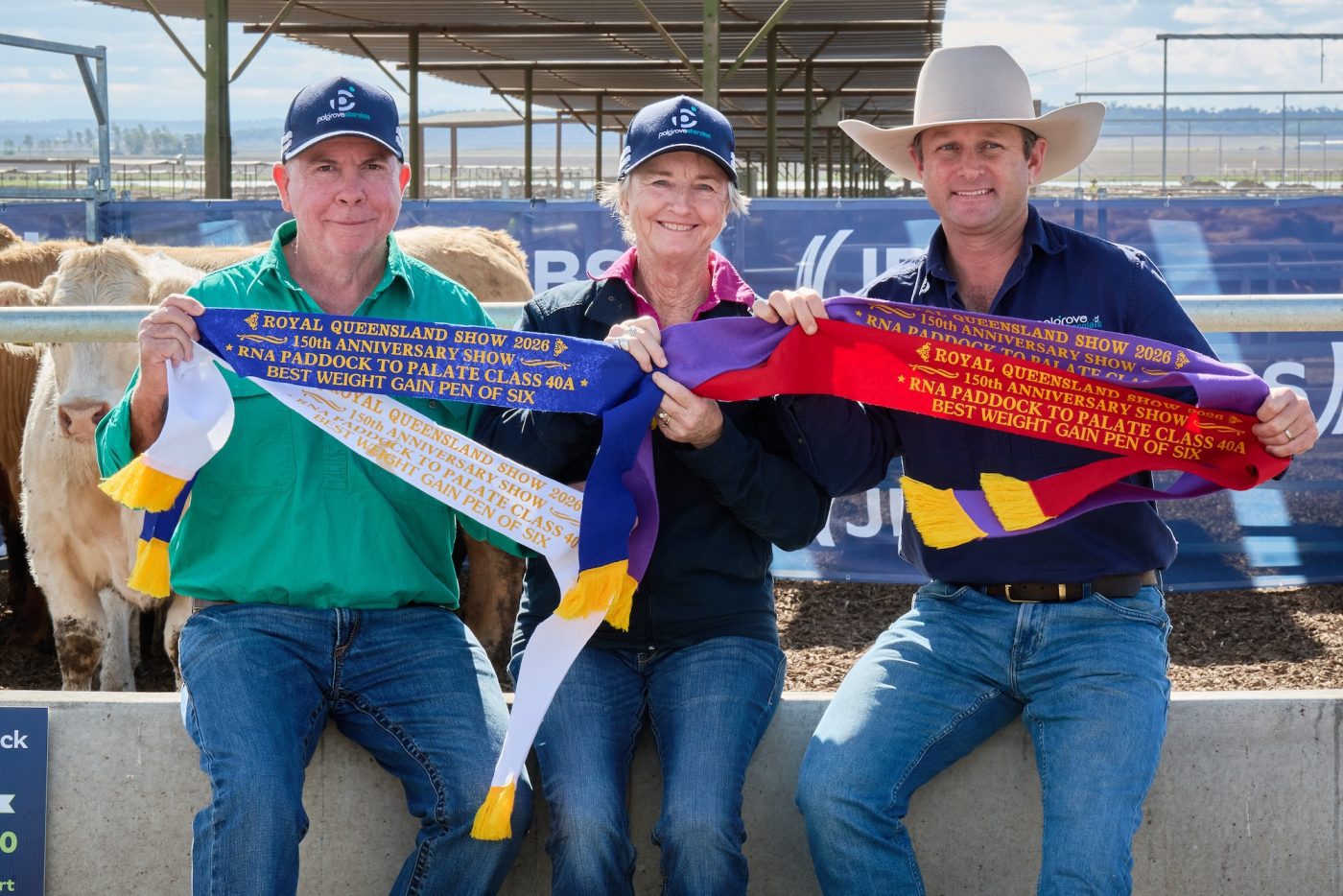
Simon and Myriam Daley and Ben Noller pictured at the 2026 Paddock to Palate weight gain competition awards presentation at JBS Beef City feedlot in June.
The premier competition is geared towards rewarding genetics with commercial profit-making power, objectively measuring pens of cattle on weight gain, carcase performance in the chiller and MSA eating quality.
Palgrove Charolais’ winning pen of six steers in the Class 37 HGP export competition (Pen No. 44) had an average carcase weight of 370.64kg, a dressing percentage of 54.78pc, p8 fat depth average of 13.86mm, rib fat depth average of 8.43mm, marble score of 0.86, an eye muscle area of 104.86, estimated lean meat yield of 60.63pc and an average MSA index score of 46.97 (that was the MSA score average across all seven steers of which one was disqualified and received 0 points; the average MSA score across the top six steers in the pen was 54.79), with overall points of 753.67. The top 6 steers in the winning pen had an average daily gain of 2.79kg/day.
The same pen also took second place in the champion of six carcases in Class 37 and won the champion individual carcase in class 37.
Palgrove Charolais’ winning pen of six steers in the Class 40 Non-HGP export competition (Pen No. 133) had an average carcase weight of 346.5kg, a dressing percentage of 54.73pc, p8 fat depth average of 13.29mm, rib fat depth average of 10.43mm, marble score of 1.14, an eye muscle area of 91.43, estimated lean meat yield of 59.34pc and an average MSA index score of 62.96, from overall points of 733.25.
The same pen also took first place in the champion of six carcases in Class 40, second in the best weight gain for pen of six steers for Class 40 (with an ADG of 2.27kg/day) and highest individual weight gain in class 40 (2.76kg).
Clearly something special
For Mr Noller, who enjoyed considerable success in the competition as a key member of the previous Palgrove leadership team, this first win as a co-owner of Palgrove Charolais was clearly something special.
He paid tribute to the quality and consistency of Palgrove Charolais genetics, noting they have now had an influence in eight of the past nine overall export class championships in the Paddock to Palate competition.

The Noller family. Picture: Palgrove
“For us to win first and second tonight in the HGP class and HGP free is certainly a big honour,” he told Beef Central after the awards presentation on Thursday night.
“It is hard enough to win this, let alone win both and get first and second overall.
“We entered six pens and four of pens have come up with first and second overall, and also the Daley family who use our genetics also got third in one of those as well.
“So its quite amazing and we’re wrapped by the result.”
Success despite seasonal difficulty at stud HQ
The success was particularly meaningful because it came during what has been a challenging first year for the new partnership from a seasonal perspective.
“It’s been a bit of a tough run in terms of a season that we didn’t expect in our first year,” he said.
“Ben Lomond is tough enough in a normal winter, so to go into winter in Ben Lomond with probably the lowest on record January to June rainfall is pretty tough.
“We’d be running probably 20 percent of our numbers there to what we normally would.
“We’ve made some big changes to truck cattle to some of the Daley’s country up at Longreach and Blackall which is a big call, but I was only up there this week and those cattle are doing very well up there, and it just shows the genetics and their adaptation into that country where we do sell a lot of bulls up there as well.”
Consistency years in the making
Winning first and second overall in both the HGP and HGP-free export competitions underlined a level of genetic consistency Mr Noller attributes to generations of breeding and “stacking of pedigrees” over a long period.
“It is a tough thing to do and I don’t know whether anyone fully understands how hard that consistency is to breed into cattle.
“While we’re very lucky to come up with first and second in both classes, I think it is really the genetics at play.”
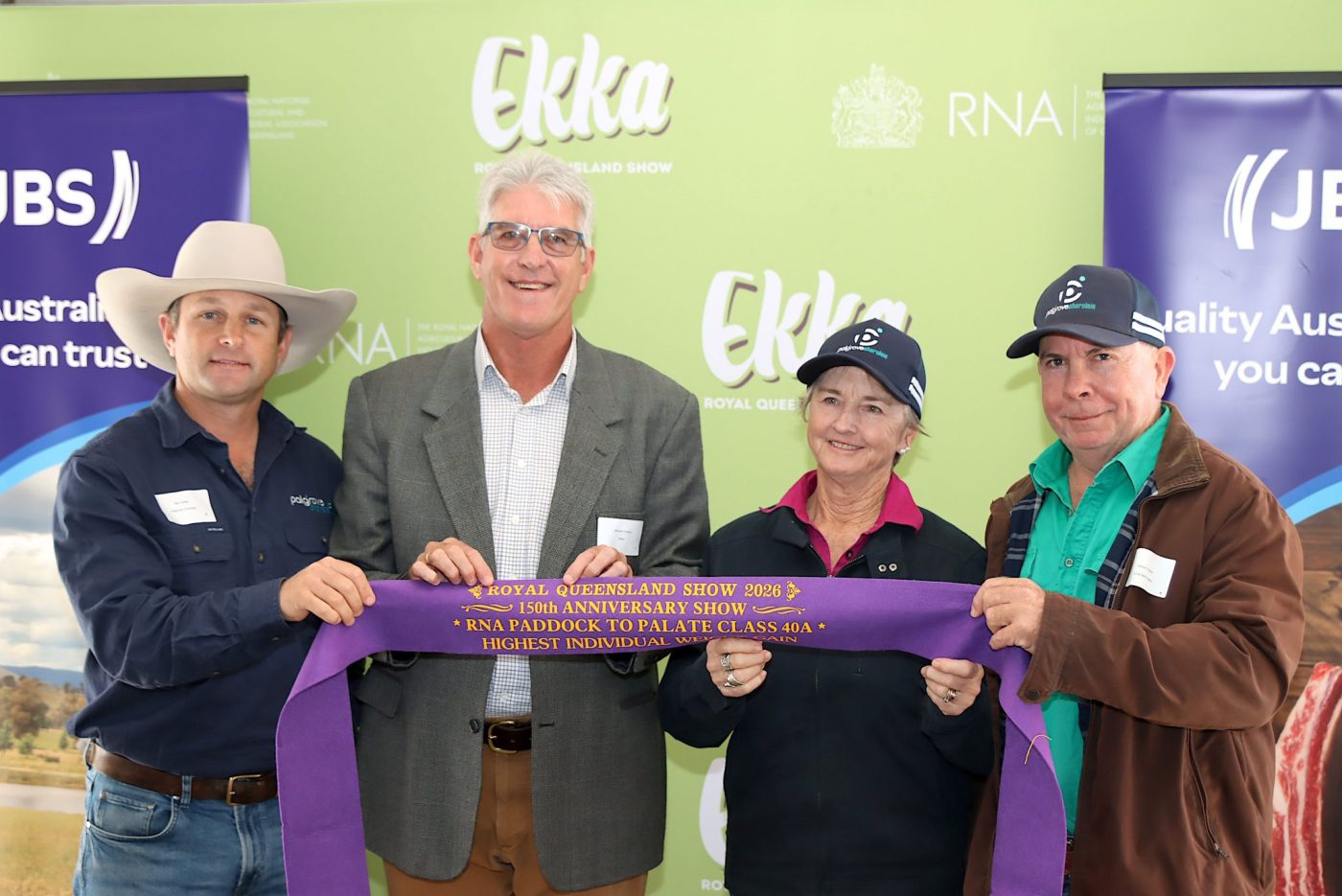
Ben Noller and Myriam and Simon Daley from Palgrove Charolais accept the ribbon for highest individual weight gain in class 40A from Michael Grieve from the RNA at JBS Beef City in June.
But as someone who has helped guide – and continues to guide – those genetic decisions, what does Mr Noller believe other producers can do to breed consistency and balance into their cattle?
“I think you have got to look at your data but you have got to use the data in balance,” he said.
“For me cattle with the right structure and the right constitution are cattle that quite regularly have very good doing-ability.
“So to me you have got to use all of your data and all of your selection criteria in balance.”
For example, selecting solely on EBVs at the expense of constitution, structure and correctness ran the risk, he said, of “breeding yourself into a corner”.
“I think if you’re always looking at one aspect of it, or if you’re aiming for IMF, you might compromise on something else, if you’re aiming for growth, you might compromise on birth weight.
“There’s always a balance within what you do, and it’s always about blending the data, but also making sure what you’re looking at on the ground is gonna hold up, particularly in Australian conditions.”
Mr Noller said the competition continued to demonstrate that Charolais-cross cattle were very hard to beat in the commercial 100 to 120-day market.
“The competition we’re looking at tonight measures the weight gain, the carcase and MSA and for me that adds profit at every point across the supply chain,” he said.
“A long game”
Ultimately, the message was that “you can’t rush genetics”.
“It’s a long game and you’ve really got to stack those pedigrees with consistent breeding cattle to get that consistency of product, and I think having been up in this competition for a number of years, I think that’s what really underpins it.”
The result also came during a significant week for the breed in Australia, with the country hosting the World Charolais Congress and more than 120 international delegates attending the Charolais judging, featuring 280 exhibits, at the Brisbane Ekka last Friday.
Spring bull selling season outlook
Looking ahead to the spring bull selling season, Mr Noller is upbeat about the prospects for this year.
“The market is very good and some of these bull sales have been very solid, we’ve seen some good results again this week.
“The Charolais sales have been good, some black sales in the south have been very solid. I think the overall outlook is very positive and the north is still doing quite well for grass, even though it’s dried off a little bit.”
RELATED ARTICLE: Daley weight gainers dominate 2026 Paddock to Palate export classes
HAVE YOUR SAY