
VIRTUAL fencing is one of the most exciting developments in grazing management in decades. Advocates point to a range of benefits including improved pasture utilisation, greater grazing flexibility, labour savings, increased stocking rates and improved animal performance.
These are attractive outcomes and, in some situations, they may absolutely justify investment. However, there is a question that deserves more attention: Are virtual fences creating value, or are they simply helping managers capture value that was already available?
The distinction is important because profitable businesses do not maximise production. They maximise return on capital.
A Simple Investment Case for Virtual Fencing
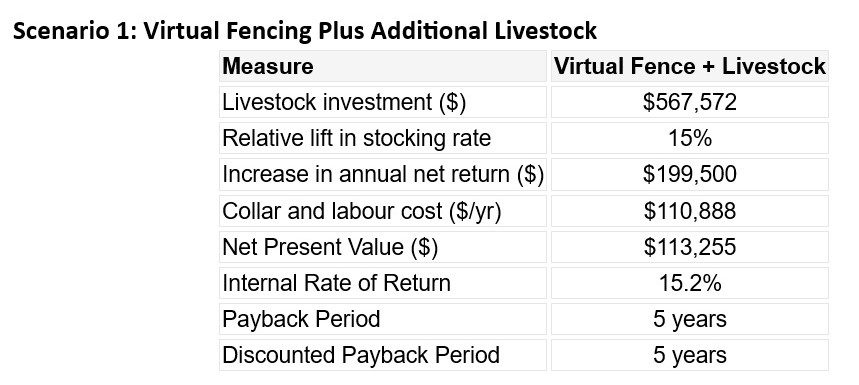
Consider the following conceptual investment analysis involving virtual fencing collars across a herd of 1000 pregnant females. In this herd progeny are grown to feedlot entry weights of about 450kg liveweight.
The analysis assumes virtual fencing facilitates a 15pc increase in stocking rate, equivalent to approximately 150 additional breeding females. Additional livestock (cows, calves and bulls) are purchased at current market values and generate a gross profit of $4.50.kg of liveweight produced. The assumption is that collars are fitted only to pregnant females and the cost is about $110 per collar per year inclusive of labour cost to fit and adjust.
Under these assumptions, the investment generates an internal rate of return of approximately 15pc over a five-year discounted cashflow period.
Given the relatively low biological and operational risk associated with carrying additional livestock where feed is available, this represents a reasonable investment outcome.
Now consider a second scenario. The same business achieves the same 15pc increase in stocking rate, not through virtual fencing, but through improved management discipline, more deliberate grazing decisions, regular feed budgeting, increased monitoring and greater management confidence.
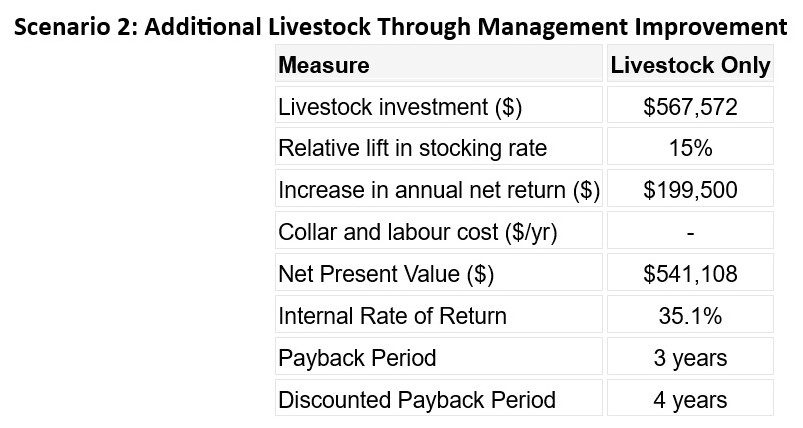
The difference is striking. The livestock-only strategy generates almost five times the Net Present Value and more than double the Internal Rate of Return.
This comparison forms the basis of an important investment question: How much of the value is being created by the technology, and how much is being created by carrying more livestock?
The Benchmarking Perspective
Agrista benchmarking has consistently demonstrated substantial variation in stocking rates and feed utilisation between businesses operating in similar environments. Farms with comparable rainfall, soil types and enterprise structures often carry markedly different livestock numbers and generate substantially different levels of production per hectare.
The implication is straightforward: Many businesses are not operating at the stocking rates required to optimise feed use.
This is not a criticism, nor does it imply every business should immediately increase livestock numbers.
It does suggest, however, that many businesses still have unrealised production potential before infrastructure becomes the primary limiting constraint.
In these situations:
- The feed is already being grown.
- The land resource already exists.
- Livestock systems are already established.
- The opportunity may simply require a different management decision.
Separating the outcome from the tool
Many virtual fencing business cases are justified using outcomes such as:
- Increased stocking rates
- Improved feed utilisation
- Higher production per hectare
These are valuable outcomes. But they are outcomes, not technologies.
Virtual fencing is simply one potential pathway to achieving them.
This distinction matters because one of the most common mistakes in investment analysis is attributing value to a tool when the value is actually generated by the underlying management change.
The critical question therefore becomes: Could a meaningful proportion of this improvement have been achieved through management action alone?
If the answer is yes, then virtual fencing may be helping unlock value, but it is not necessarily the primary source of that value.
The most important comparison
Figure 1 shows the difference in earnings and return on investment between a production benefit achieved through increased stocking intensity with and without a virtual fence. Without the investment in the virtual fence, the net cumulative earnings and return on investment are $427,800 and 20% higher respectively without the virtual fence.
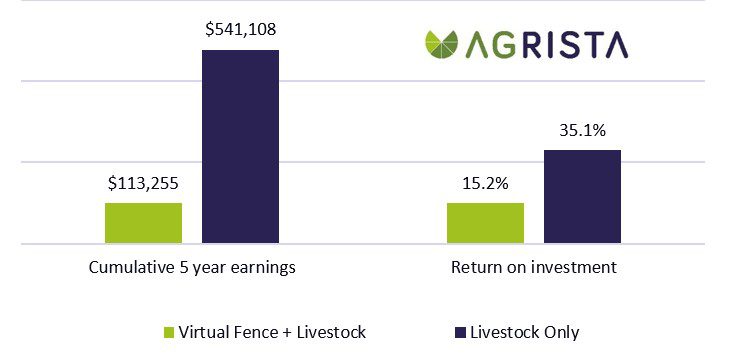
Where management alone delivers the same lift in production, investment returns are far higher
This does not prove virtual fencing is a poor investment. It demonstrates something far more important.
The majority of value is being generated by carrying more livestock.
The collar itself is not generating profit. The livestock are. The technology only earns its keep if it creates benefits that cannot be achieved through management improvement alone.
Why the evidence often overstates the technology
There is a second reason the published returns to virtual fencing often look better than the returns a producer will actually experience.
Most published results come from product-funded trials or product-facilitated demonstration farms.
- The farms selected to trial new technology are rarely average operators.
- The trial period usually coincides with far closer monitoring of paddocks, stock and data than normal business-as-usual.
- The published gain reflects the combined effect of the collar, the closer attention, and the manager selected for the trial – not the collar in isolation.
 This is a recognised pattern in technology adoption research, sometimes called the technology halo effect or co-intervention bias: crediting a tool for gains produced by the management and monitoring that arrived alongside it.
A related effect, documented in workplace studies, is that people change their behaviour simply because they know they are being observed, regardless of the tool involved. A closely-watched paddock during a trial is not the same paddock the rest of the year.
None of this means the published results are wrong. It means they usually answer a different question to the one a producer actually needs answered. Not “did this technology work on a demonstration farm,” but “will this deliver a return over and above what closer management alone would achieve on my place, without the collar.”
The psychology behind technology adoption
If the economics can favour management action, why does technology often attract so much enthusiasm? The answer is behavioural as much as economic.
Technology feels like progress.
A producer investing more than $100,000 in collars, subscriptions and infrastructure receives immediate evidence of action. There are collars, demonstrations, dashboards, apps, maps and support teams. The investment is tangible.
Management improvement is far less visible. It requires:
- Confidence
- Discipline
- Feed budgeting
- Monitoring
- Risk management
- Continuous decision making
Technology provides a visible solution, whereas management improvement is often invisible.
As a result, producers may become more willing to implement difficult management changes once technology is installed. Ironically, a significant proportion of the resulting benefit may come from increased management focus rather than from the technology itself.
The expensive motivation problem
This creates an uncomfortable possibility. Virtual fencing may, in some situations, function as an expensive source of motivation. If benchmarking indicates that feed is already under-utilised and stocking rate could be increased through better management, then producers may be paying substantial sums to achieve outcomes that were already available.
The technology may still generate a positive return. But that does not automatically make it the highest-return investment.
The relevant comparison is not: Virtual fencing versus doing nothing.
The relevant comparison is: Virtual fencing versus the next-best alternative use of capital.
In many businesses that alternative may simply be carrying more livestock.
When virtual fencing may be exactly the right investment
None of this should be interpreted as an argument against virtual fencing. There are many situations where it may generate exceptional value:
- Expensive conventional fencing requirements
- Large paddocks requiring subdivision
- Difficult terrain
- Labour shortages
- Environmental management obligations
- Situations where infrastructure genuinely limits grazing control
In these circumstances, virtual fencing may unlock opportunities that management alone cannot achieve.
The test is straightforward: could the same grazing intensity realistically be achieved with conventional fencing and labour, at reasonable cost? Where the honest answer is no – because of scale, fragmentation, unmanned country or the need for night moves – the technology is solving a genuine physical constraint, not simply buying discipline the business could have exercised anyway.
The economics become much easier to justify.
A better question for producers
Before investing in virtual fencing, producers should ask:
- Am I already stocked at levels delivering optimum feed utilisation?
- Is infrastructure genuinely limiting feed utilisation?
- What proportion of the expected benefit comes from management change?
- What is the cheapest way to capture most of the opportunity?
- How does this investment compare with simply carrying more livestock?
- Would I make this management change anyway, even if the technology did not exist?
- Could I trial the management change for one season, on existing infrastructure, and measure the result before committing capital?
These questions force attention back to the core principle of capital allocation.
Conclusions
Virtual fencing may well become one of the most important grazing technologies developed in recent decades. But technology should not be evaluated against today’s performance. It should be evaluated against the best management alternative.
Analysis of Agrista’s farm benchmarking data suggests many grazing businesses still have opportunities to improve feed utilisation and increase stocking rates through management action alone.
 Author John Francis is director of agricultural consultancy and benchmarking firm, Agrista
HAVE YOUR SAY