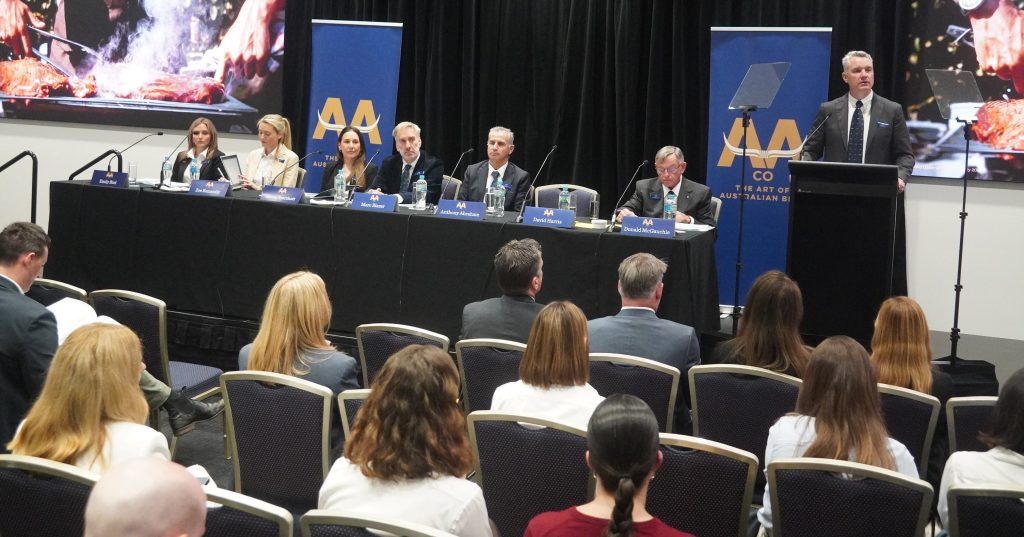
Managing director David Harris addresses this morning’s AA Co AGM in Brisbane
THE prospect of a shareholder dividend, the future of the mothballed Livingstone meatworks near Darwin, and sustainability issues have been perennials among shareholders asking questions during the Australian Agricultural Co’s annual general meetings, and this morning’s 2026 event did not disappoint.
AA Co last paid a dividend back in 2008 (unfranked, 7c), meaning long-suffering, if patient shareholders have waited 18 years for another. We found out from a director this morning, however, that the company had to borrow funds in order to pay the 7c dividend almost two decades ago.
As reported back in May, AA Co lodged a record operating profit of $71.6 million for its full year ended 31 March, navigating increasingly uncertain market and environmental conditions to achieve the outcome. The operating profit represented a 23pc increase over the previous financial year, while total revenue increased 9pc to $422m. Adjusted for cattle losses worth $13m as a result of the North Queensland flooding event earlier this year, an underlying operating profit of $80.6m was recorded.
This year’s AGM held this morning in Brisbane was relayed online for the first time, and it had a noticeable impact on attendance, with fewer than 30 in the room, excluding internal staff, advisors and observers. Most noticeably absent were the ‘ma and pa’ investors that used to attend in numbers. There was exactly one present this year.
Investor questions were reasonably few in number, but responses were arguably the most comprehensive seen at any AGM in recent times.
Here’s a sample:
Livingstone beef plant
The perennial question came about what lies ahead for AA Co’s Livingstone Beef plant near Darwin (mothballed since 2018 after only 18 months’ operations, after spending $110m on its construction).
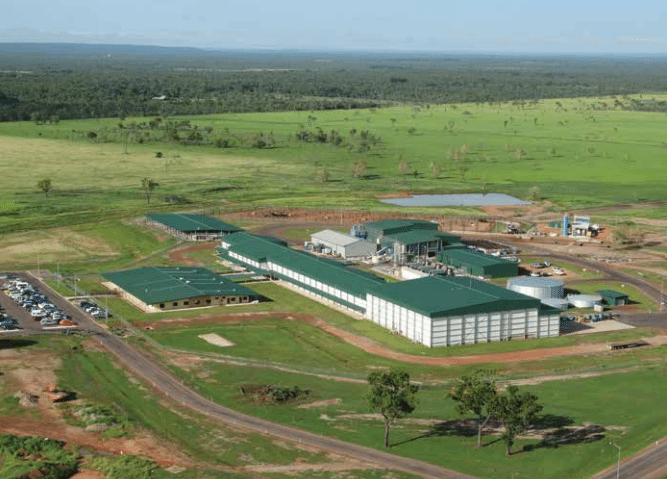
AA Co’s Livingstone Beef plant
There has been a series of rumours over the past year of possible buyers or lessees – both domestic and offshore based – none of which have materialised to this point.
“The strategic review of Livingstone remains ongoing,” board chairman Don McGauchie told the gathering.
“We are open-minded about the site’s potential, and continue to see value in the asset. We’ve been doing quite a bit of work on this, but at this stage there is no material update on what has previously been disclosed,” he said. “We will update shareholders if there are any developments that are appropriate for disclosure.”
Dividend?
Noting AA Co’s ‘great financial result’ last year, a shareholder in the room focussed on the need to “maximise the value to the shareholders.”
 “This year, $25.6m was spent on property, plant and equipment – a 44pc increase on the five year average. There is still a significant focus on cap-ex as a use of funds, as opposed to other options like maximising shareholder returns,” he said.
“I understand that growing the value of the business is important, but as a shareholder, I don’t own the assets of the business – I own the shares.”
He asked how the board considered shareholder value being maximised, when over a ten-year period, those sorts of actions (re-investing in the business) had not generated shareholder returns.
Investments in the ‘long-term’
While in past years, chairman McGauchie’s responses to this perennial question have been concise, limited to the need to invest in the business to lift performance, he provided a much more extensive reply this year.
“This is a question that we frequently get asked,” he said. “As a shareholder myself (McGauchie Super Pty Ltd is listed among the 20 largest shareholders, with 771,000 shares) as well as a company director, I look at that matter quite carefully.”
Mr McGauchie pointed to the competitive advantage that AA Co had over ‘big family operations and smaller operations’ in how it performs.
“There were two things we could do, at our scale, that others could not do, at least as well: marketing and innovation. From the original company position of 21 properties run more or less independently, with a small executive team, we set about developing a truly integrated supply chain, where all of the properties had to work in concert with each other.
“We then started building a (meat) marketing team, which is now at a world standard. The additions to those teams over the past couple of years have added to that strength – which has very much put AA Co at the head of the pack.”
 Mr McGauchie said in each of AA Co’s four main markets around the world – the US, South Korea, the Middle East and UK/Europe, a different operating model applied.
“When we started in the US, we were hoping we could take more control of the market and distribution ourselves. That’s proven very difficult, because of the size and structure of the US market. So we now work with some very strong customers in that space.
“In the Middle East, the UK and to an extent, in Europe, we see much greater opportunity to take more control of our product, dealing directly with chefs and restaurants. We’re looking at how we manage that.”
Investing in the company’s meat marketing team had been ‘absolutely essential’, he said, “and we’re seeing the benefit of that flowing through. A lot of our capital – that spare cash – is going into building that team.
“But we are ahead of the pack. Many (other supply chains) who thought we were not on the right track a decade ago are now copying us, but they don’t have the capacity to have people on the ground and the marketing skill that we have, to execute.”
“So there has been a big investment in that side of the business.”
“Having said that, we still have a lot of sets of cattle yards on properties that are ‘1970s model,’ and need replacing – and they get more and more expensive every time we build a new set. But they are very important from the perspective of the management of the properties, of staff and of cattle,” Mr McGauchie said.
In the field of stock water, investment in moving from turkey’s nests to tanks had been a ‘huge’ improvement in water efficiency, and grazing distribution efficiency, he said.
“We have taken an approach which the board thinks is exactly right in investing in assets, concentrating investment on the really important things, rather than simply allocating a sum of money to each property. Station management participates in this, in a way that allows them to tell us what the priorities are.”
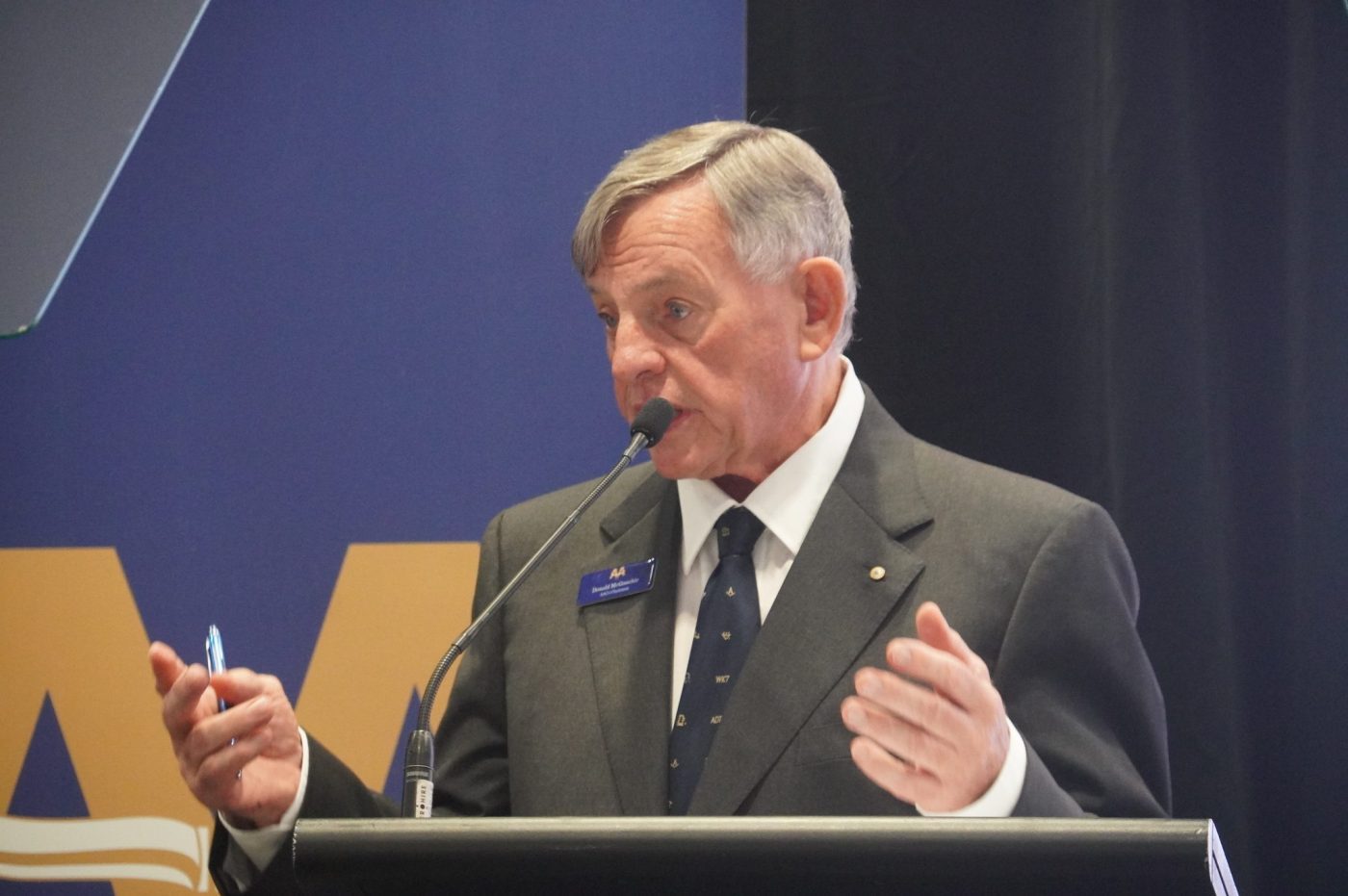
AA Co board chair Don McGauchie
Mr McGauchie told shareholders the AA Co enterprise value had increased by $1 billion over the past ten years.
“All of those investments are going into the long-term, into developing the integrated supply chain we have now, which as last year’s results show, is really starting to show cash,” he said.
High performance Wagyu genetics would continue to be embedded in the breeding herd, delivering higher quality cattle and meat, right through the system.
“All of that investment costs a lot of money, but the benefits of that investment come back to you (investors) in due course. As we look further at the new metric of net meat margin (details to follow), we will generate more cash, adding to the enterprise value, but also giving ourselves the opportunity for greater flexibility in the way we manage capital – including all the things we all want to see (apparently a reference to dividends).
“But we believe the benefits that are being generated in the business by doing what we have done are right, and that will take us into the future.”
“People have said to me: Doesn’t AA Co ever intend to pay a dividend? Of course we do, and in due course it will continue to be a consideration. But not just yet,” Mr McGauchie said.
Methane reducing feed additives
What was clearly evident in this morning’s presentations and lines of questions was the growing emphasis on sustainability, in all its forms from land management to carbon and methane.
Beef Central will circle back with articles focussing on AA Co’s sustainability progress in the near future.
Another shareholder asked about progress in AA Co’s trial use of the recently publicly-listed SeaForest asparagopsis methane-reducing feed additives.
“This is a really good news story, potentially,” he said. “How much of a game changer is it, potentially? Some of the hype is an 8pc increase in cattle growth, on top of the methane abatement. How practical is it for a company that owns almost 1pc of the Australian landmass to use it?
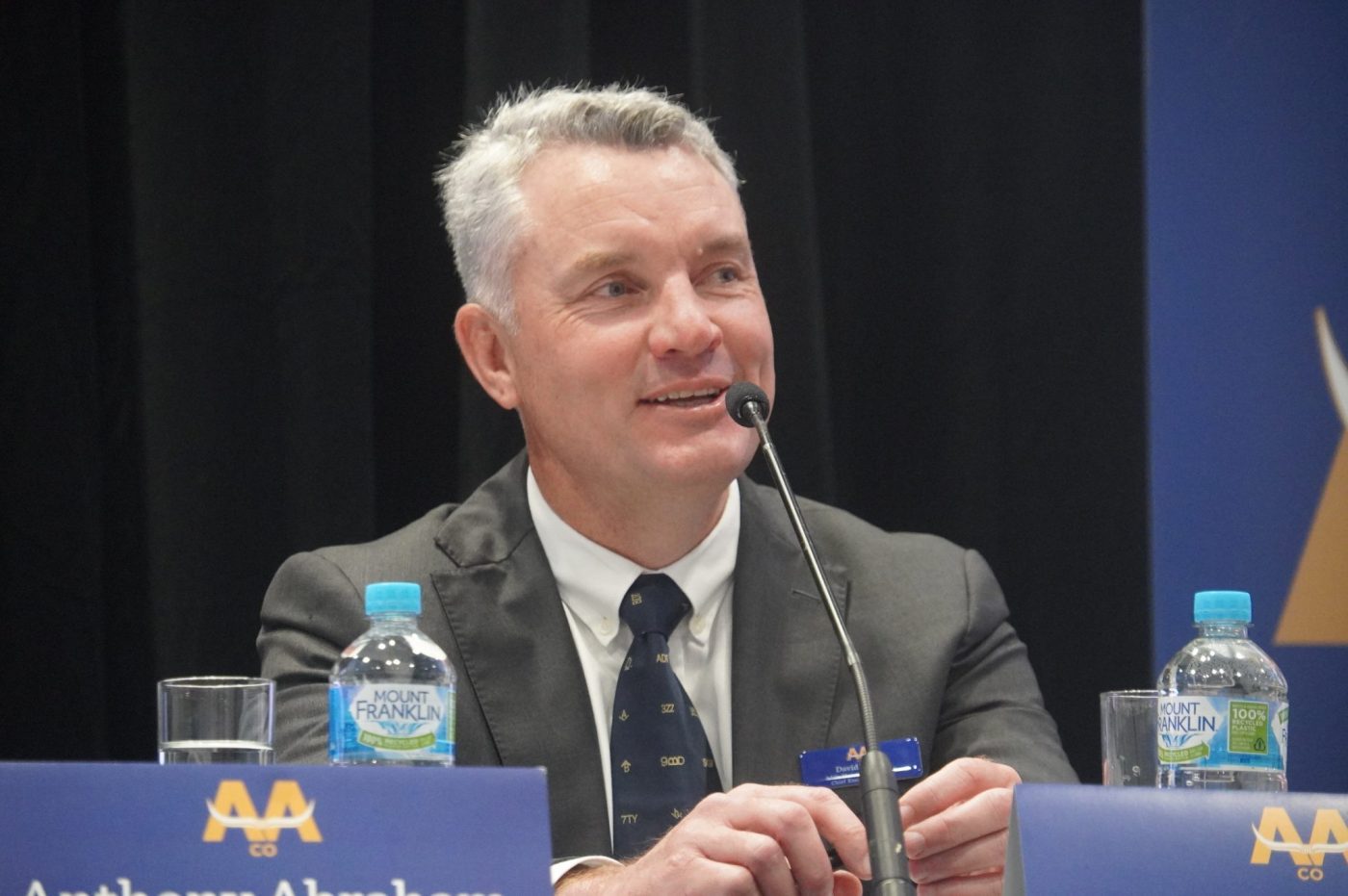
CEO David Harris addresses this morning’s AA Co AGM in Brisbane
Both chairman McGauchie and CEO David Harris gave measured responses.
“One of the things we have been careful to avoid is saying things that aren’t supported by evidence,” Mr McGauchie said.
“We are conscious of the challenge of greenwashing, and also conscious of the need not to mislead people inadvertently. There was a lot of scrutiny on greenwashing – quite appropriately – because there was a lot of BS out there. We only say things that we can prove,” he said.
“But managing the carbon/methane issue is an interesting development.”
CEO David Harris said generally speaking, AA Co definitely saw opportunity for methane mitigants in the market.
“Yes, we did do a trial with SeaForest. At this point, there isn’t anything further in play. We are also looking at trials with other methane mitigant products.”
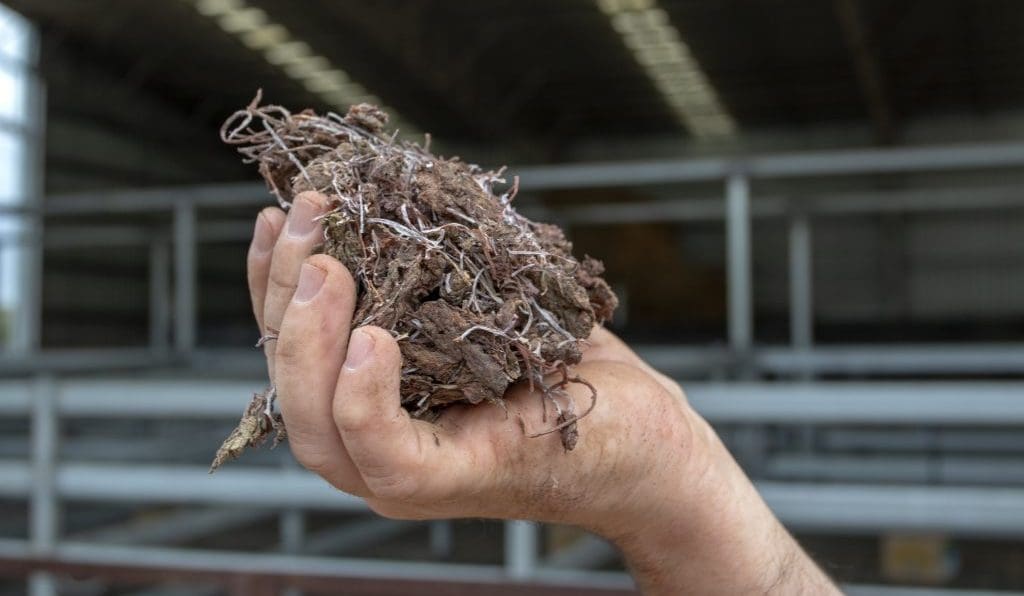
Raw dried Asparagopsis seaweed before it is refined into a feed supplement.
“It’s fair to say that we were at the pointy end of the SeaForest piece during the trial. Not wanting to speak too specifically about that product versus others, they had challenges with production volume and cost of production, which meant at that time it certainly was not applicable across the whole business. There wasn’t a cost/benefit there for it.”
Mr Harris said there were several ways to look at methane mitigants.
“Do you essentially just want to have a better outcome for the environment; is there a market demand in which you can help pay for some of the cost of using the additives; and then, do you get productivity improvement?”
“There are cost and production metrics there that need to be taken into account. The really difficult part at the moment, is that not all of those can be answered with a ‘yes’.”
“We’ll continue to work with different products in that space. One of the reasons we invested in Athian (a company developing ‘credible, scalable, beef-specific carbon-insetting methodologies’) was to try to provide a platform to try to monetise some of the cost of using these things – because they are significant,” Mr Harris said.
“While its easy to apply in the intensive (lotfeeding) part of the business, the real opportunity for these methane mitigating technologies is in the rangelands and pastoral side of the business. It’s also why AA Co has invested in the Zero Net Emissions CRC, which is running a lot of the additive trials now. Which ones do we have to run ourselves, versus participating at arms length, or supporting trials?” he asked.
“In summary, we do think methane mitigants have a place, but at this time most of them don’t stack up from a cost/benefit perspective. But we’re all hoping they do, and we’re investing in building that marketplace, so they can hopefully have a positive cost/benefit.”
He said there was absolutely no doubt that the story behind SeaForest aligned with AA Co’s own nature-led, high-quality, discerning look and feel behind its branded beef products.
“I just don’t want to go broke in the process,” he said.
“We’d love a magic bullet. That clearly isn’t there at present, but we are onto this all the time, and will clearly have to look at how this develops,” Don McGauchie said.
- AA Co shares were trading at $1.36 this afternoon, down from the recent six-month high of $1.39 in early July.
HAVE YOUR SAY