
Source: 2026 Safer Farms Report
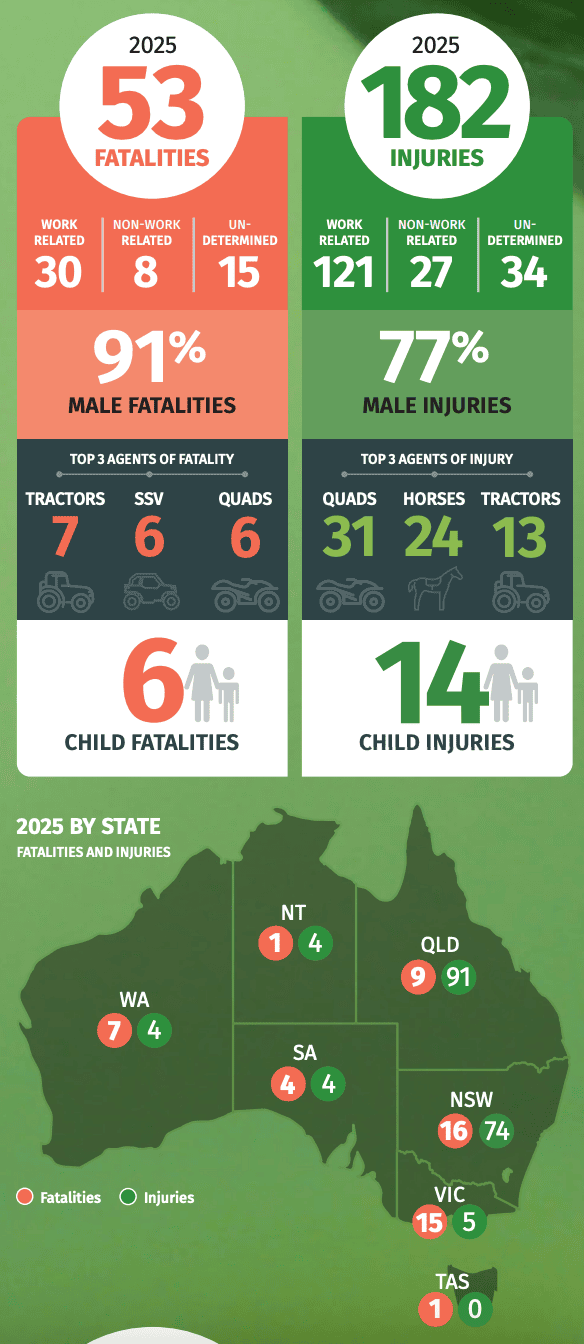
NEW figures released for National Farm Safety Week reveal 53 lives were lost and a further 182 people were seriously injured on Australian farms in 2025, bringing the nation’s farm death toll to 427 lives since 2019, more than one person every week for seven consecutive years.
The figures are a reminder that while Australian farmers produce the food and fibre that keeps the nation running, too many families continue to be affected by preventable injuries and fatalities on farm.
Source: 2026 Safer Farms Report
They also reinforce the importance of continuing to build safer farms, stronger safety cultures and better outcomes for the people behind Australian agriculture.
The figures are contained in the 2026 Safer Farms Report, released this week by FarmSafe Australia supported by WFI Insurance.
WFI’s Workers Compensation claims data shows clear seasonal injury spikes across grain growing sectors, with the number of injuries increasing 43 percent on average during harvesting season (October to December), compared to prior months.
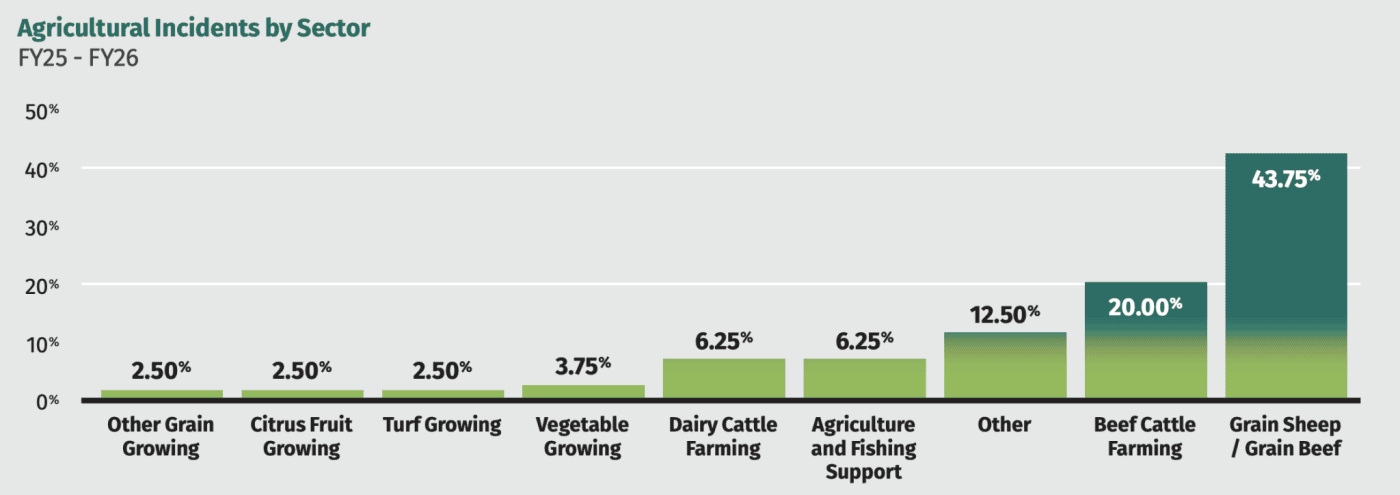
Grain-sheep and grain-beef cattle farming continue to be the most frequent incident sectors comprising 44 percent of all claims.
Beef cattle farming accidents remained consistent at 20pc in line with last year, followed by dairy-cattle farming at 6pc.
Knee injuries were more prominent this year, occurring at double the rate of FY25, with hands being the body location sustaining the most injuries.
Trauma and soft tissue injuries were up over 14pc, and fractures were the leading injury type again this year.
Nationally over the year, the top three leading mechanisms for injury were being hit by animals, by moving objects and falling from heights.
Of the different age categories, millennials accounted for the largest proportion of injuries lodged in FY26 (39pc), followed by Gen Z (34pc), Gen X (19pc), and Boomers (7pc).
Across WFI’s portfolio, there has been a significant increase in fire related claims this year, up 47pc across crop, 37pc in motor and 35pc in farm property, the highest seen over the past six years.
Livestock related claims are the highest this decade, and have surged 40pc from last year.
Farm motor collisions and motor damage continue to steadily decrease, down 6[c and 19pc respectively from FY25. Within WFI’s liability portfolio however, impact related claims continue to dominate, increasing 8% from last year.
Farmsafe Australia chair Felicity Richards said while the report highlights the challenges facing Australian agriculture, it also provides reason for optimism.
 “Most incidents don’t happen because people don’t care about safety. They happen during routine jobs, busy periods and moments of pressure when shortcuts begin to creep in.”
“Whether we realise it or not, those moments matter because they become the standards we set and the standards others follow.”
With tractors, side-by-sides and quad bikes continuing to be the leading causes of fatalities on Australian farms, Ms Richards said the industry should focus on the small, everyday behaviours that help build a stronger safety culture.
“It’s simple things like wearing a helmet, putting on a seatbelt, reducing speed and using rollover protection that can make a real difference.”
Ms Richards said safer farms are built through thousands of everyday decisions.
“Culture isn’t built through posters or paperwork alone. It’s built through what people see; a helmet worn, a seatbelt buckled, a decision to stop and reassess, a conversation about fatigue or someone having the confidence to speak up.”
“This National Farm Safety Week, we’re asking every person in agriculture to think about the example they’re setting. Because the way we work today shapes the culture we’ll leave for tomorrow.”
‘Set the Standard: Show ‘em how it’s done’, Farmsafe Australia’s National Farm Safety Week campaign, runs from 19–25 July 2026.
For more information and resources, visit Farmsafe Australia. The 2026 Safer Farms Report is available at: Safer Farms Report 2026.
Hang on. After reading the article after 5/6 years since the senate enquiry into quad bikes in Australia and the push to Side by Sides for safety reasons, why are side by sides listed as one of the 3 main causes of fatalities on farms?
The senate enquiry was adamant they where superior to atvs and would reduce the unnecessary loss of life.
For my business the reliability of our Honda ATVs have been key to how we run our grazing business. I was happy to install a ROP post purchase and still view this as a safer alternative to Side by Sides which look, in my opinnion, to be no where near as convienient but also more likely for owners/staff to cut corners. And personally, side by sides are untenable around water/waterways, the pinning risk far more obvious.
Can we get some data now, on how effective these legislation changes have been given Australian farmers have been illogically forced into losing the most reliable ATVs on the market (Japanese manufactured ATVs). I would suspect given the far lower numbers of side by sides when the enquiry was done, the numbers now might be a shock for some, not for this ATV user.
Japanese manufacturers should be granted access back into our market with the commitment the owner/farming entity will chose and fit their ROP prior to use, not the manufacturer. Give us the safer farming ATVs back please.