
DUNG beetles are quietly performing a vital climate change mitigation service for Australia’s livestock sector, slashing methane emissions from cattle manure by a staggering 85 percent*, a new study has found.
While dung beetles are well-known champions of soil health and pasture productivity, this new study conducted by Southern Cross University is the first in Australia to quantify their direct impact on greenhouse gas emissions.
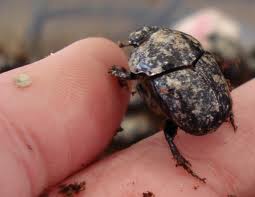 Along with the impressive reduction in cumulative methane emissions from manure (85pc*), the study revealed dung beetles reduced the total greenhouse gas footprint of decomposing manure by 18pc.
Using gas analysis mesocosms over a 90-day period, the research team from the University of New England and Southern Cross University compared emission profiles between cattle dung pats colonised by a representative mix of four introduced beetle species and beetle-free control pats in northern NSW.
“By tunnelling and aerating the dung, these beetles effectively repurpose greenhouse gases for low-emission decomposition,” says Professor Nigel Andrew, co-author and researcher at Southern Cross University.
“They disrupt the suffocating and anaerobic conditions required by methane-producing microbes and shift the pathway toward aerobic respiration. Essentially, they are providing the ideal conditions for high-impact methane to be converted into lower-impact carbon dioxide.”
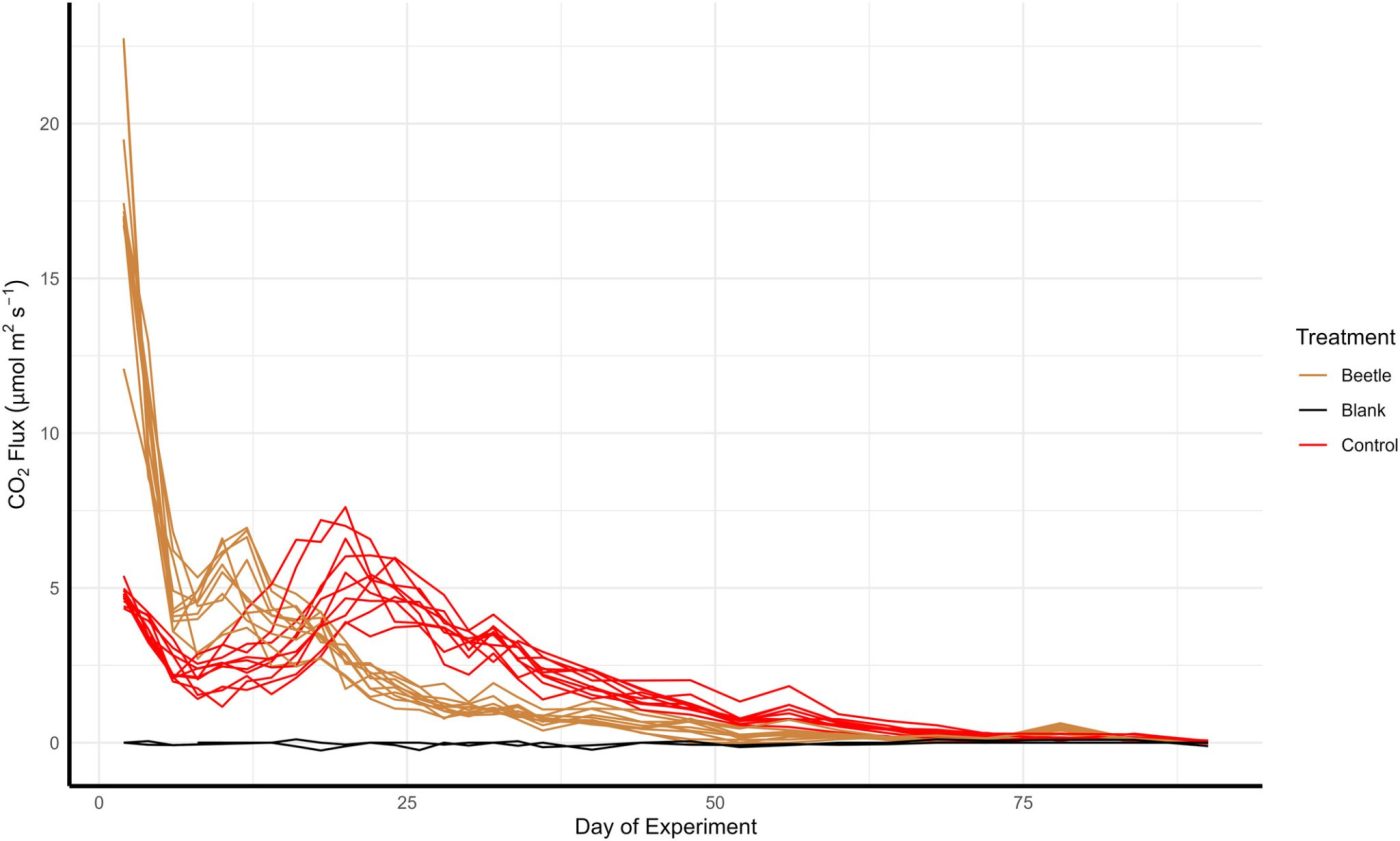
The presence of beetles in the experimental chambers leads to higher carbon dioxide (CO2) flux in the first 14 days of the experiment compared to chambers without beetles. In ecology, flux describes the exchange of matter or energy between the environment and an ecosystem. However, the second, lower peak of flux observed in all chambers was lower in beetle chambers and occurred earlier. Both types of chambers showed CO2 fluxes falling to near-zero amounts by approximately Day 50, though flux from no-beetle chambers was consistently slightly higher than for beetle chambers from Day 20 to Day 70.
Livestock agriculture remains a primary driver of global greenhouse gas emissions, with open pastures acting as a major source of methane (CH4), carbon dioxide (CO2), and nitrous oxide (N2O).
While Australia is home to more than 500 native dung beetle species adapted to marsupial droppings, the CSIRO introduced more than 20 species from Africa, Hawaii, and Southern Europe between 1968 and 1992 to improve soil aeration, boost pasture growth and prevent pest fly breeding as result of the dung produced by livestock.
The study focussed on four dung beetle species: Euoniticellus intermedius, E. africanus, E. fulvus and Onthophagus granulatus.
Key findings
- Methane elimination: While control dung pats exhibited methane spikes at Day 6 and Day 16, pats colonised by dung beetles maintained near-zero methane fluxes throughout the entire 90-day experiment.
- Fast-forwarded decomposition: Beetle activity shifted the decomposition pathway, accelerating the initial release of lower-impact carbon dioxide within the first 14 days compared to dung pats without beetles.
- Lasting structural impact: The climate-regulating signature of the beetles persisted long after the insects had physically left the dung pat (most departed by Day 23), indicating the physical aeration and tunnelling by beetles induced long lasting changes to the microbial environment.
Implications for climate-resilient agriculture
As land managers and policymakers face mounting pressure to reduce the environmental footprint of grazing systems, these findings present a low-cost lever for agricultural carbon accounting in the future.
The researchers highlight that while Australia’s seasonally variable climate impacts beetle activity patterns, supporting and strategically distributing active dung beetle populations represents an immediate opportunity to lower the global warming potential of livestock production. The study underscores the necessity of factoring invertebrate-mediated biological processes into national agricultural emission inventories.
Co-author Jean Holley said: “This study adds to the already impressive repertoire of ecosystem services that the humble dung beetle provides to Australian agriculture. Not only do they recycle nutrients, reduce fly numbers and aerate the soil, but they may also help to mitigate greenhouse gas emissions from livestock production.”
* Editor’s note: The methane reduction claim of 85pc relates specifically to emissions from cattle manure – not enteric methane produced from the animal’s rumen.
Study details
“Introduced dung beetles suppress methane emissions from cattle dung and alter the temporal dynamics of greenhouse gas flux,” by Jean Holley, Martin Brummell, and Nigel R. Andrew.
Journal: Ecological Entomology
DOI: https://doi.org/10.1111/een.
Source: Southern Cross University
HAVE YOUR SAY