
THERE’S plenty of evidence of ‘tougher going’ on the export beef sales front, as the new financial year unfolds – especially at the manufacturing meat end.
Much of the impact is explained by China’s 55pc tariff on Australian imported beef since triggering our 2026 quota in the middle of June – and indirectly, Brazil’s impact in other export markets as it draws closer to filling its own China quota and starts pushing meat elsewhere.
Australian export beef is arguably most directly exposed to Brazilian competition in the lean frozen trimmings segment, traders suggest.
More product is being pushed back onto the domestic market, but as history has shown, Australia’s relatively small 28 million population is not capable of absorbing extremely large volumes of beef diverted out of export channels.
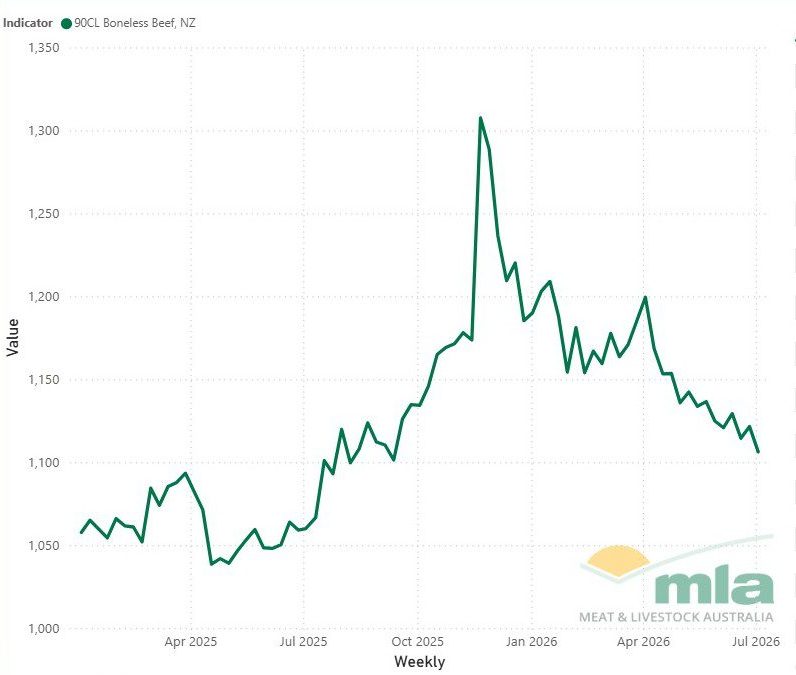
90CL imported frozen price to the US – 2025 to 2026 YTD – measured in A$
MLA’s latest entry for imported 90CL grinding beef destined for the US for the week ending 3 July was A$11.06/kg, down 93c/kg or 8pc from its recent high point on 4 April. In USc/lb CIF terms, last week’s quoted 90’s price at US347c/lb is back 8pc on early April rates.
While there has been some currency movement in play, the market for imported 90s into the US has been trending down fairly consistently since it hit record highs of +A1300c/kg back in November (see graph above plotting the price for the past 18 months starting January 2025).
The recent movement is a direct reflection of the changes in flows of both Brazilian and Australian lean trimmings into the US market, exporter meat traders told beef Central yesterday.
Australia triggered its 55pc tariff into China on June 18, and Brazil is well advanced in doing the same.
Big spread emerging between US domestic and imported
That growing Brazilian supply pressure into the US is “100pc the reason” for the drop in prices being seen for imported Australian trimmings and cow beef used for manufacturing purposes, a leading trader said yesterday.
“At the start of the year, fresh domestic US 90s were worth around US420-430c/lb, and Australia was maybe US40c/lb off that rate.
 “Now we are a dollar (US100c/lb) behind. Fresh domestic 90s were trading at US463c/lb this week, and Australian frozen at US360-365c/lb, while Brazilian product is around US315c/lb.
“Why has that gap opened up? There’s less and less fresh domestic US 90s as kills have continued to decline, and there is more and more Brazilian product now flowing into the US, as Brazil draws closer to filling its China quota. It’s serving to push down demand and price for Australian equivalent.
“That’s been happening for a while now. Brazil is now pushing more than 50,000t/month of beef into the US market – more than Australia. Back around 2021-22, Brazil was exporting around 100,000t of beef a year to the US. Today they are doing that volume in two months – that’s the change,” the trader said.
“And with trading conditions over the next few months as China business slows, that Brazilian volume into the US is only going to grow. On top of that, it’s not a high-demand period for beef in the US at present. It traditionally becomes a slower sales period anywhere after the July 4 holiday through to the first week of September. All that is likely to further pressure prices.”
If there is a saving grace in the export beef supply-demand dynamic in July, it’s that beef production across Australia is slowing down (reference Wednesday’s story on this, based on the NLRS weekly slaughter statistics.)
Back in March-May when conditions were dry in parts of Australia, rates of slaughter soared, reflected in record export volume, but shipments have since moderated somewhat. That’s reduced the volume of beef backing up in domestic channels.
When will China buying return for 2027?
In the background, there is still a lack of clarity around the timing of China’s re-entry into the buying pool for Australian beef, for 2027 consumption, and the use of bonded cold storage.
The issue concerns whether China will allow bonded cold storage of imported beef later this year, in preparation for release in early 2027 to escape the 55pc tariff.
Beef Central was told that no clear indication has yet been provided by the Chinese Government, but the Australian Embassy in Beijing is pursuing the matter.
Some traders suspect that without clear guidance from the government, different Chinese ports may interpret differently what can, and cannot be done in bonded storage.
Why is it important? If a bonded cold storage system is allowed, it’s likely that Chinese customers will start buying Australian beef earlier in the fourth quarter (likely around October) to hold in bonded facilities until January release, the export meat trade source said.
Without it, Chinese buying is unlikely to start until only a few weeks before the new year – just long enough for the sea voyage to end as the new calendar year ticks over, avoiding the tariff.
Even if China does allow bonded cold storage, some say the volumes of beef involved from Brazil, Australia and others could run out of cold storage space at Chinese ports, as stocks are built for January release.
This could have a significant impact on meat markets, depending on which applies.
HAVE YOUR SAY