
THREE recently-completed cattle trials in the United States have supported claims made around feed conversion efficiency using a popular feed supplement fed for methane inhibition.
And in an associated development, carbon credits generated through a pilot project involving feed additive manufacturer Rumin8 and a major South American beef processor have been officially certified and claimed.
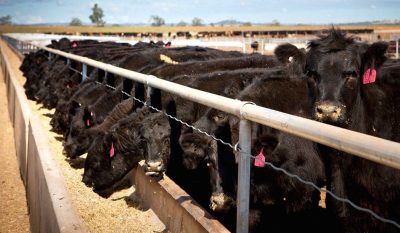 Preliminary results from the US trials found the average feed conversion efficiency for beef cattle fed a ration containing Rumin8’s methane-reducing feed additive to be 4.1pc, 8.3pc and 10.7pc better than controls. Rumin8’s active ingredient is a laboratory-synthesised version of Tribromomethane, commonly known as bromoform, found in asparagopsis seaweed. This organic compound effectively interrupts methane production in the rumen.
“The feed conversion efficiency figures alone underscore our product’s value and its attractiveness to cattle ranchers, farmers and feedlots,” Rumin8 chief executive David Messina said in a statement.
“When you look at the productivity figures and calculate how many extra kilograms of meat can be produced or kilograms of feed can be saved, and then put a dollar value on those savings, it makes a compelling case for including Rumin8 feed additives in a feedlot ration,” he said.
In the first trial, Angus crossbred steers supplemented with the methane inhibitor achieved an 8.3pc increase in feed conversion efficiency compared to controls, as well as an 81pc reduction in methane production.
In a similarly designed second trial, the feed conversion efficiency of the treatment group was 10.7pc better than the control group over a three-month period, with a statistically significant p-value.
In the third trial covering 460 head, the average daily gain for the treatment group was 2.8-3.6pc higher than the control group, and feed conversion efficiency was 4.1pc better.
 At this week’s US carcase beef and feed ration prices, the benefit of that feed conversion efficiency and methane reduction was calculated to be up to up to US$137 per head per year (equivalent to about $46/head on a 110-day program).
“The significant reduction in methane emissions gives ranchers and feedyards the option to monetise the associated carbon credits, supply low carbon meat, and benefit from the productivity benefits – or a combination of all three,” Mr Messina said.
“Those are some pretty good choices.”
“The recent results we are seeing in the US are an accumulation of five years’ work that is now coming together in the form of a convenient, highly-effective and profitable supplement for beef and eventually dairy farmers,” he said.
The results from the US trials mirrored other studies previously conducted using Rumin8 in the US, Brazil and Australia.
Trial work in beef cattle showed a trend toward increased average daily gain of up to 12.5pc. In addition, trials in Brazil yielded up to an 8.4pc improvement in ADG in beef cattle on pasture, and up to a 5pc feed conversion efficiency improvement under feedlot conditions.
“Our hypothesis has always been that by using Rumin8 feed additives, energy normally expelled by the animal in the form of methane could be converted into usable energy for its growth and production. These results support that,” Mr Messina said.
“Our objective has been to develop a methane-abating feed additive where the productivity gain more than covers the cost of the product. The feed conversion efficiency benefits recorded in these two trials indicate we are on track to achieve that very objective.”
Carbon credit claims milestone
In an associated development, carbon credits generated through a pilot project undertaken between Rumin8 and major South American beef processor and exporter, Minerva Foods, have been officially certified and claimed.
“The Minerva pilot has proven that Rumin8’s feed additive can generate verified carbon credits, and therefore a new revenue stream for producers can be unlocked, in addition to generating the productivity benefits,” Mr Messina said.
Source: Rumin8
HAVE YOUR SAY