
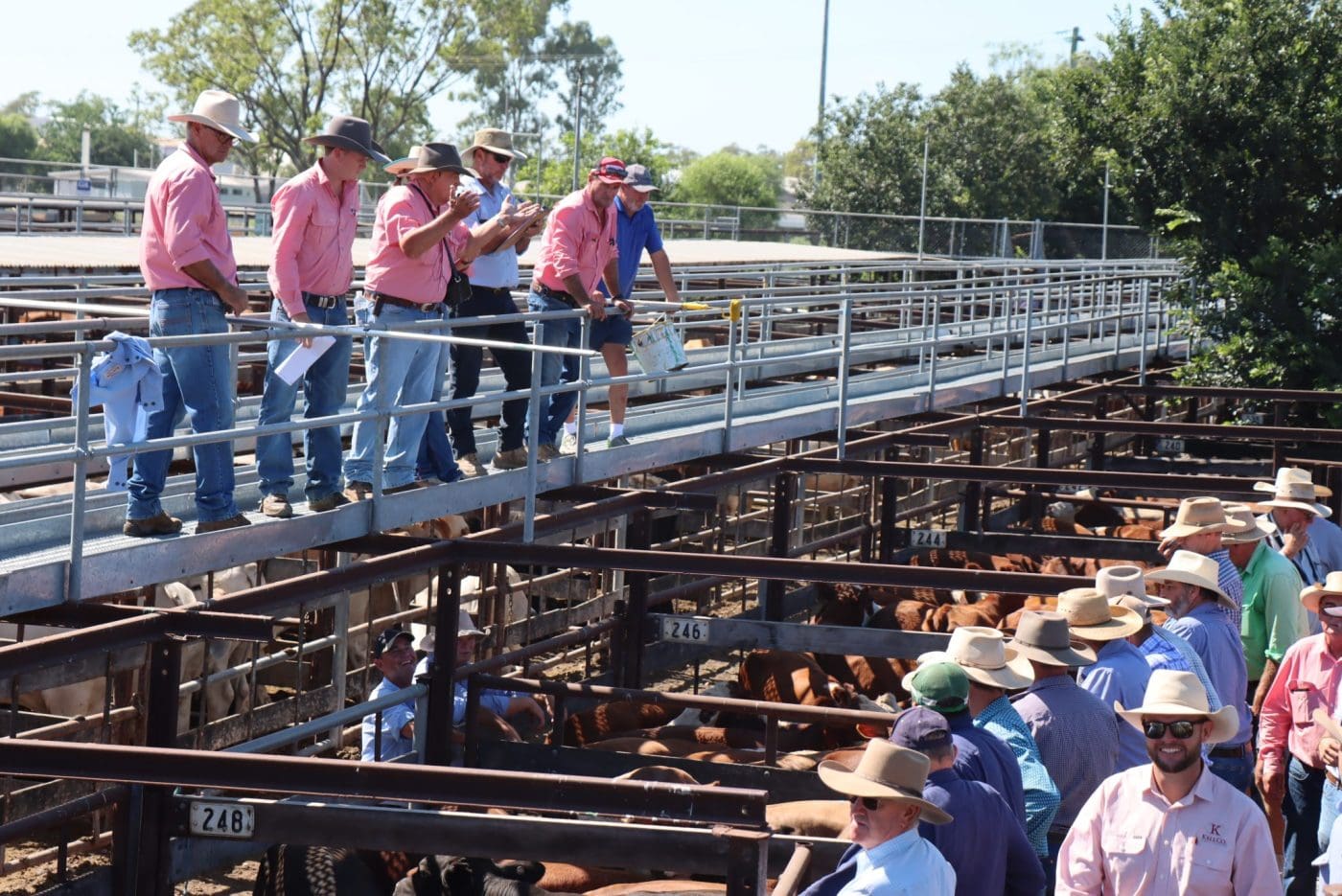
A NEW cattle tick fee is in place as of today at Australia’s second largest saleyards, in an effort to bolster the selling centres biosecurity.
The Western Downs Regional Council (WDRC) introduced the fee in response to an increase of cattle arriving at the Dalby saleyards carrying ticks, placing additional pressure on operations and posing significant risk to the cattle tick-free zone.
From today, 1 July, producers will be charged $2750 (including GST) per consignment that arrive at the saleyards infested with ticks. It is the first such penalty fee at any saleyards in Australia.
“It will now be cheaper to have cattle inspected and scratched then it will be to take the chance and send them to the Dalby sale,” Brendan Gilliland, president of the Dalby Agents Association said.
“This takes the guesswork out of it for producers in high-risk areas, it is a few hundred dollars to do the right thing and have the cattle inspected, compared to the $2750 fee if they take the chance.”
Mr Gilliland told Beef Central in February the selling centre was under immense pressure from buyers and vendors to stop the number of tick-infested cattle being presented at the sale, after a number of outbreaks in the tick-free zone were believed to have started from cattle bought out of Dalby.
“In all honesty, we are seeing infested cattle turn up to Dalby almost on a weekly basis,” Mr Gilliland told The Week in Beef at the time.
He said something had to be done to strengthen the biosecurity protections and reassure buyers that it was safe to buy cattle out of Dalby.
“We had to do something to bring the integrity of our biosecurity back here – we need to be able to guarantee to our vendors and buyers that our biosecurity protocols have integrity and they do not need to worry about ticks spreading through Dalby,” he said.
How the fee will work
WDRC Council Spokesperson for Business Strategy and Economic Development Councillor Megan James said the measure was an important step in protecting the integrity of the region’s livestock industry.
“Dalby Regional Saleyards is a critical part of our beef supply chain, with almost 300,000 cattle passing through the facility in the 2025-26 financial year,” Cr James said.
“Protecting our tick-free zone is essential to maintaining market access, industry confidence, and the long-term sustainability of the sector.
“Council has worked closely with agents, industry stakeholders, and the Department of Primary Industries (DPI) to address the growing issue, with a shared understanding that cattle should not be arriving at the saleyards with ticks.”
Cr James said the fee would be passed on through selling agents to help recover the additional administration required to manage infested consignments and encourage confirmation of tick-free status of cattle prior to transport.
“When cattle arrive with ticks, the entire consignment must be isolated, managed under biosecurity protocols, and removed from the sale process,” she said.
“There is flow on effects across the entire operation – from delays and restricted movement, through to additional handling and freight, compliance requirements, and coordination with biosecurity authorities.
“The fee simply recovers those additional costs and reinforces the need for cattle to be confirmed tick-free before they arrive.
“Confirming cattle are tick-free before they arrive at the saleyards is the simplest and most effective way to avoid the risk and the cost.
“Livestock agents will administer the fee as part of the sale process and play an important role in communicating requirements to their vendors to ensure consignments are tick-free prior to arrival.”
Mr Gilliland said the fine will be payable by the vendor and if the cattle were inspected and certified clean and ticks were later found on them at Dalby it would be up to the vendor to go back to the third-party scratcher.
“If the ticks are found upon delivery after the sale, the vendor will be contacted, as has been done recently and they have two options – take the cattle back or cover the cost of those cattle being treated,” he said.
Cattle from Dalby sale found with ticks
As Mr Gilliland pointed out, in the last two years Dalby has seen an increase in tick-infested cattle being presented at the sale which is believed to have spread ticks into the tick-free zone, resulting in outbreaks in the clean area.
Taroom cattle producer Olivia Martin said she would normally buy at Dalby most weeks but has had to reduce her participation in the sale due to her concern of buying tick infested cattle.
“In the last month myself and other producers from Taroom who have purchased cattle at Dalby that had come from the tick line, they had been cleared by a third-party inspector and plunged dipped, they were sold as clean at Dalby, only to have ticks found on them at Dalby and again at the Taroom clearing dip,” she explained.
“The cattle were treated at Taroom and then reinspected four days later and still had ticks on them. This is hugely concerning because by this stage it had been seven days since the cattle had been certified as clean.”
Cost recovery needed for tick infested cattle from clean yards
Mrs Martin explained the only thing keeping her property clean is the extra costs she is incurring by having all cattle from the Dalby sale reinspected and treated by her local third-party certifier.
“Dalby is in the tick-free zone and should be a clean yard, but we know the risk of buying tick infected cattle is very high there, so we send all of the cattle we buy to the Taroom clearing dip,” she said.
“That adds a significant cost to our business, we are paying to have the cattle inspected, often treated, hay in the yards while they are quarantined, extra freight to and from the dip, we are looking at up to $90 per head for an eight-day program.
“This doesn’t include the weight loss, administration and logistics costs and none of these costs are reimbursed.
“But this is the only way we have been able to stay clean. The system is broken.”
Mrs Martin said she was hopeful Dalby’s new cattle tick fee would reduce the presence of tick infested cattle, but the goal needed to be making Dalby clean again, so further changes were needed.
“There needs to be better enforcement of accredited third-party scratchers. If they certify cattle as clean and they are not, they need to be accountable,” she said.
“I would ultimately like to see the DPI take more control of cattle ticks and have all cattle inspected at a clearing facility like it used to be.
“Because cattle are inspected on farm, the third-party provider can only work in the conditions they are provided. So, if they can’t reach their hand in to check both sides of the cattle, then the facilities are preventing them from thoroughly inspecting cattle.
“That’s why all inspections should happen at a clearing dip to ensure the yards are adequately set up for the job.”
Mrs Martin also said chemical resistance needed to be explored and application of chemical to ensure it is killing the ticks.
“There has been some talk about having a dip installed at the Dalby Saleyards, I think that should be investigated. We also need to have the DPI taking more control of the situation and overseeing infestations,” she said.
“But importantly while the system is being improved, there needs to be compensation for producers who are buying ‘clean’ cattle and then finding ticks on them, the costs we are incurring need to be recouped.”
Tick outbreak transparency needed
One of the major changes Qld’s cattle industry has called for is transparency from the DPI on where cattle tick outbreaks have occurred.
“We can only strengthen our own biosecurity if we know where ticks are because there is a growing number of infested properties in the tick-free zone,” Mrs Martin said.
“I think a platform that shows where ticks have been found in the tick-free zone would be hugely beneficial, so we can work out where the risk is, where the once removed properties are and then we can take steps to reduce our risk.
“This is only needed because the system is broken. The focus should be on rebuilding the integrity of cattle tick management in Qld, but until then – we need transparency to reduce our personal risk.
“This is a whole of industry issue – tick-infested and tick-free, we all need to work together to stop the spread of cattle ticks to ensure we can say to our markets with integrity – these cattle are free of ticks.”
HAVE YOUR SAY