
Increasing herd productivity remains the most effective way for cattle producers to lower methane emissions from their herds, producers attending a field day at Champion Station near Blackall on Tuesday heard.
Russell Pastoral Operations’ Champion Station is one of 12 producer demonstration sites across Australia working with the Zero Net Emissions for Agriculture Cooperative Research Centre (ZNE CRC) to put technologies and management practices aimed at reducing emissions to the commercial grazing test.
Among the technologies discussed at the field day were Halter virtual fencing collars, C-Lock GreenFeed machines that measure feed efficiency and methane emissions from individual cattle, and flux towers that monitor local carbon and greenhouse gas cycles.
The field day featured presentations from a range of experts on technology and research, while also providing producers with an opportunity to ask questions about the justification for investing in emissions-reducing technologies and practices and how looming mandatory emissions reporting requirements could affect family cattle businesses.
Productivity remains quickest emissions win
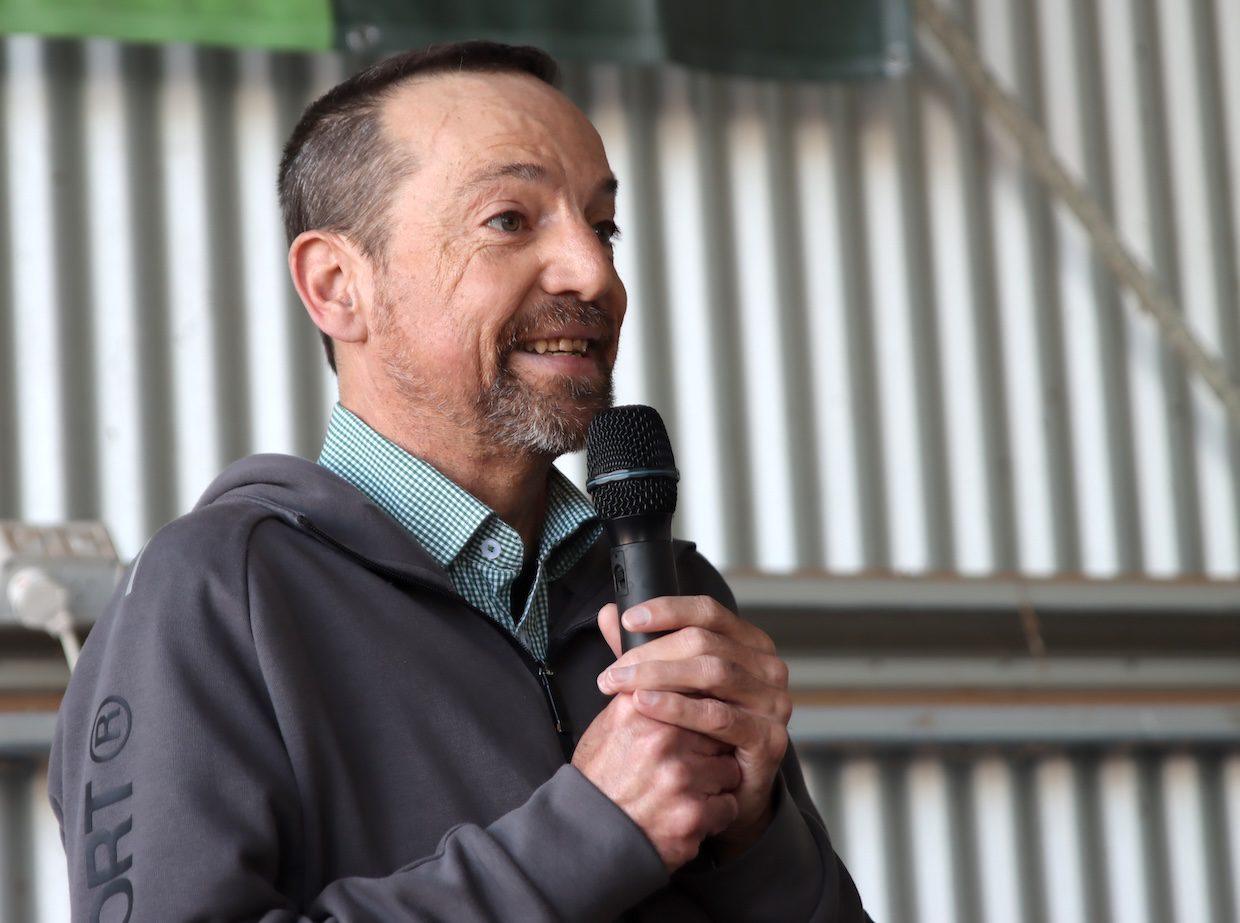
Research director of the ZNE CRC, Professor Ben Hayes, opened the discussion by saying “the good news was that anything you do to improve productivity on your property is going to reduce methane emissions per kilogram of beef,” he said.
 He identified three of the biggest opportunities as improving herd fertility to produce more calves, turning cattle off earlier through faster growth, and selecting for moderate mature cow size.
“Those three things to improve productivity will also reduce your emissions per kilogram of beef by up to about 30 percent.”
Professor Hayes also outlined three reasons why reducing methane emissions matters.
The first was that high-value markets are beginning to demand a certain emissions profile.
This not only presented a market access issue, but also a market opportunity.
To illustrate the point, he used the EU canola market for biodiesel as an example. He said the EU had set a carbon footprint threshold for canola entering the bloc, believing only European producers would be able to meet it.
“But the Western Australian and South Australian producers of canola got together and said we think our emissions are actually lower than that threshold, so they got CSIRO to do a profile of their emissions, and indeed they were quite a bit under that EU threshold,” he said.
“So that opened up that high value market to those West Australian and South Australian producers, and that’s been a very lucrative market worth about $40 million over the past 10 years, so worth having.”
The second reason to reduce methane was the link to feed efficiency.
“So there’s some good work coming out now that shows that if you reduce methane at the same time you’ll improve feed efficiency.” (A presentation from veterinarian and Wagyu breeder Joe Grose provided a deeper dive into this issue and will be covered in a following article on Beef Central.)
The third reason was the impact of rising temperatures on agriculture.
“So even Brahman cattle that are really resilient struggle to get back in calf if the temperatures are really warm, as we have showed with our data.
“So that’s just three reasons to consider.”
Collaboration to tackle emissions issue
Professor Hayes said the CRC was established through collaboration between industry, government and research organisations to develop practical, commercially viable pathways for reducing agricultural emissions.
“This task of reducing emissions is quite a big challenge for Australian agriculture, so that’s why we’ve put together this Cooperative Research Centre to tackle this problem. CRCs come together when you have lots of industry partners wanting to deal with a problem.
“They go to government and government matches those funds that the industry partners can raise.
“So for our CRC the challenge was reducing emissions, and we have industry partners right across the supply chain, so large pastorals, big family farms, banks, Rabobank, for example, right through to supermarkets like Coles, so in all, I think there’s 70 partners tackling this challenge.”
He said the partners had been clear that any technology developed by the CRC must not only reduce emissions but also improve profit for producers.
“So it’s quite a tough challenge,” he said.
“They also said we want to see these technologies in a real farming system, not just in the lab, but on a real farm.”
Champion Station is one of the CRC’s 12 producer demonstration sites established to test technologies under commercial operating conditions.
Prof Hayes said projects currently underway include identifying northern pasture species containing naturally occurring compounds such as tannins that suppress methane production in the rumen; selecting cattle with genetically lower methane emissions while maintaining productivity traits; and developing biodegradable rumen boluses capable of reducing methane emissions by as much as 30 to 40 percent over several months.
Another project is focused on how producers could be rewarded for adopting new low-emissions technologies through models such as insetting, which was explained in detail in a presentation by the ZNE CRC’s Claire Mahony.
Mandatory reporting on the way
One producer said he was still unsure why smaller producers should be concerned about reducing their emissions.
Prof Hayes responded by saying one of the first things that will happen under mandatory reporting requirements is that large businesses such as major beef processors will have to report their scope three emissions.
“Which means the methane emissions from the animals that come from the farms that supply them,” Prof Hayes said.
“As soon as that comes in, there’s going to be pressure to reduce their total emissions, so they’re going to be looking for suppliers with lower emissions, and as I said, right at the start, the way to go is better fertility, faster turn off times, moderate cow weight, so you can supply that upcoming demand.”
He was also asked what three things the average cattle production business should be doing now in preparation for mandatory reporting rules due to take effect from 2028.
Professor Hayes said “knowing their number” was worth exploring.
“I think getting a handle on where your number actually sits, because once you know that you can start looking at the impact of changes, like if you improve your fertility with really good fertility genetics, how does that change your number?
“So I think that is one thing, and then the other things are just those productivity improvements that I talked about, better fertility, faster growth rates, moderate the cow size. That’s where I’d be putting the effort.”
Ben Hewitt from Hewitt Foods reinforced the message that benchmarking provides a strong foundation for improved productivity and emissions outcomes.
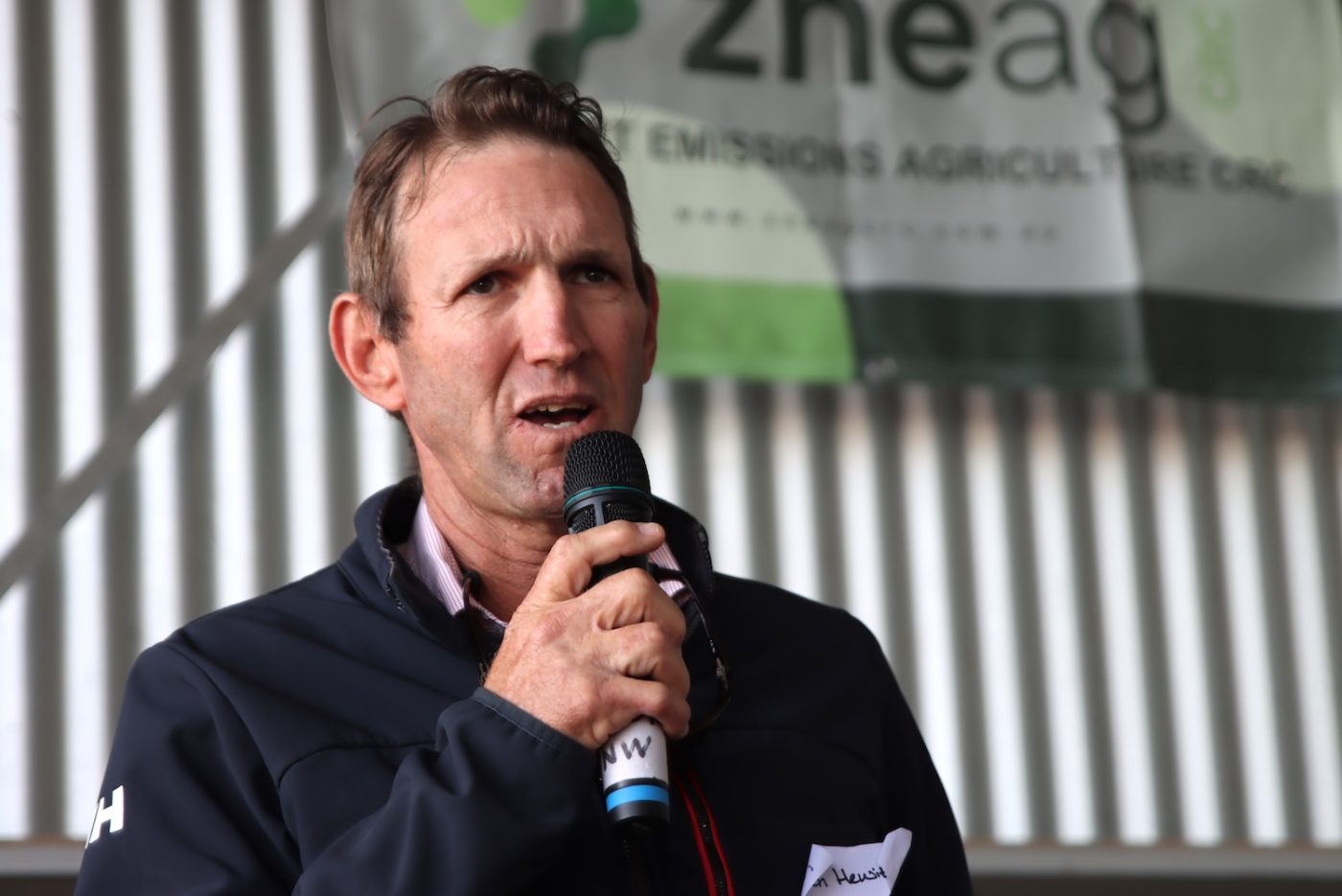
Ben Hewitt
“My takeaway would be that it really starts back with knowing the number, as Ben said this morning,” he said.
“If I reflect on our shared experience, essentially we started benchmarking our financial performance quite a long time ago in a group with Bush Agri, and from that point we knew our number, we knew our productive performance, and we also knew our financial performance, and from there we could make decisions all the way along of how that would influence what business decisions we’d make.”
He said knowing production figures such as output per hectare and adult equivalent allowed producers to better match cow size, growth rates and market specifications, while simultaneously improving emissions performance.
Mr Hewitt also urged family producers not to become overly concerned about future reporting obligations.
“I wouldn’t get too worked up about it,” he said.
“Know your number and you’re starting to have some influence on what that number is positively, then you’re going to be fine for your mandatory reporting, in my opinion.”
He said larger businesses managing reporting obligations across supply chains would require information from producers, but producers should expect to be appropriately rewarded.
Will producers get their fair share
Several questions centred on whether producers would ultimately be treated equitably.
Capturing the sentiment, Nutriment Health’s Andrew Doljanin raised concerns that producers were often “the ones who get paid last”.
“They do all the work but get paid last, until all this other infrastructure gets put in place, and I think that’s a bit of a common theme in agriculture.
“How do we get it that producers get 90 percent and all the other players get 10 percent.
“It’s like there’s a really good caricature of a bloke in a boat – there’s eight blokes on the top of the bank telling him how to row it. He’s busted his gut rowing everyone else.”
 ZNE CRC representative Claire Mahony acknowledged that concerns around profit sharing remained a challenge in developing carbon markets, but said emerging abatement methodologies based on direct emissions reductions, such as feed additives and manure management, could offer more immediate payment opportunities than soil carbon credits.
Professor Hayes said the industry needed to be active in shaping market mechanisms.
“This area is in a state of flux,” he said.
“I think the key is to get on the front foot with people like Cattle Australia and so on to actually make this happen rather than sit back and be price takers yet again. I think we have an opportunity in the next few years that window is open, but it’s going to close, and we should be on the front foot here.“
Russell Pastoral Operations managing director Adam Armstrong said his motivation for adopting carbon-focused management had never centred on carbon credit income.
“What brought me on this journey, if you want to call it that, was not potential revenue from an ACCU (Australian Carbon Credit Unit),” he said.
“The science is strong enough to show us that with carbon rich soils in this environment here, we get better rainfall infiltration and better water holding capacity once that water is in the soil.
“That’s why I went down this journey… even if I don’t get paid anything, as long as the cost of putting that carbon in the soil the cost benefit is still there, we will just benefit from the additional productivity, that’s why we are doing this.”
Reducing methane emissions per kilogram of beef is certainly an important metric, and improving productivity is a logical and worthwhile objective. However, whether reducing emissions intensity alone is sufficient to address the broader methane challenge remains, in my view, an open question.
There is no doubt that better management practices—including improved fertility, higher-quality nutrition, superior genetics, and faster turn-off rates—should be fundamental to every beef production system. These practices increase profitability, improve resource efficiency, and reduce emissions intensity. They represent good management and should be pursued regardless of climate objectives.
That said, there are practical limits to how much productivity improvements alone can achieve. Even the most productive animal will still produce methane as a natural consequence of rumen fermentation. Once those management gains have largely been realised, further meaningful reductions in absolute methane emissions are likely to require additional intervention.
For that reason, I believe the industry should continue to investigate and adopt safe, practical, and economically viable methane-reducing technologies. Novel feed additives, rumen modifiers, slow-release delivery systems, or other scientifically validated innovations have the potential to reduce net methane production beyond what management improvements alone can deliver.
Ultimately, I don’t see productivity improvements and methane-reducing technologies as competing approaches—they should be viewed as complementary. Good management establishes the foundation, while targeted methane-reducing technologies may provide the next step in achieving meaningful reductions in livestock emissions without compromising productivity or profitability